
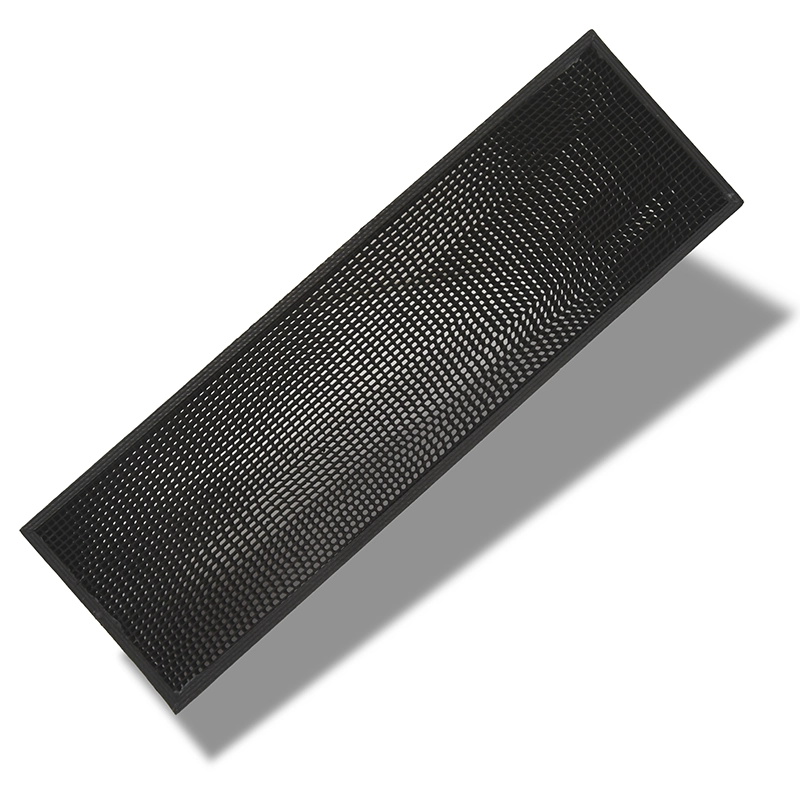
Cutting your own filter panels from board is well within the reach of a maintenance workshop. It needs little equipment and it goes wrong in a small number of specific ways, all of which are avoidable.
What you need
A way to cut: a fine-toothed saw or a sharp utility knife on lighter gauges. A template or a square and a marking method that shows up on polypropylene – a soft pencil works, a ballpoint does not. And somewhere flat to store the finished panels, which matters more than it sounds.
A hot knife is worth having if edges need sealing, though a honeycomb panel does not require a sealed edge to hold its shape. It is an option, not a requirement.
Where it goes wrong
Tolerance drift. Cut from a worn template enough times and the panels creep. Make templates from something that does not wear – thin metal or a rigid plastic offcut – and check one against the aperture occasionally.
Non-square cuts. A panel that is out of square on a millimetre or two will bind at one corner. Cutting against a proper fence rather than a marked line prevents this entirely.
Storage. Stacked flat, polypropylene panel is fine. Leaned against a wall in a warm room for a month, it takes a set and arrives at the frame slightly curved, where it will not seal. This is the most common cause of a panel that measured correctly and still bypasses.
Keeping it consistent
If the same size comes round repeatedly, make a permanent template and label it with the aperture it belongs to and the date it was checked. Templates outlive the people who made them and are often the only record of what a plant was fitted with.
When to stop cutting in-house
When the volumes justify it, or when consistency starts to matter more than speed. Finished panels arrive identical every time and remove a workshop task. Most operations cut in-house for years and then switch when a maintenance reorganisation removes the person who knew how.
Dust and fume control
Cutting thermoplastic produces fine swarf that travels, and a hot knife produces fumes. Neither is a reason not to cut, but both are reasons not to do it on a bench used for anything else, and to have extraction or at least good ventilation.
Eye protection is worth insisting on. Swarf from a saw is thrown, and it is the sort of task people do quickly and without thinking – which is when it happens.
Templates and records
Make a permanent template for any size that recurs, label it with the aperture it belongs to and the date it was checked, and hang it up. Templates frequently outlast the people who made them, and they are often the only record of what a particular plant was fitted with – particularly after a refurbishment changes the frames.
Where a template is worn or damaged, remake it from the aperture rather than from the old template. Copying a worn template copies the wear, which is how panels drift out of fit over years.
What we can do
We supply honeycomb filter board in sheet form or cut to size, and can supply finished panels to the same dimensions if you later decide the cutting is not worth doing. Tell us your sizes and we will quote both routes.