
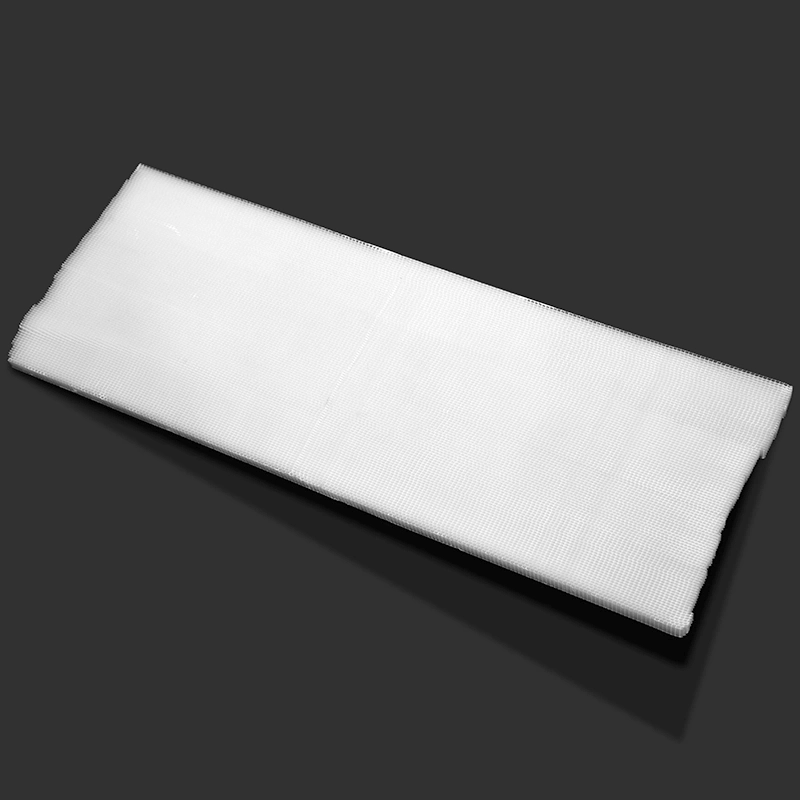
Evaporative cooling is beautifully simple: move air through a wet surface and the evaporation does the work. The engineering is in the wet surface, because it has to hold water uniformly, resist air pressure, survive continuous wetting, and not rot, rust or scale into uselessness within a season. That combination is harder to find than it sounds, and it is why the medium matters more than the fan.
What the medium has to do
Four jobs, and they conflict:
- Hold water over a large surface area. Evaporation happens at the water-air interface, so more wetted area means more cooling. A thin film on a complex surface beats a puddle in a tray.
- Present low air resistance. Every pascal across the pad is fan energy, forever. The medium has to be open enough that the fan is moving air, not fighting the pad.
- Distribute water evenly. Dry patches do no cooling, and they are where scale and biological growth concentrate first.
- Survive the water. Continuous wetting, dissolved minerals, treatment chemicals, sunlight and biology — the medium lives in the least friendly environment on the site.
Why polypropylene honeycomb suits it
A honeycomb structure is a natural fit for two of the four jobs. The cells create an enormous internal surface area relative to the face area, which is where the evaporation happens, and the open structure keeps air resistance low because the air path is straight rather than tortuous.
Polypropylene contributes the survival properties: it does not absorb water, so the pad does not swell, soften or become a growth substrate in the way cellulose media can; it is not corroded by water or by common treatment chemicals; and it tolerates sunlight if stabilised. Washability is the bonus — scale and biological film can be rinsed out rather than accumulating until the pad is replaced.
The honest limitation is water holding. A bare polypropylene surface is not strongly wettable, so water tends to drain rather than film across the cells. This is usually addressed in the medium’s construction — surface treatment, or a pairing with a wetting layer — rather than by accepting dry patches. It is the question to ask a supplier: how is wettability achieved, and does it survive washing?
Scale: the thing that kills pads
Evaporative systems concentrate whatever is dissolved in the water, because pure water leaves as vapour and everything else stays. Minerals deposit on the medium, and scale does three bad things at once: it blocks cells, it raises air resistance, and it creates rough surfaces where biological growth colonises.
Control measures, roughly in order of effectiveness:
- Blow down — bleed off concentrated water and replace it, so the system never reaches saturation
- Water treatment appropriate to the local supply hardness
- Periodic cleaning of the medium, which polypropylene tolerates far better than cellulose
- Pads angled and drained so they dry between cycles rather than sitting in a sump
The last one is under-rated. A medium that dries fully between wetting cycles resists both scale and biological growth much better than one that never dries — and a non-absorbent medium dries quickly, which is another quiet advantage of polypropylene over paper-based pads.
Where this applies
Beyond dedicated evaporative coolers, the same medium works in a range of adjacent jobs: pre-cooling air for industrial processes, greenhouse and livestock ventilation where humidity can be traded for temperature, and as a wetted scrubbing stage for dust and odour. In each case the selection logic is the same — surface area, low resistance, chemical and biological survival.
What to specify
- Airflow and face velocity, so resistance can be predicted
- Pad thickness and dimensions, and the frame it must seat in
- Water quality — hardness, treatment chemicals — because that decides the survival question
- Whether the pad runs continuously wet or cycles
- Cleaning method, and how often you are prepared to do it
If you tell us the airflow, the water quality and the application, we can recommend a cell structure and thickness — and tell you honestly if evaporative cooling is a sensible option for your climate at all.