
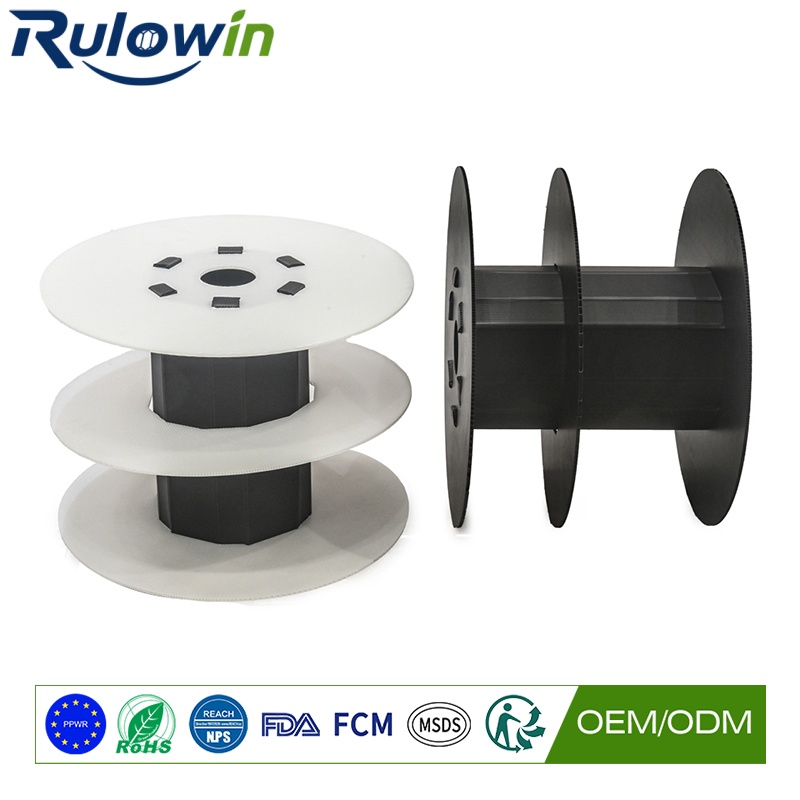
Magnet wire below roughly half a millimetre changes the requirements for a spool. The product is delicate in one direction and expensive in another, and the failure modes shift from “the spool broke” to “the insulation is damaged and nobody can see it”.
What makes fine wire different
- The enamel is thin and everything damages it. Abrasion against a rough core, contact with a flange, grit between layers — all of it can compromise insulation without leaving anything visible.
- The product is worth a lot per kilogram. A metre damaged is expensive in a way that a metre of structural cable is not.
- Nothing self-heals. A scratch on heavy cable sheathing is cosmetic. A scratch through enamel is a short waiting to happen.
- It takes almost no load to deform it. Fine copper bends permanently under pressures that would not register on anything heavier.
Core surface
The core is the first thing that matters and the first thing people skip. Every requirement is about smoothness and consistency:
- No seams standing proud — this is where the discussion of core construction becomes relevant, because a wound tube has a spiral seam and an extruded one does not
- No burrs, no joint steps, no damage from previous use
- Surface consistency around the circumference, because a rough patch every revolution marks every wrap
Inspect cores before winding fine product. A core that has been in service for fifty trips on heavy product is not a suitable core for fine magnet wire just because it is clean.
Tension
Everything about fine wire argues for lower tension. Less compression into the core, less risk of turns pressing through insulation, less chance of the wire stretching — and fine wire stretches, which changes its electrical properties in ways that matter to somebody downstream.
The trade is that low-tension packs are more prone to movement. This is the tension discussed generally in our article on tension taper, and for fine wire the operating window is narrower on both sides.
Flange contact
The consequences of product touching the flange are worse here, and the mechanisms are the same ones covered in our article on edge marks. Fine wire that has rubbed against anything has lost insulation.
Generous clearance, smooth flange faces, nothing raised on the face. If your flanges have printed markings, check they are not standing proud.
Cleanliness
Particulate contamination that is harmless on heavy product can abrade enamel. This argues for:
- Clean storage rather than open yards
- Cores inspected and wiped before winding
- Some thought about what the spool has previously carried, if you reuse it
The general arguments in our piece on cleaning between runs apply, with the note that for this application “looks clean” is not the standard.
Static
Fine wire moving over surfaces accumulates charge, and it attracts dust, which then abrades. The antistatic considerations discussed in our article on conductive and antistatic spools are more relevant here than in most applications, though whether they are worth paying for depends on how dusty your environment is.
Where plastic hollow board suits this
Reasonably well, with one caveat. The advantages are a smooth consistent flange face, no splinters or loose fibres, and low weight. The caveat is dimensional consistency — if you need very tight tolerance, this is one of the applications where moulded construction may genuinely serve you better, as discussed in our comparison of construction methods.
We would rather say that up front than sell you into an application that suits us less than an alternative.
What to specify
- Core surface finish and construction — say it explicitly, it will not be assumed
- Temperature history, if spools see heat in transit
- Whether the product is going into anything where a single insulation defect is expensive
- Cleanliness expectations at the point of winding
Tell us the gauge and what it is going into, and we will be honest about whether our hollow board spools are the right answer or whether the fine-gauge work should go on something moulded.