
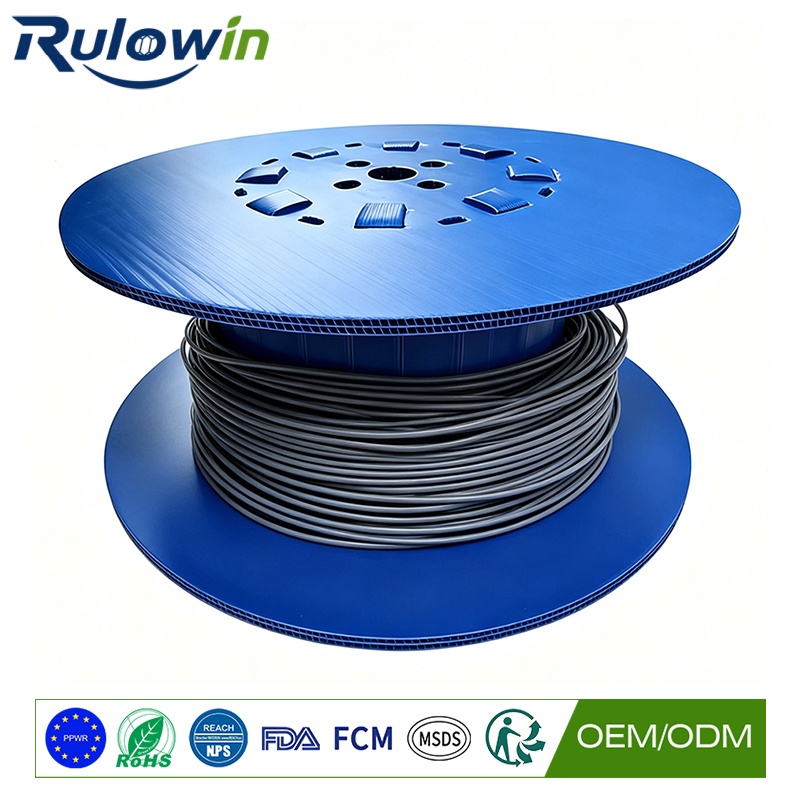
Every spool has to be turned by something, and turned against something. On a payoff the machine usually brakes the spool; on a take-up it drives it. Either way torque crosses the interface between machine and spool, and how that happens shapes both the bore design and how long the spool lasts.
Plain bore, friction drive
The simplest arrangement: the shaft expands or the spool is clamped, and torque transfers through friction between shaft and bore. No features needed beyond a round hole of the right size.
Advantages: cheap, no orientation needed when loading, nothing to break.
Problems: everything goes through friction, which means adequate clamping is essential and any shortfall produces slip. Slip wears the bore, generates heat, and shows up as tension variation. It is also the arrangement most sensitive to dimensional mismatch — which is why bore wear is the failure mode most associated with it.
Plain bores suit low-torque applications: light product, braking rather than driving, modest speeds.
Keyway
A slot cut into the bore engaging a key on the shaft. Torque transfers positively rather than through friction, which takes the clamping requirement out of the equation.
Advantages: positive drive, no reliance on friction, consistent timing between spool and machine where that matters.
Problems: the torque lands on one narrow contact face. In steel that is acceptable; in polypropylene it is a stress concentrator, and a keyway cut into unreinforced PP is a crack waiting for an excuse. The corner at the base of the slot is the usual origin.
If you need a keyway on a plastic spool, the answer is usually a metal insert carrying the keyway rather than the feature cut into the plastic directly. That costs more and it has to be specified at design stage — retrofitting is not realistic.
Keyways also force orientation when loading. Operators learn to do it quickly, but it is slower than dropping a spool onto a plain shaft.
Drive pins engaging the flange
The cleanest answer from a wear standpoint. Pins on the machine engage holes or recesses in the flange, and the bore does nothing except locate.
Advantages: almost no bore wear, because no torque crosses it. Positive drive. Load spreads over several pins rather than concentrating.
Problems: requires features in the flange, which means the spool has to be designed for it, and it requires the machine to be built that way. Most machines are not. Pin holes also collect dirt and can elongate over very long service.
Where we have seen it retrofitted onto existing equipment it has generally gone well, provided the holes are reinforced. Unreinforced holes in hollow board elongate, and once they are elongated the drive becomes sloppy.
What to specify
- Whether the spool is driven or braked. Braking loads are usually gentler and suit plain bores better.
- The torque figure, roughly. It does not need to be precise — “about this much” is enough to choose between the three.
- The shaft diameter, measured, not nominal. Several readings around the shaft, because worn shafts are rarely round.
- Whether the machine has any features already — pins, keys, expanding mandrel. Usually the machine dictates the answer and the spool has to follow.
A note on driven applications generally
If you can choose, driving or braking through something other than the bore extends spool life considerably. Most people cannot choose, because the machine was bought years before the spool was specified. In that case the honest goal is making the plain bore survive acceptably rather than eliminating the wear — good fit, clean shafts, and not over-tightening the clamp.
Tell us which arrangement you have when you ask about our hollow board spools, and we will tell you what we would expect from each. We will also tell you if your machine arrangement is one we think will eat spools regardless of how they are built.