
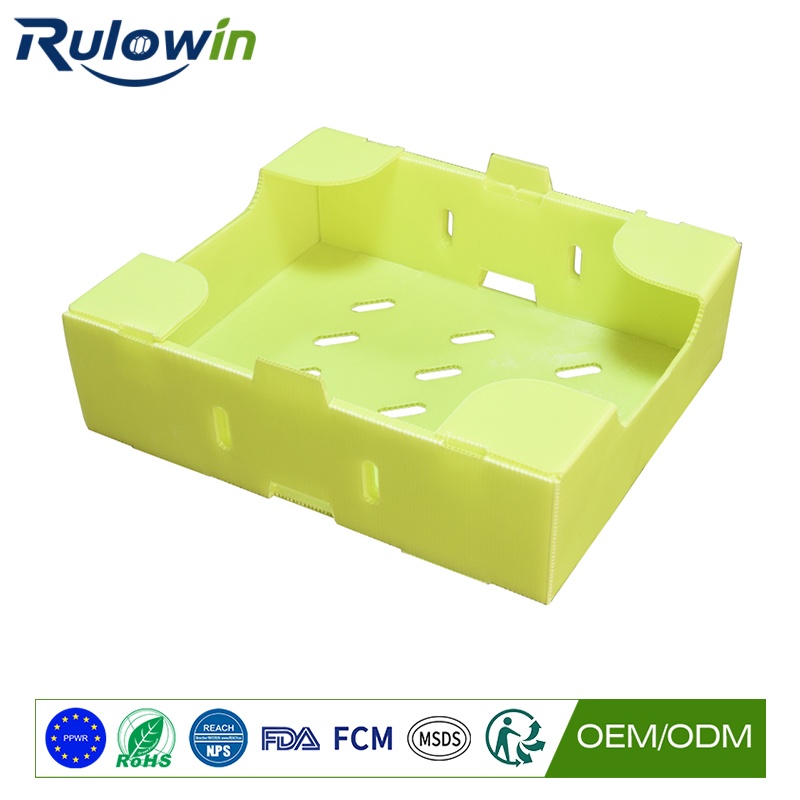
Polypropylene crates run on roller conveyors in most packing houses without trouble. When they do not, it is almost always one of three specific things, and all three are visible in a five-minute test with a sample crate.
Roller pitch
The gap between rollers has to be small relative to the crate base. A crate with a narrow foot or a ribbed base can drop into a wide gap and jam, or ride along with a bump at every roller that eventually damages the base.
Rule of thumb: the crate should always be supported by at least two rollers, preferably three. If your crate base is short in the direction of travel and your roller pitch is wide, you have a problem that no crate change will fix – the conveyor needs closer rollers.
Base design
A crate with a flat, continuous base runs smoothly. A crate with pronounced ribs or a recessed foot catches. This is a real conflict: recessed feet are good for stacking and for drainage, and bad for conveyors.
If your operation runs both crate types, the compromise is usually a base with shallow ribs and a continuous outer rim – the rim carries the crate over the rollers and the ribs do their job when stacked.
Weight and speed
A light empty crate on a fast conveyor will skate and skew, because there is not enough weight to keep it tracking. This is why empty crate return lines are often slower than loaded ones, and why crates sometimes leave the line at a curve.
If empties are skewing, reduce the line speed or add side guides rather than changing the crate. It is a dynamics problem, not a crate problem.
What polypropylene does that cardboard does not
It is slippery. Crates accelerate on a decline and will run away on a steep gravity section more readily than a cardboard tray would. If you have gravity roller, check the decline – a slope that was fine for a tray may be too steep for a slick plastic base.
And it is noisy. Plastic on steel rollers is louder than most people expect, and on a long line it is worth knowing in advance.
Testing before you buy
Ask for two sample crates and run them down the actual line, loaded and empty, at full speed, including the curves and the transfers. Ten minutes. Any incompatibility shows up immediately, and it is far cheaper than discovering it after two thousand crates arrive.
If the crates are washed after use, the wash cycle matters too – covered in can PP crates go through an industrial wash tunnel.
Transfers, which are where crates get damaged
Crates survive the straight runs and get damaged at the transfers – where one conveyor meets another, where a crate drops onto a lower line, and at the end stops. Those are the places to look.
A drop of more than a few centimetres between sections will eventually crack crate corners. A hard end stop does the same. Both are adjustable, and both are cheaper to fix than a fleet of crates.
Worth walking the line with the sound off and looking at the transfers specifically. The crates will tell you where the problem is, usually in the same two or three places every time.
What we can do
We make PP crates for produce with conveyor-friendly base designs and we will ask about your line before quoting. Tell us the roller pitch and line speed, and we will tell you which base suits it – including when your conveyor needs changing instead of the crate.