
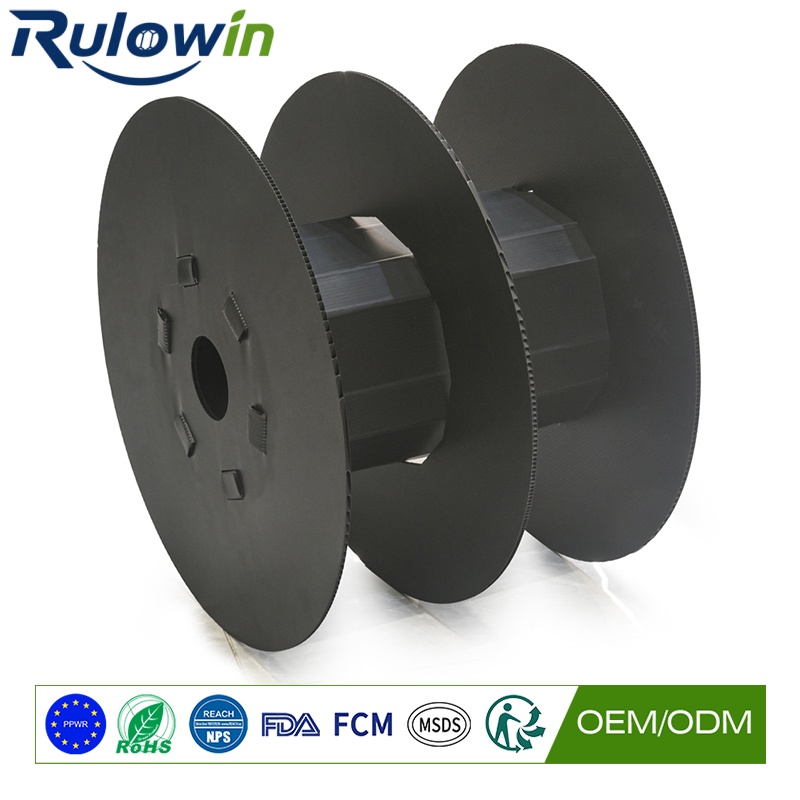
Almost every crew switching from wooden drums to plastic reels asks whether their existing stands will take them. The answer is usually yes, because the interface is just a bore on a shaft, and plastic reels are generally made with bores matching the common stand sizes. There are three things worth checking before ordering a container though.
One: the bore, to tolerance
Nominal bore size is not enough. A stand with a shaft of a given diameter needs a bore that is a close fit – a couple of millimetres of slop produces a wobble that shows up as periodic tension variation in the payout, which on sensitive cable is a quality problem.
Measure the shaft, not the drawing. Shafts wear, and a stand that has been in service for years may be a millimetre under nominal.
Two: load capacity and the weight difference
A plastic reel with cable on it is lighter than the equivalent wooden drum, so capacity is rarely the issue. The reverse can be: a stand designed for a heavy drum may have a brake or a friction device calibrated for that weight, and a much lighter reel behaves differently under the same setting.
If the stand has an adjustable brake – most do – it needs setting for the new weight. A brake set for a heavy drum will stop a light plastic reel dead, and a crew that does not adjust it will conclude the reel is faulty.
Three: flange clearance
The stand’s arms or cones have to clear the flange. A plastic reel with a thicker flange than the drum it replaces may not sit down on the cones properly, or the retaining collar may not engage. This is a two-minute check with a sample and it is the one people forget.
Also worth checking: whether the stand grips the hub by cones that bite in. Cones designed to dig into wood will chew a plastic hub. Flat-faced cones or a through-shaft with collars are the right arrangement for plastic.
Why the switch usually improves things
Two reasons beyond weight. Bore consistency – a moulded bore is round, and a wooden drum’s bore frequently is not, so the reel runs truer. And balance – a moulded reel is balanced, where a repaired drum often is not.
The full comparison is in plastic reel versus wooden drum for fiber cable.
What to do if they do not fit
Two options, and the first is usually better. An adapter sleeve – a collar that fits your stand’s shaft and presents the bore size you need – costs very little and lets you run any reel on any stand. Most suppliers can supply one, and it is far cheaper than changing stands.
The second is to specify the reel with the bore you need, which is fine if you are ordering in volume and your stands are consistent. It is not fine if your stands vary across sites – in that case an adapter per site is simpler than several bore sizes.
Either way, test with a sample before committing. A bore that is right on paper can still be wrong on a worn shaft.
What we can do
We supply industrial fiber optic cable reels in the common bore sizes and will supply a sample to test on your stands first. Tell us the shaft diameter and the stand model if you know it, and we will confirm the fit before you order – including telling you when a different bore is needed.