
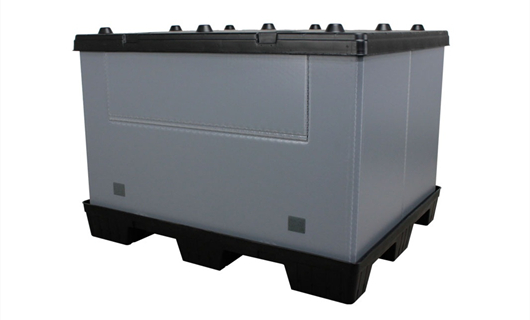
Sleeve boxes go into racking routinely, and in some operations that is the entire point – the box is the unit load and it lives in a rack between moves. But racking is a harder load case than a floor, and it is worth understanding why before specifying boxes for a racked system.
What racking does differently
On a floor, the base is supported continuously. On rack beams, it is supported on two lines, and everything between the beams is spanning. That is a bending load on the base, not a bearing load – a completely different case and a much more demanding one.
A base that is perfectly adequate on the floor will sag between beams, and once it has sagged the sleeve above it is no longer square.
Checking it
Ask the supplier whether the base is rated for beam support, and at what beam spacing. This is a specific rating and a serious supplier will have it. If they cannot answer, treat it as unrated.
Then measure your beams. Not the nominal – the actual spacing, on the rack you will use, including whether the beams are level. Boxes on an unlevelled beam carry load on one side and lean, which is the same failure described in why a pallet sleeve box leans to one side.
Deck it, if in doubt
A deck panel – a sheet or a set of boards laid across the beams – turns beam support back into continuous support and removes the whole problem. It costs a little per bay and it makes any box work in any rack.
If you are putting sleeve boxes into existing racking that was not designed for them, decking is usually the right answer rather than buying a heavier base.
What the sleeve contributes
Nothing structural, in this case. The sleeve carries vertical load down to the base; it does not resist the bending in the base. So a heavier sleeve does not fix a sagging base. This is a common and expensive misdiagnosis.
What a heavier sleeve wall does help with is the lateral knocks a racked box takes – being pushed in by a forklift, or rubbing against its neighbour. In a tight rack, that is worth something.
Height and access
Two practical points. A racked sleeve box cannot be opened – the lid needs headroom, so check the clear height above the beam before assuming boxes can be picked from in the rack. And if boxes are picked from progressively, racking is the wrong environment; a sleeve box in a rack is a storage unit, not a pick face.
What to check periodically
Racked boxes accumulate damage quietly. Two checks, worth doing quarterly: bases for cracking at the corners, and sleeves for creases that have gone soft at the corners.
A base that has begun to crack in a rack is carrying the whole load of that box on a compromised corner, and it is worth pulling before it fails rather than after. A sleeve that has lost a crease is not holding the box square, and the load above is bearing unevenly.
Both are visible without moving anything. A walk down the aisle with a torch is enough.
What we can do
We supply factory-direct pallet sleeve boxes with bases rated for floor or for beam support, and we will ask which before quoting. Tell us your beam spacing and load weight, and we will specify the base – including when decking is the cheaper fix.