
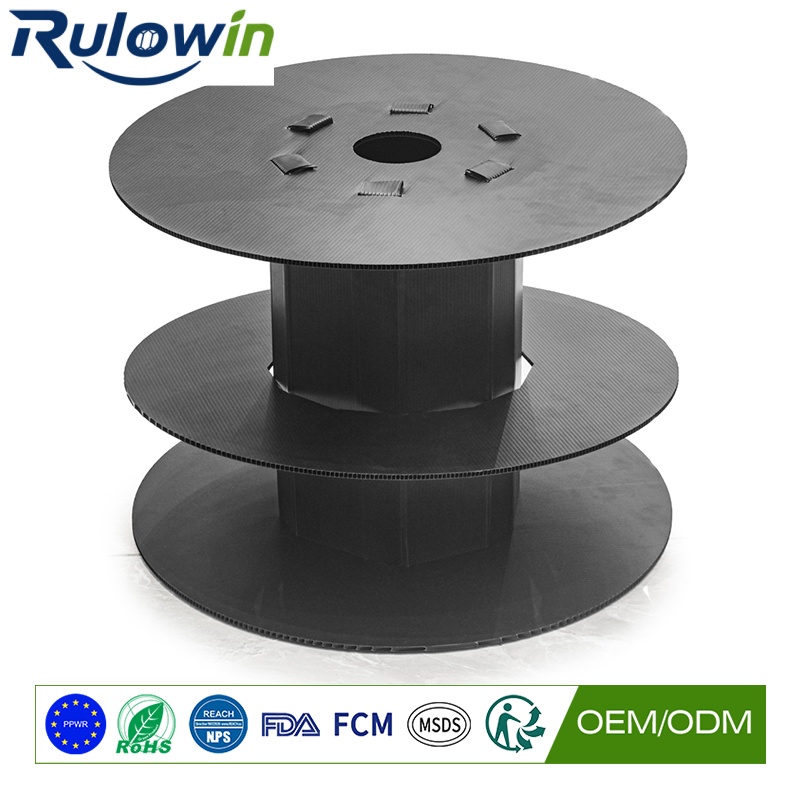
Static on a spool is usually a nuisance rather than a hazard: the product clings to itself, dust is attracted to the surface, and operators get a small shock on a dry day. Occasionally it is more serious than that, and the difference matters because the two cases need different materials.
When it is just annoying
Dry air plus a polymer surface plus movement is a reliable way to generate charge. In a heated warehouse in winter, a plain polypropylene spool will hold a surface charge and pull dust out of the air. For most industrial cable and wire this is cosmetic — nobody rejects a drum because it is dusty.
If that is your problem, the answers are environmental rather than material: raise the humidity, reduce the handling speed where you can, and fit the usual ionising bars or tinsel at the payoff if the charge is causing handling problems. Do not pay for a conductive compound to solve a dust problem.
When it actually matters
Three situations justify specifying the electrical properties:
- Sensitive components wound on the spool. Anything with an exposed semiconductor junction, and some sensor assemblies, can be damaged by a discharge through the winding.
- Flammable atmospheres. A solvent-based coating line, or anywhere with a dust explosion risk, where an ignition source is unacceptable.
- Clean processes. Where attracted dust is a yield problem rather than an appearance one — medical tubing, some optical products.
In all three the requirement should be written as a number with a test method, not as the word “antistatic”.
The three bands, briefly
Standards vary in their exact boundaries, but the working distinction is: conductive (charge moves freely), static dissipative (charge drains at a controlled rate — the usual target for packaging), and antistatic (the material does not readily generate charge, but does not drain one either).
State which band you need and which standard you work to. Asking for “antistatic” without either will get you whatever the supplier happens to make.
The failure mode nobody plans for
There are two ways to make polypropylene dissipative. Compound a conductive additive into the resin, so the whole spool is dissipative, or apply a topical antistatic coating that sits on the surface.
Topical treatments are cheaper and they work — until they wear off. They are removed by washing, by abrasion, and by time. A spool that measured correctly on delivery can be insulative after fifty trips through a wash line, and unlike a cracked flange, this failure is invisible.
For a reusable spool programme, specify a compounded material and say so. If cost forces a topical treatment, put periodic testing into the maintenance schedule and re-treat when it fails.
Humidity dependence
Many antistatic mechanisms rely on absorbed moisture, so performance varies with relative humidity. A spool in specification at 50% RH can drift out of band in the dry air of a heated winter warehouse — which is exactly the condition where static problems show up in the first place.
Ask for figures at more than one humidity level, and test in your own conditions at the worst time of year.
What to put on the enquiry
- Band required and the standard you work to
- Whether the property must be permanent or whether a topical treatment is acceptable
- How it will be tested — surface resistivity or point-to-point resistance — because they are not the same measurement
- Wash regime, if any, and the humidity range in service
Colour tells you nothing here. Black spools are often conductive because carbon black is an effective additive, but a black spool with a decorative pigment is just a black spool. Ask for the number.