
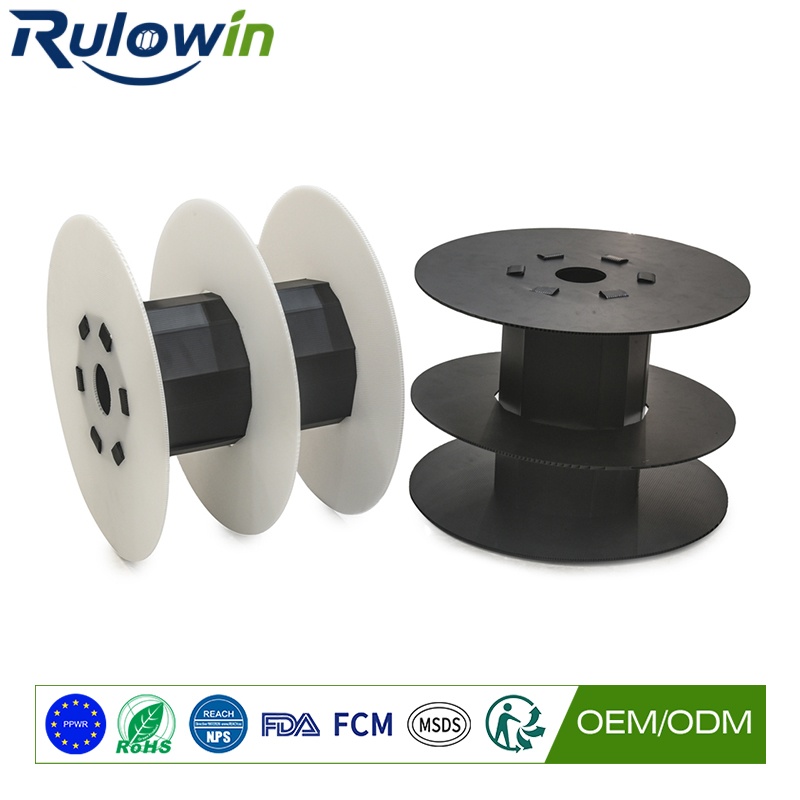
The concern is reasonable: polypropylene has a glass transition temperature around freezing, and below it the material becomes notably more brittle. If you are shipping spools through a northern European winter or storing them in an unheated yard, it is worth knowing what that does and does not mean.
What cold does to the material
Two things, mostly. Stiffness goes up, and impact resistance goes down. A spool that shrugs off a knock at 20 °C may crack when dropped from the same height at -10 °C. The static strength is largely unaffected — it is not going to collapse under a wound load because it is cold — but it becomes much less tolerant of sudden impact.
Copolymer grades behave better than homopolymer in the cold, and the difference is meaningful. If your spools will see freezing temperatures, this is worth specifying rather than assuming, because it is not something you can tell by looking at a finished spool.
Where cold actually causes failures
In our experience, and in what we hear back from customers, the damage almost never happens in steady cold storage. It happens at the moment of handling:
- Dropping or tipping a spool off a pallet onto frozen ground. Frozen concrete is an unforgiving surface and a cold spool has much less give.
- Forklift impact — a tine catching a flange. The same glancing hit that would scuff a warm spool can crack a cold one.
- Unloading in a hurry when it is cold and dark and everyone wants to finish.
The pattern is cold plus impact, not cold alone. A spool sitting in a yard at -15 °C for two months is usually fine. A spool dropped once at -15 °C is a coin toss.
What we would not claim
We are not going to quote you a minimum service temperature as a hard number, because the honest answer depends on whether the spool will be handled, how, and how often — not on the material alone. A figure on a data sheet measured on a notched sample in a lab does not tell you what happens when a forklift clips a flange in a yard in February.
What we can say is directional: copolymer grades, adequate wall thickness on the flange, and rounded rather than sharp rim geometry all push cold tolerance in the right direction. If cold handling is a genuine part of your duty, tell us and we will specify accordingly, and we will tell you if we think a different construction would serve you better.
Practical handling in cold conditions
- Do not drop spools. Obvious, and the single biggest factor. Cold turns a survivable drop into a crack.
- Let them warm up before impact-prone operations. If spools arrive cold, an overnight stay inside takes the edge off.
- Avoid dragging across rough ground. Abrasion plus cold is a bad combination on a flange rim.
- Stack lower. Cold ground is often less level than a warehouse floor, and a leaning stack puts a bending load on the lower flanges that they would not see on a flat floor.
When cold is not the problem you think it is
If you are seeing flange cracks in winter, it is worth checking whether cold is genuinely the cause or whether it is a contributing factor on top of something else — an existing crack that has been growing, a design that was already marginal, or handling that was always too rough and merely became visible when the temperature dropped.
We have had reports of winter cracking on spools that were also being dropped regularly in summer. The cold got the blame; the drops were the cause.
The other side of the comparison
Worth keeping in perspective: plywood reels in the same conditions absorb water, and wet-plus-freezing is considerably worse for them than dry cold is for polypropylene. Steel gets cold and stays cold, and is unpleasant to handle without gloves. Every material has a cold-weather story; polypropylene’s is manageable if you know that impact is the mechanism.
If cold handling is part of your duty cycle, say so when you get in touch and we will specify the grade and the geometry for it.