
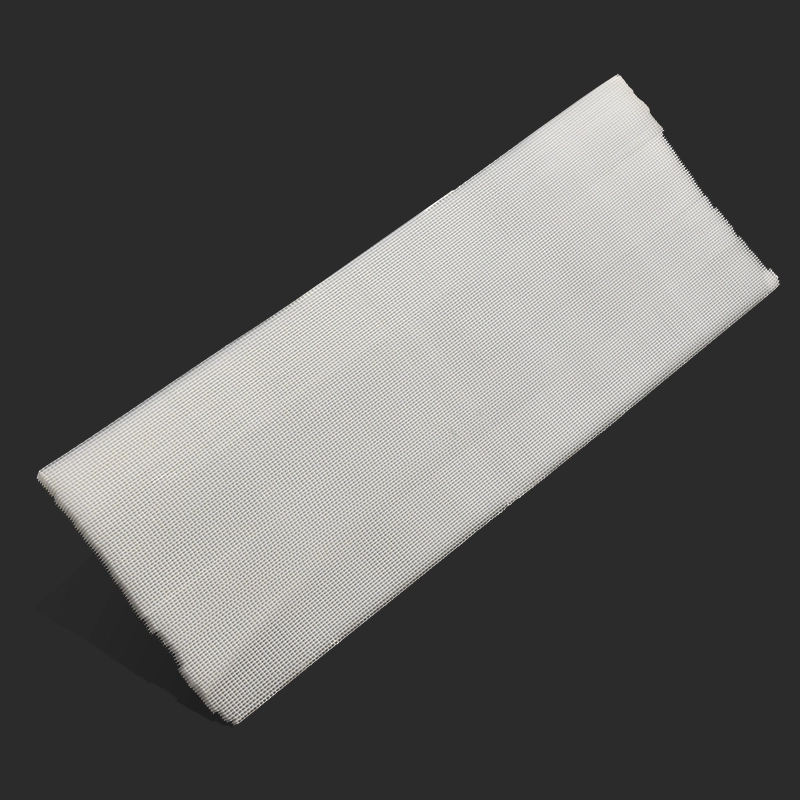
Cell size is the variable that most changes how a honeycomb filter behaves, and it is frequently specified by copying whatever was used before. Choosing it from the particle range you are actually dealing with is not difficult and usually changes the outcome.
What cell size does
Smaller cells pack more wall into the same face area. More wall means more capture surface and more obstruction – higher capture, higher resistance, and somewhat faster loading in terms of pressure. Larger cells leave more of the face open: lower resistance, higher flow capacity, less capture surface.
Everything else being equal, the useful question is how small the particles are that you need to intercept. A cell size that is large relative to the target particle will simply let it through, whatever the open area figure says.
Working from the particle range
Naming the material is usually enough. Lint and textile fibre, hair, coarse household dust, insect debris and seed husks are all large – a relatively open cell handles them at very low pressure cost. Fine airborne dust, smoke and anything respirable are small, and no coarse honeycomb cell will hold them.
Where the range is mixed, as it usually is, the stage should be specified for the coarse end and the fine fraction left to the stage behind it. Trying to catch both in one coarse cell pushes the selection small enough that resistance rises sharply and the coarse stage stops being cheap to run.
Depth and thickness interact
A smaller cell with a thinner panel can behave similarly to a larger cell with a thicker one, because both change the amount of wall the air passes. Thickness is often the easier variable to change where a frame depth is already fixed, and it is worth considering before moving to a different cell size.
The practical caution is that thicker is not free. It adds resistance roughly in proportion and it may not fit the frame, which is usually the binding constraint in a retrofit.
What to ask for
Give the supplier the airflow, the face area, the depth available and a description of what the air carries – in plain terms, not a micron figure you do not have. That is enough to select sensibly. A micron rating you cannot verify is worse than an honest description of the dust.
How open area is measured and quoted is explained in what open area means on a filter panel.
Too small, and too large
A cell smaller than it needs to be costs resistance for capture that is not required. It loads faster in pressure terms, needs washing more often, and the extra capture it delivers is in a size range the downstream stage was going to handle anyway. This is the common error, because smaller reads as better.
A cell too large for the target material simply passes it. The screen stays remarkably clean and remarkably low in resistance, and the dust appears somewhere else – on the coil, on the grille, in the room. A screen that never seems to need cleaning is worth checking against this.
The practical check is what collects downstream. If the protected surface stays clean, the cell may be smaller than it needs to be and you are paying for it. If it loads anyway, the cell is too large.
What we can do
We supply PP honeycomb filter media in several cell sizes and will ask what you are catching before quoting one. Describe the material and the airflow and we will recommend a cell size – and tell you if your requirement is below what any coarse cell can hold.