
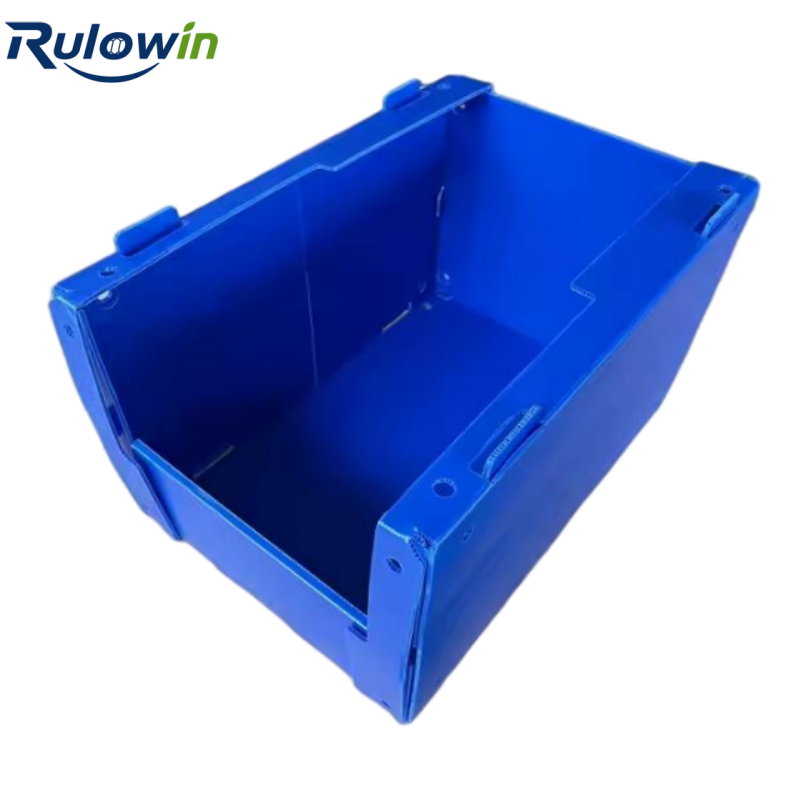
A line changeover involves material as well as tooling: the old parts come off the line, the new ones go on, and the containers they arrived in have to change too. Where the container changes as well as the part, the presentation at every station changes – stands, angles, positions – and that is work. Where the container is the same regardless of the part, that work disappears, and it disappears on every changeover for the life of the line.
What actually happens at a changeover
The old containers are removed, the new ones are placed, and the presentation is adjusted so the operator can reach the new parts. Where containers differ in height, footprint or opening, the stands have to be adjusted or swapped, and that is the slow part. Where they are identical, the swap is a lift and a place, and the stations do not change at all. The difference is minutes per station, multiplied by the number of stations, multiplied by the number of changeovers per day.
Standardisation does not mean one size
The common objection is that parts differ and one container cannot suit all of them. That is true for volume, and it is not true for footprint. A family of containers sharing a footprint and differing in height gives the same presentation at every station – same stand, same angle, same position – while still matching the volume to the part. That is the version of standardisation worth pursuing, and it is much easier to achieve than a single size.
Where the saving shows up
In the changeover time itself, which is the visible part, and in the error rate just after a changeover, which is not. A station whose presentation has just changed is a station where parts get picked from the wrong container, or dropped, or presented badly for a few cycles. Where the presentation never changes, that source of error disappears entirely, and on a high-mix line it is often worth more than the time saving.
The cost side of standardising
A standardised family means some parts travel in a container larger than they need, which costs transport volume and sometimes dunnage. That is a real cost and it has to be weighed against the changeover saving. Where changeovers are frequent – several a day – the saving dominates almost always. Where they are rare – once a week – the volume cost dominates, and optimising per part is the better answer.
Colour and other visual differentiation
Where containers are standardised, distinguishing them becomes a marking problem rather than a shape problem. Colour, labels or inserts do that, and they have to be durable enough to survive the handling cycle. Where the differentiation is by label only, and labels wear, the fleet slowly becomes uniform and the wrong-part risk returns. The marking has to be as durable as the container. See running several orders in one box family for the same problem in a different setting.
How to quantify it before committing
Time a changeover now, and count how much of it is presentation adjustment rather than part change. That fraction, multiplied by changeovers per day and by the number of stations, is the annual saving, and it is usually larger than expected. Where it exceeds the cost of the extra volume from standardising, standardise. Where it does not, do not – the calculation is straightforward and it should be done with real numbers rather than with a preference.
What to standardise first
Footprint, then presentation height, then stack features. Opening style and colour last, because they cost the least to vary and matter least to the station. Standardising in that order gets most of the benefit for least of the disruption, and it can be done progressively rather than as a single project.