
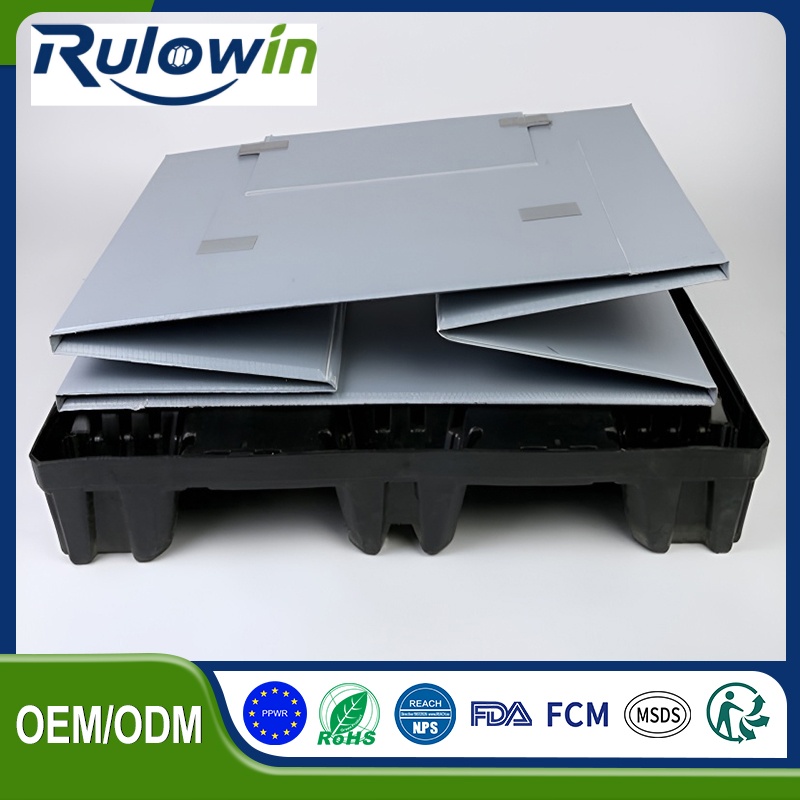
A plant that buys one box per part number ends up with a warehouse of idle fixtures and a packaging budget that grows every time the product range does. A plant that buys one adjustable box per route gets more use out of fewer boxes and accepts a slightly slower load. The trade is worth understanding rather than guessing.
The cost of a dedicated fixture
A dedicated dunnage set is fast to load, gentlest on the part and useless the moment the part changes. If a plant changes models twice a year, a dedicated set has an idle half-life measured in months. That is a real cost and it usually is not in the quotation comparison, because the second box is bought by a different person in a later year.
Adjustable systems and what they cost you
Adjustable dunnage uses movable posts, slots, movable dividers or a peg system. The cost is loading time, because the operator now has a decision to make, and decisions introduce errors. The counter-measure is to make the adjustment tool-free and clearly indexed, so the change is a slide rather than a calculation.
Changeover time as the deciding number
Time the changeover honestly, including the walk to find the other fixture and the time to check the setting. If changeover is under a minute and the operator has a marked gauge, adjustable wins on almost every mixed-family route. If it runs to ten minutes and two people, dedicated fixtures are cheaper in practice, whatever the arithmetic says on paper.
Standardising the outside, varying the inside
Keeping one box envelope across a family of parts gives you freight predictability, consistent stack heights and one set of handling rules, with only the internals changing. This is usually the highest-value standardisation available, and it is much easier to sell internally than a change to the container itself.
Colour coding and the error it prevents
Where variants share a box, a colour band or a clip-on tag keyed to the part number reduces mis-loads. It is a weak control on its own and a useful prompt alongside geometry that already prevents the worst error. Anything visible from across the aisle is worth more than a label the operator has to walk over to read.
Where a family box is the wrong answer
When the parts differ enough that one set cannot protect them all without compromise, a family box protects none of them properly. In that case it is better to accept dedicated fixtures for the top few part numbers and a general-purpose box for the tail, which is the same shape of decision as choosing between a box and a rack for a range of stock.
Piloting the changeover
Run the adjustable set against two real part numbers with two real operators for a week and record the changeover times without telling anyone you are timing them. The number you get will be different from the number you were quoted, and it is the one to plan with.
Where the family box saves the most
The saving is largest on part numbers that run in short campaigns. A dedicated fixture for a part that runs for three weeks a year is idle for forty-nine, and it also has to be stored, labelled and found when the campaign returns. A family box absorbs the campaign without any of that, and the slightly slower load is paid for twice a year rather than every week.
For the few parts that run continuously, a dedicated set still wins, because the load time matters every day. A mixed fleet of a handful of dedicated boxes and a larger number of family boxes is a normal and sensible outcome, and it is cheaper than either extreme.
What we can do
We build PP honeycomb board boxes with adjustable internals, indexed so a changeover is a slide rather than a setup. Send the part family, not just one part, and we will design the box around the family.