
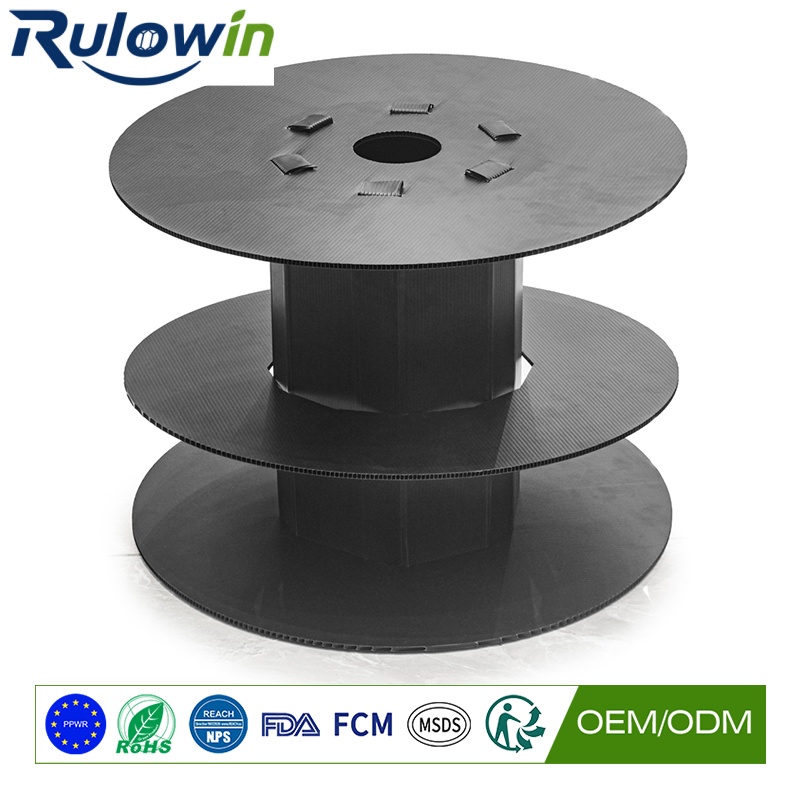
Reels stored outdoors are common on cable jobs, and the question of whether sunlight damages them has a qualified answer: fading yes, warping sometimes, structural loss eventually – and which of those you get depends on the grade and on whether the reel is loaded.
What UV does to polypropylene
Ultraviolet breaks polymer chains at the surface. The visible effect is chalking and colour loss; the mechanical effect is that the surface layer loses strength and becomes brittle. It is a surface phenomenon that works inward, so a thick section can lose surface strength and still be structurally fine for a long time.
UV-stabilised grades slow this dramatically. The distinction matters: an unstabilised reel stored outdoors for a season and a stabilised one are visibly different objects by the end of it.
Warping specifically
Warping needs heat plus load. A flange in the sun gets warm; if something is pressing on it while it is warm, it takes a set. An empty reel lying flat in the sun, with nothing on it, mostly does not warp – it fades.
Stacked reels in the sun are the risk. The bottom reel carries the weight of the stack, gets hot, and the flange takes a set. That is the combination that produces warped flanges, and it is a storage problem rather than a material one.
How to tell UV damage from something else
UV damage is surface: chalky, sometimes crazed, and it comes off on your hand. A crack from mechanical damage is clean-edged and often starts at the rim or at the hub. If the surface is chalky and there is a crack, the crack probably started at the surface – which is how UV damage leads to mechanical failure.
Crack patterns and their causes are set out in why cable reel flanges crack. If the reels are going to live outside rather than just sit in the sun for a week, the storage arrangement matters as much as the grade and is covered in storing empty cable reels outside long term.
How long outdoor storage is acceptable
For a stabilised grade, a season outdoors is unremarkable. For an unstabilised one, a season is enough to notice the difference, and two seasons is enough to matter. If reels are going to live outside, specify for it – it costs little at the point of purchase and nothing to ask.
Covering a stack is the cheap alternative and it works well. A tarpaulin over the stack removes the UV and reduces the heat, and it costs less than the difference in grade.
What to check before reusing an outdoor-stored reel
Flex the flange rim with your hand. If it feels brittle rather than springy, or if the surface powders when you rub it, the reel has lost strength and should not go back into service with a heavy load on it.
Also check the hub. It is less exposed than the flange but it is the load path, and a hub that has lost surface strength is the more serious fault of the two.
The tarpaulin caution
A dark cover in strong sun makes the stack hotter than no cover at all, because it traps radiated heat while blocking the UV. It solves the surface degradation and can make the heat problem worse, which is not an obvious trade.
Use a light-coloured cover, or a cover with an air gap and ventilation. Both keep the temperature closer to ambient, and the UV protection is what you were after in the first place.
What we can do
We supply export-grade plastic fiber optic cable reels and will tell you which grades are UV stabilised and which are not. Tell us whether your reels sit outside – if they do, we will specify accordingly rather than letting you find out.