
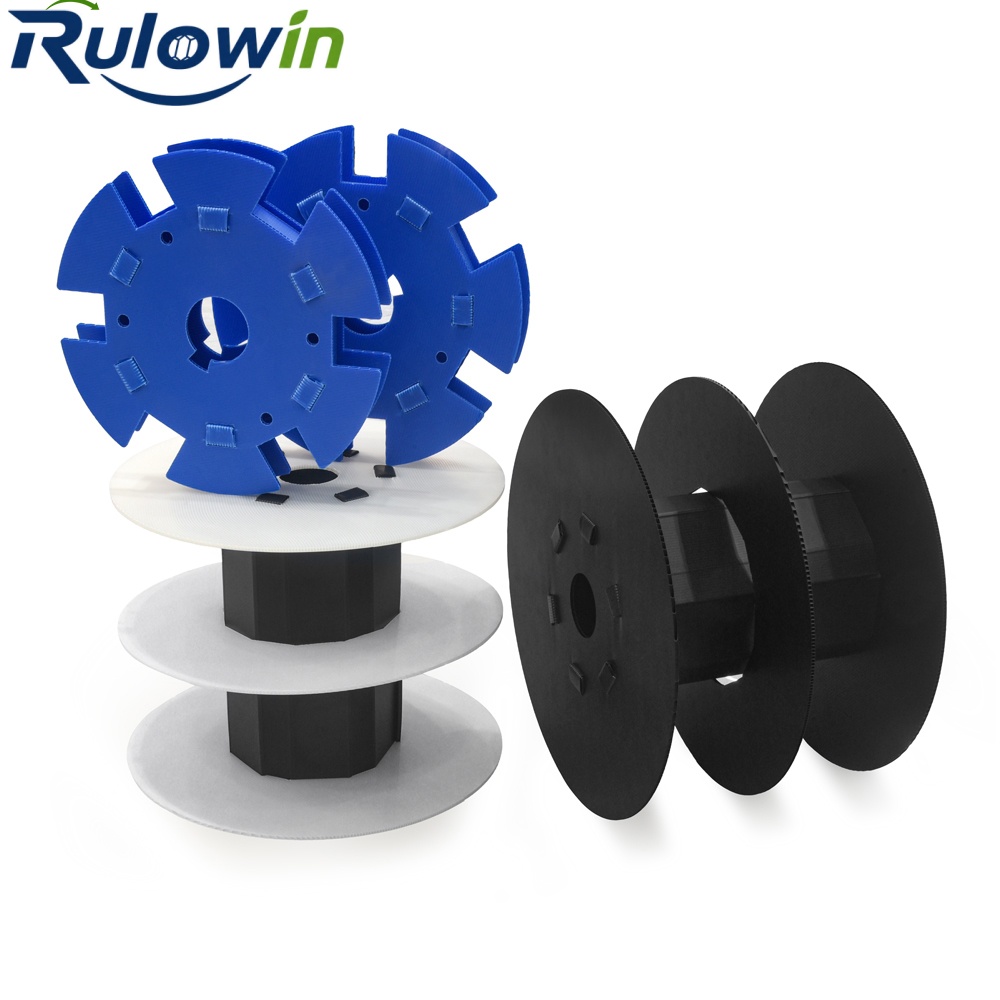
When cable breaks on payoff, the spool gets blamed. Sometimes that is fair — a damaged flange, an out-of-round core, a burr at the joint. More often the spool is doing its job and the tension is doing the damage, and the two are easy to tell apart once you know what to look at.
The basic relationship
For a fixed braking torque at the spool, tension in the product is inversely proportional to the radius at which it is leaving. Start with a full spool and the radius is large, so tension is low. As the spool empties, the radius falls and tension rises — slowly at first, then sharply over the last few layers.
Depending on the ratio between flange and core diameter, tension at the end of the run can be several times what it was at the start. If the process was set up on a full spool, the end of the run is where it breaks.
Where the transients come from
Steady tension is manageable. Transients break product, and there are four common sources:
- Start and stop. Inertia means the spool overshoots on braking and lags on acceleration. A hard stop from high speed is the classic breakage moment.
- Spool runout. An eccentric spool produces a once-per-revolution tension pulse. At high speed this is a continuous vibration, and on fine product it is enough to exceed the limit on its own.
- Product catching. A snag at the flange, a layer that has dug in, a rough core — each produces a spike that no control system can anticipate.
- Spool changeover. The splice between two spools is where most operators will tell you the trouble is, and they are usually right.
Telling spool problems from tension problems
Spool-induced tension variation is periodic — it repeats once per revolution if the spool is out of round, or at a layer frequency if the wind is uneven. Tension-control problems show up at start, at stop, or progressively through the run.
A simple way to separate them: run the same product off a known-good spool. If the problem follows the spool, it is the spool. If it happens on every spool but only at the end of the run, it is the tension curve. If it only happens on start and stop, it is the control settings.
What actually helps
- Measure tension. A load cell in the line costs less than one rejected spool and turns all of this from guesswork into a number you can set limits on.
- Flatten the curve. A larger core reduces the full-to-empty ratio and leaves the control system headroom.
- Ramp, do not step. Acceleration and deceleration ramps cost a little cycle time and remove the largest transients in the process.
- Check the spool before it goes on. Roundness, bore fit, flange condition. Two minutes at the payoff prevents the argument afterwards.
The bit people forget
Back-tension is not only about not breaking the product. Too little tension is its own problem: layers shift, the pack loosens, and the product can dig into the layer below and jam. A spool that runs slack will birdnest just as reliably as one that runs tight.
The target is a window, not a number, and the window narrows as the product gets finer. If you tell us the product, the speed and the payoff setup, we can tell you where we think that window is and what spool geometry gives you the most room in it.