
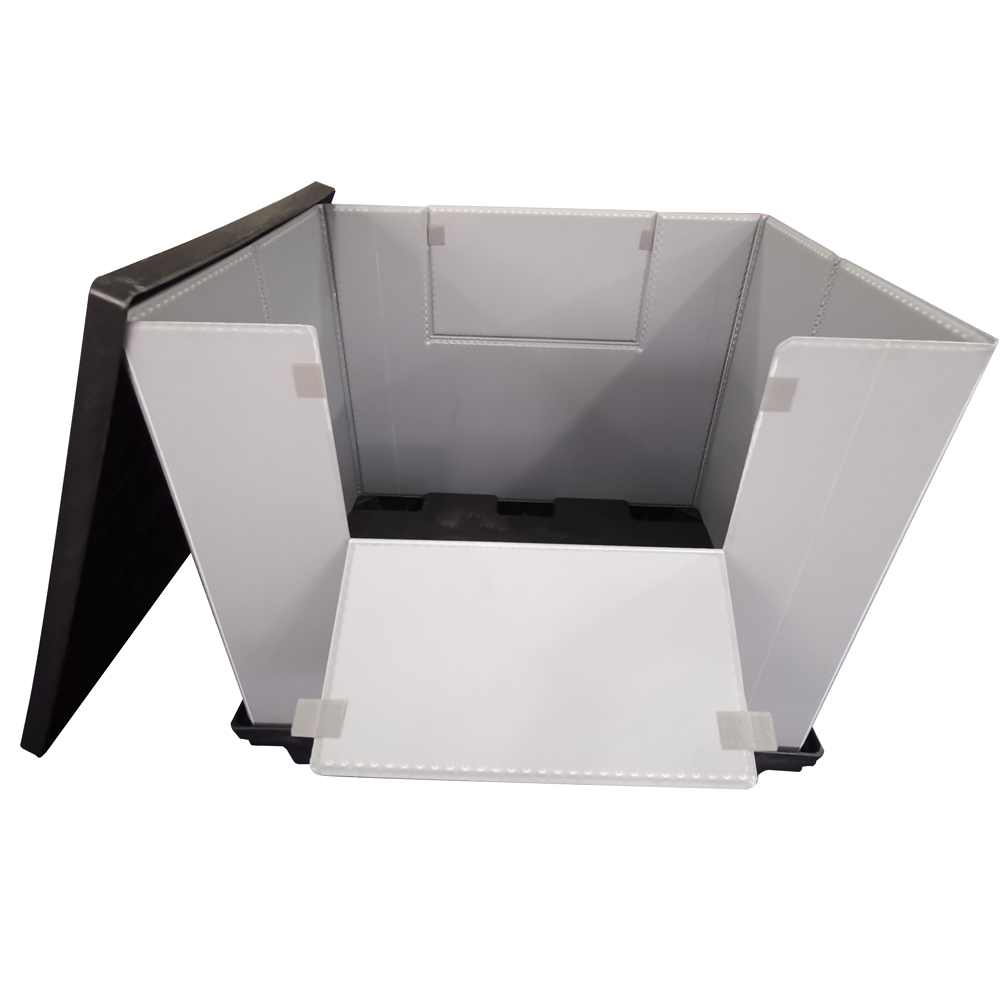
Pallet collars – the hinged wooden frames that build a box on a pallet – are common because they are cheap and everyone understands them. People look for alternatives for three reasons: they are heavy, they do not collapse, and they need ISPM 15 treatment to cross borders.
The direct substitute: a sleeve box
A pallet sleeve box does the same job – base, walls, lid on a pallet – and collapses flat for the return. It is lighter, it does not need export treatment, and it assembles without tools. Against that, a collar is cheaper to buy and more tolerant of rough handling.
Which wins depends on the same question that governs every returnable: do the empties come back. If they do, the sleeve wins on weight and return volume. If they do not, collars are cheaper and you should keep buying them. This is not a close call in either direction.
Option two: a moulded plastic collar
There are plastic collars that hinge like wooden ones. They are lighter than wood, they stack when collapsed to some degree, and they last much longer. They are also considerably more expensive to buy than either wood or a sleeve.
These suit operations with high handling frequency and a closed loop, where the collar is being opened and closed many times a week. At low frequency the extra cost does not pay back.
Option three: nothing, plus a different pallet
Sometimes the right answer is not a container at all. If the product is uniform, boxed, and stable, a wrapped pallet on a good pallet with a top cap may not need walls. Removing the walls removes the whole cost of containing them.
This is worth checking before buying alternatives to something you may not need. We see a lot of operations containing loads that would travel perfectly well contained only by wrap.
What a collar does better than a sleeve
Partial access. A collar can be opened at one layer to reach part of the load without dismantling the box. A sleeve cannot. If your operation picks progressively from a pallet – which happens in parts distribution and in some retail replenishment – this matters more than the return volume does.
Collars also take a side impact better. A sleeve wall is a folded sheet; a collar is a frame with thickness. In an operation where pallets get knocked about, that is a real difference.
Trying before switching
Run twenty sleeve sets on one lane alongside your collars and watch them for six months. Count damage, count how many come back, and count how long assembly takes. That is a small outlay and it gives you your own answer rather than a supplier’s claim.
If you are weighing sleeve against crate rather than against collar, that comparison is in pallet sleeve box versus wooden crate, cost per trip.
What a collar does that a sleeve cannot
A collar can be opened at any layer. If you pick progressively from a pallet – taking the top layer off, then the next – a collar lets you do that without dismantling anything. A sleeve does not.
There are sleeve designs with a drop front or an access flap, and they narrow the gap considerably. But if partial access is central to how the pallet is used, a collar or a moulded box is the honest answer and a sleeve is the wrong one.
Worth being clear about this before switching. It is the one functional difference that no amount of economics overrides.
What we can do
We supply reusable pallet sleeve containers and will compare them honestly against what you use now. Tell us the pallet, the load, the lane and whether empties come back, and we will tell you whether switching pays – including when collars are genuinely the better answer.