
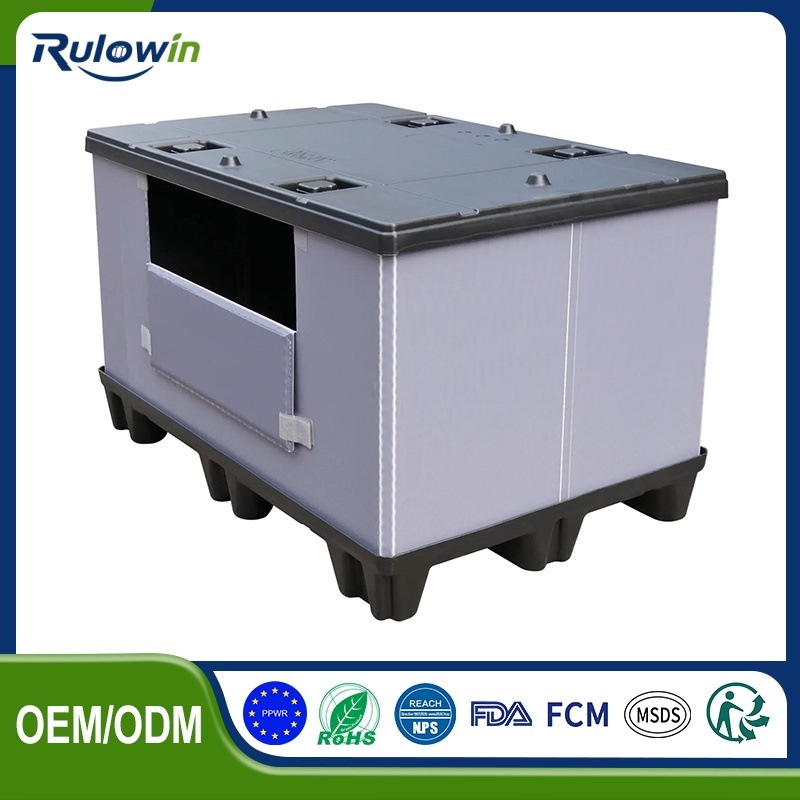
The corners of a container are simultaneously its stiffest feature and its most vulnerable point. They are stiff because two walls meeting at right angles brace each other, and they are vulnerable because that same geometry concentrates stress – and because a container set down at any angle lands on a corner. Where a fleet is handled roughly, corners fail first by a wide margin.
Why the geometry concentrates stress
Two panels meeting at a corner create a stiff region, and anything that tries to deform the box – an impact, a twist, a load applied at one point – puts its highest stress at the change of section. A crack that starts at a corner propagates along the line where the wall meets the base, which is the classic failure shape. It looks like a manufacturing defect and it is almost always a service load.
Impacts land on corners
A container dropped lands on a corner or an edge, because those are the extremities. A container pushed into another container arrives corner-first. A container set down on an uneven surface comes to rest on one corner and takes the whole load there. Every one of those is a concentrated impact at a small area, and the corner is the part designed to receive it – which is why it is also the part that fails.
What reinforcement does
Three things. It thickens the section, which reduces the stress for the same load. It distributes an impact over a larger area, which reduces the peak. And it changes the failure mode from a brittle crack to a deformation that is visible before it becomes a hole. All three are worth having, and a reinforced corner is one of the cheapest features available at the tooling stage.
Types of reinforcement
A thicker section at the corner, which is the simplest. A radius rather than a sharp angle, which distributes stress better and is free at the design stage. An external rib or boss, which adds material where it is most effective and makes the corner the part that takes the impact instead of the wall. Or a different material in the corner region, which is the most expensive and rarely necessary.
What it costs
A small amount of material and a tooling detail, and in most cases nothing per unit beyond the material. Where a fleet is dying of corner damage, reinforcement typically extends the average service life by a large multiple, and the payback on the extra material is measured in months. It is one of the highest-return changes available in a container specification.
Where reinforcement is not the answer
Where the corners are being broken by something specific – a chute with a step in it, a transfer with a drop, a handling method that sets containers down on a corner every time. Reinforcement raises the threshold and does not remove the cause. Where corner damage is extreme, look at the equipment before ordering tougher containers, because the cause is usually visible once you look.
Inspecting corners
Look for a crack rather than a scuff. A scuffed corner is cosmetic; a cracked one is structural, because the crack will propagate along the base joint. A simple criterion – any crack longer than a finger width means retire – is checkable in seconds and prevents the failure happening in service. The wider set of modes is in the damage modes that end a container.
What to ask for
Tell the supplier the fleet is dying of corner damage and ask what reinforcement they recommend, at what cost, and with what effect on expected cycles. A supplier who cannot answer the third question has not tested it. Where corners dominate the retirement data, this is the first conversation to have when specifying the replacement fleet.