
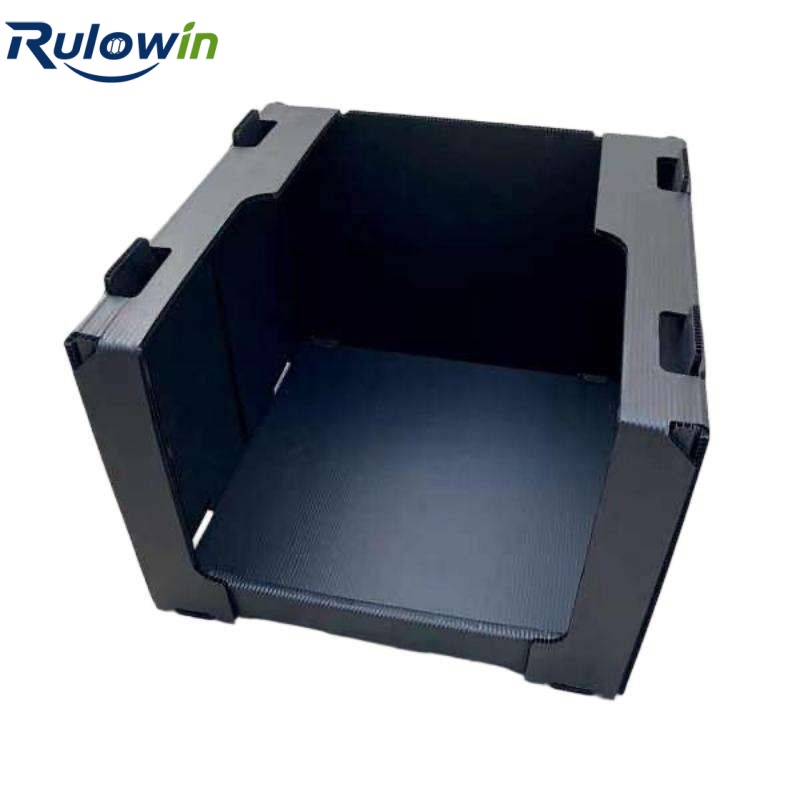
A container that has been stacked loaded for months is not the shape it was. The change is small – a few millimetres – and it is permanent, it accumulates, and it is the reason a fleet that ran well on automated equipment for a year starts faulting. The mechanism is creep: plastic continues to deform under sustained load, and heat accelerates it substantially.
What creep is
Under a constant load a polymer deforms gradually over time, at a rate that depends on the stress, the temperature and the material. It is not failure – the container is not about to break – but the deformation does not recover when the load is removed. A container that has crept two millimetres stays two millimetres out of shape for the rest of its life.
Why stacked storage is the worst case
The bottom container in a stack carries everything above it, continuously, for as long as the stack stands. That is a sustained load with no recovery period, and it is the condition that produces the most creep. Where stacks stand for weeks rather than hours, the bottom container is permanently changed – and where the fleet rotates, every container spends time at the bottom.
Temperature multiplies it
The rate roughly doubles for every ten degrees or so in the range a warehouse occupies. A container that would take years to creep measurably at twenty degrees might do it in months at forty. Where a facility is warm, or where stacks stand in direct sun or near a heat source, creep is the dominant life-limiting mechanism and it is frequently not recognised as such.
What the deformation does
Three things, in increasing order of consequence. The container no longer sits flat, so it rocks on a conveyor and does not seal for a vacuum lift. The walls bow, so the effective width changes and the container stops fitting guides or slots. And the stacking features no longer seat, so stacks become unstable. All three are automation problems before they are structural ones.
Where it shows up first
On automated equipment, because manual handling absorbs a few millimetres and machines do not. A fleet that has been running manually for years and is then put onto a conveyor or into a rack system appears to fail immediately, and the cause is accumulated deformation rather than anything wrong with the new equipment. The tolerance question is in the tolerance automation demands.
Reducing it
Lower the stack, or shorten the time stacks stand. Store in a cooler place. Specify a heavier board or a stiffer construction, which reduces the stress for the same load. Or rotate the fleet so no container spends long at the bottom of a stack. The first two cost nothing, the third costs material, and the fourth costs discipline.
Measuring it
Put a straight edge across the base of a sample of containers from different ages in the fleet and measure the gap. Where the gap grows with container age, creep is happening and the rate tells you how long the fleet will remain fit for purpose. It is a two-minute check and it is the basis for a replacement forecast that is actually grounded.
What to write into the specification
Stack height, duration at the bottom of a stack, and the maximum service temperature. Given those, a supplier can specify a construction that holds geometry for the intended life. Given none of them, the container is specified for a load case and will still deform under a duration case, which is a different thing.