
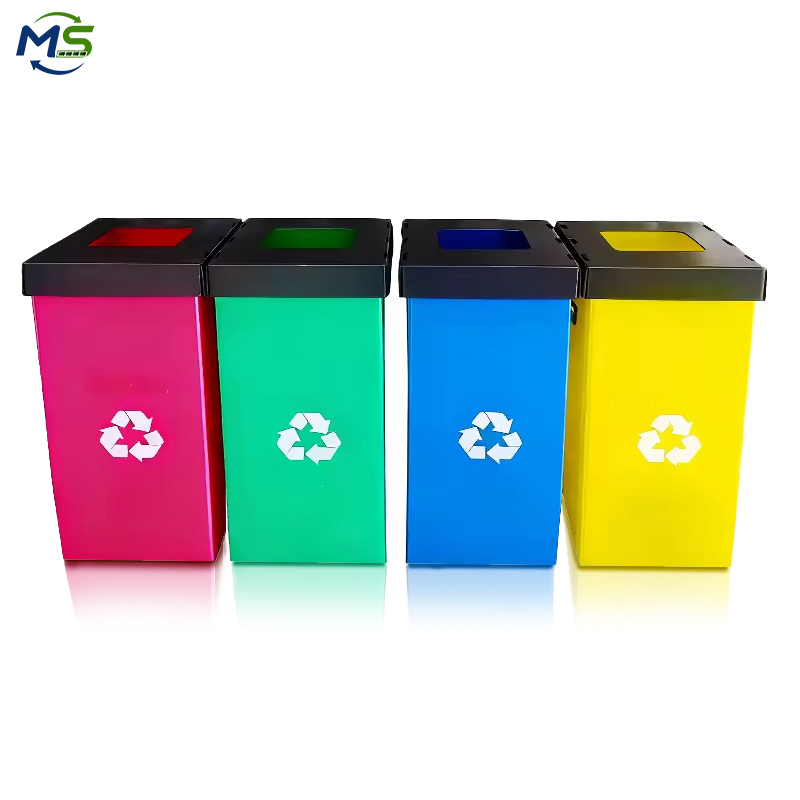
Most plant layouts show the flow of full containers carefully and the flow of empties not at all. The empties are assumed to go back the way the fulls came, which is sometimes true and often not – because the two flows have different volumes, different timing and different shapes. Where a line is crowded and nobody can say why, the empty path is usually the answer, and it is usually missing from the drawing.
The two flows do not mirror each other
Fulls arrive at a rate set by consumption and are consumed steadily. Empties are generated at the same rate but are not removed steadily – they accumulate until somebody takes them. The result is a continuous generation and a batch removal, which means the empty flow is lumpier than the full flow even though the volumes are the same. A route designed for the full flow does not fit the empty one.
Shape changes at the moment of emptying
A container that held parts becomes a container that holds air, and its geometry can change: a lid comes off, a divider comes out, a sleeve folds, a box nests. Those changes are opportunities – a nested stack is a third of the height – and they are also operations that have to happen somewhere. Where the layout has no place for the change of state, it happens in the aisle, which is where the crowding comes from.
Who takes them away
Somebody has to, and if it is not a defined role it becomes whoever has a moment, which means it happens late and in large batches. A defined empty collection route, at a defined frequency, on a defined path, converts a crowding problem into a scheduled movement. Where the collection is combined with the delivery route – drop fulls, pick up empties, one pass – the cost is small and the benefit is that the empties always leave.
Space for the changeover
Where containers nest or fold, the operation takes a moment and a small amount of space, and it is best done at a defined point rather than wherever the container happens to be emptied. A nesting station next to the line – a bench, a stand, a marked floor area – costs a couple of square metres and removes the empties from the aisle. Where the changeover requires a tool or two hands, it needs a surface, and that surface should be on the layout.
What happens during a stoppage
When a line stops, fulls stop being consumed and empties stop being generated – but the empties already generated are still there, and the delivery route may still be running. A stoppage therefore tends to produce a pile of empties and nowhere to put them. Where the empty buffer is sized for normal running, it is undersized for the recovery from a stoppage, and that is worth including in the calculation. The sizing method itself is set out in how much box buffer a line actually needs.
Measuring whether it works
Count the empties at the line at the same time each day for a week. A number that grows is a collection problem; one that spikes and falls is a frequency problem; one that is stable and large is a space problem. Three different fixes, and the count distinguishes them in a week. Where the count is not stable, no amount of extra floor space solves it, because the space would just fill up.
What to draw
The empty path, the point where the container changes state, the collection frequency, and the maximum pile before collection. Four things on the layout, and they take an afternoon. Where they are on the drawing, the line runs with a predictable amount of material at it; where they are not, the aisle becomes the buffer, which is the most expensive space in the plant to use that way.