
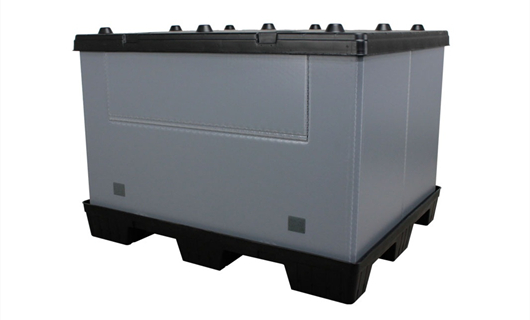
An autonomous mobile robot working with containers is usually working with stacks, and a stack converts a small per-box tolerance into a large total one. A box held to plus or minus one millimetre becomes a six-high stack that varies by twelve millimetres between its best and worst case. That is the number the robot’s sensors and the building’s clearances have to live with, and it is where most height problems on automated handling projects actually come from.
Where the tolerance goes
Per-box variation comes from the tooling, from the board or moulding thickness, and from the way the box folds or seats. Stacked variation adds all of those and adds a fourth: how the boxes seat on each other. A stacking feature with any play – a lip that allows a millimetre of movement before it engages – contributes per interface, so a six-high stack has five interfaces each contributing. Designing the stacking feature so it seats positively, rather than approximately, removes the largest single contributor.
Nesting empties is a different case again
Empty containers frequently nest, and the nested height depends on how far each box drops into the one below. That in turn depends on friction, on deformation, and on whether the box is clean – a box with grit in the base sits higher than a clean one. A robot that expects a fixed nested height for empties will meet a range instead, and the range is usually wider than anyone expects. Where empties are moved automatically, measure the nested height across twenty boxes with varying levels of use rather than trusting the drawing.
Clearance under structures
Robots pass under mezzanines, doorways, conveyor sections and ducting. Every one of those has a fixed underside, and the load has to pass below it with margin. The margin has to cover the tallest stack the fleet will produce, not the nominal stack – and the tallest stack is the one made from the tallest boxes, which on a mixed fleet is a real possibility. Where clearance is tight, specifying a maximum stack height and enforcing it at the loading point is more reliable than trying to tighten the box tolerance.
Sensor height and the top of the load
Many robots detect load presence or load height with a sensor looking across the top of the deck. A stack that varies in height presents the sensor with a moving edge, and at the extremes the sensor either misses the load or false-triggers on the one behind. The fix is normally to set the sensor for the worst case, which costs a little sensitivity, or to constrain the stack height so the range narrows. Both are easier than chasing the box tolerance down to nothing.
The cost of tightening the box
Holding a tighter height tolerance is possible and it costs money, in tooling, in inspection and in rejection rate. Whether it is worth it depends on where else the variation can be absorbed. Where the robot can tolerate fifteen millimetres, spending to hold two is wasted. Where it can only tolerate five, no amount of stack management will save a box that varies by three per unit. The sum is per-box tolerance times stack height plus interface play, and it has to come in under the robot’s limit with margin.
Drift over the service life
Containers change shape in service. A box that has been stacked loaded for months takes a small set; one that has been washed hot and cooled quickly takes another. Both reduce the height slightly, which sounds helpful until a sensor calibrated for the original height stops seeing the load. Where a fleet has been running for a year and robots start reporting missing loads, measuring the boxes is the first check, and it is cheaper than recalibrating the fleet. The wider dimensional picture is in the box audit before an automation project.
What to write into the enquiry
Maximum stack height, tolerance per box, nested height for empties, and the minimum clearance anywhere on the route. Given those four, a container can be specified that the robot will handle consistently. Given only the box size, the robot will handle the boxes it was shown and then meet the ones it was not.