
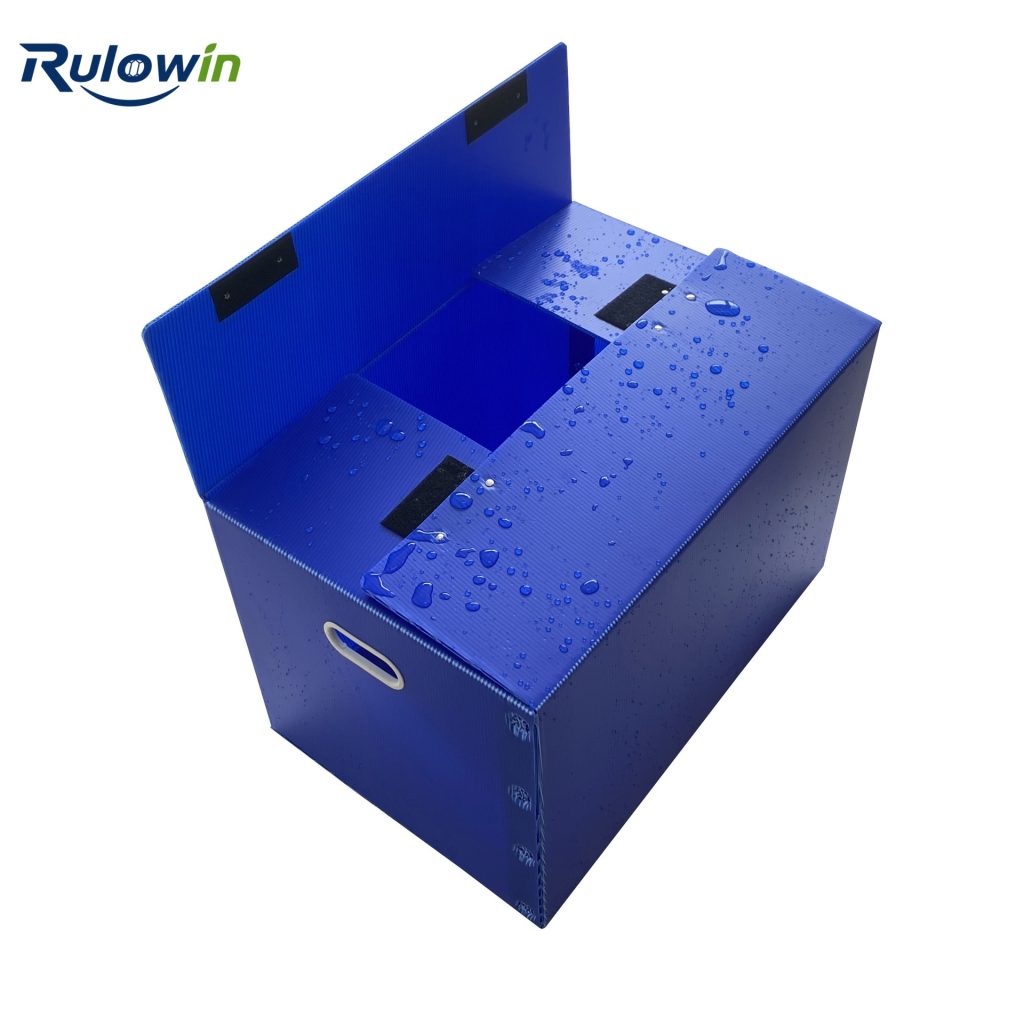
An automated guided vehicle moves a load by lifting it slightly and carrying it. Everything it needs from a container follows from that: a footprint it can find, a base it can support, and enough friction that the load does not walk during acceleration and braking. None of those are exotic requirements, but all three are routinely left out of the container specification, and the result is a vehicle that works in the demonstration and misplaces loads in service.
The footprint has to be repeatable
Most AGVs locate the load either by a fixed position on the deck or by sensing. Where the position is fixed, the container footprint has to be the same every trip, which means the manufacturing tolerance matters directly. Where the vehicle senses, it still needs a consistent edge to find, and a container whose walls bow or whose base overhangs its nominal size presents a different edge each time. The practical requirement is the same in both cases: a footprint tolerance the vehicle supplier has agreed to, held across the fleet and across the service life of the container.
Support points, not a surface
A lift deck is usually smaller than the load and contacts it at defined points or along defined rails. A container base designed to sit flat on a pallet may not be stiff enough to span between those points, and it will sag between them, which changes both the height the vehicle sees and the stability of the load. The fix is either a base stiff enough to span, or a deck arrangement matched to the box. Where the vehicle is specified first, the container has to follow; where the container exists already, the deck can usually be adapted, and that is the cheaper direction.
Friction and the walk problem
A load on a smooth deck under acceleration will slide, and it does not take much – a few millimetres per trip accumulates over a shift into a load that has walked off the deck or into a neighbouring position. The contact between base and deck is what prevents this, and a base with a high-friction finish or a complementary profile is the standard answer. Where loads routinely walk, check the base finish before blaming the vehicle’s acceleration profile; a polished or worn base is the usual cause.
Height consistency across the fleet
Vehicles that carry a stack, or that have to pass under a fixed structure, are sensitive to total height. A container family where the boxes vary in height by more than a few millimetres – because of tooling variation, or because a stack of empties nests differently each time – produces a fleet whose total height is unpredictable, and the vehicle either collides or loses capacity. This is the tolerance question taken up in height tolerance for AMR handling, and it is the one most often missed when a container is chosen for looks rather than for geometry.
What happens at the pick-up and set-down
The lift-and-lower cycle applies a vertical acceleration to the load, briefly reducing or increasing the effective weight. A load that is stable at rest can shift during the transition, particularly if the contents are loose. Where a box carries parts that can move, internal dunnage or dividers are part of the vehicle specification as much as of the packaging one, and they are worth specifying together rather than treating as separate problems.
Identification from the vehicle’s point of view
The vehicle needs to know what it is carrying, and it reads that either from the fleet management system or from a tag on the load. Where it reads a tag, the tag has to be somewhere the vehicle’s reader can see from its own approach direction, which is usually the side or the end rather than the top. A label placed for a person standing at a bench is frequently invisible to a reader mounted at deck height. The placement rules are set out in where to put an RFID tag on a box. , and what survives on the box itself in where a barcode label survives on a box.
What to give the vehicle supplier
The footprint with tolerance, the base drawing, the loaded and empty weights, the overall height with tolerance, and the position of any identification feature. Five numbers and two drawings. Given those, a vehicle can be specified to run the container reliably; without them it can only be specified to run the container that was demonstrated, which is not always the same thing. Tell us the deck geometry and we will confirm which of our containers present a repeatable footprint on it.