
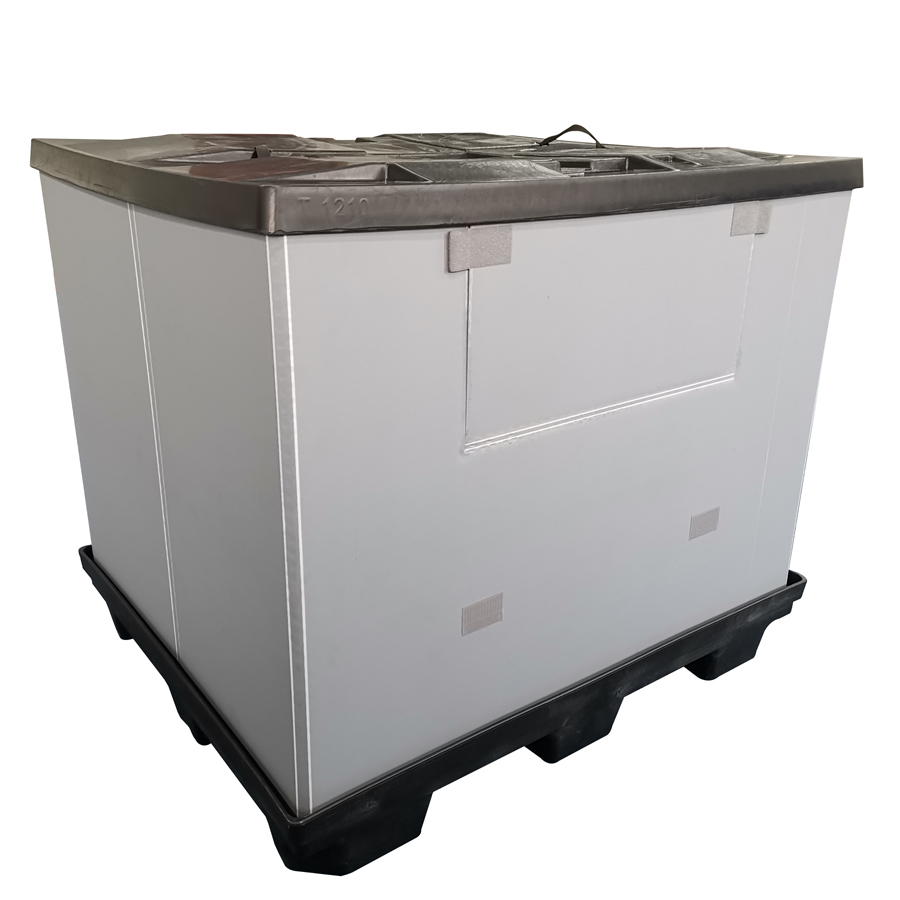
The two families of pallet pattern come from cartons, where every unit is identical and disposable. Reusable boxes change two things: the wall carries load rather than the contents, and the boxes have to come apart again at the far end. Both matter when choosing between a column stack and a bonded one.
What a column stack does to a box
Stacking box directly on box puts the load into the walls, which is what a corrugated PP wall is good at. The path from the top layer to the deck is vertical and continuous. The weakness is lateral: columns have little resistance to a sideways shove, so a column stack leans if the load is not contained by wrap or by the vehicle walls.
What a bonded pattern buys
Interlocking each layer ties the stack together and resists the sideways movement that undoes a column stack. The cost is at the top: unless the box dimensions happen to work out, the final layer is incomplete, and a partial layer is a partial load that still gets wrapped and still gets billed. Some patterns are designed to finish flat, and those are worth asking for by name.
Where carton logic misleads
Cartons fail by crushing, so patterns distribute weight over as much board as possible. Reusable boxes fail by wall buckling, corner damage and lid displacement, which are not fixed by spreading the load. A pattern borrowed from carton practice can therefore make a box stack worse while looking tidier on the diagram.
Boxes with a stack feature
Many returnable boxes have a lip, a recess or a nesting stop that only engages one way round. The pattern has to respect it, and more importantly the packer has to be able to see it. A stack feature that requires the box to be rotated in a particular orientation is a feature that will be got wrong on a Friday afternoon.
Mixed heights in one load
A load of identical boxes is the easy case. Real loads often carry one or two taller or shorter units, and those have to be placed so the layer above still has something to sit on. The general rule is to build the tall units into the bottom layers and top out with a full layer of the standard size, which usually means carrying a few empty or filler boxes to complete it.
How many patterns a fleet needs
One pattern per box size per pallet format, written down and kept with the load plan. That sounds like a lot and is usually three or four sheets. The alternative is packers improvising, which produces a load that is stable on a good day and not on a bad one.
What changes the answer
Boxes with a tall, thin footprint interlock well and column-stack badly, because the bonded pattern is what stops them walking. Boxes close to square and with a registering lid column-stack well and gain little from bonding, because the registration is doing the work.
The second input is the route. A bonded pattern matters more the rougher the road and the more often the load is handled. A column pattern matters more where the load is squared away in a rack or against a vehicle wall and is never really free to move.
What we can do
We build PP corrugated turnover boxes with a defined stack orientation, and we will supply the pattern that goes with the size. Tell us the box size and the pallet formats, and we will send the layout. The layer-by-layer side of this is covered in where to put the strap.