
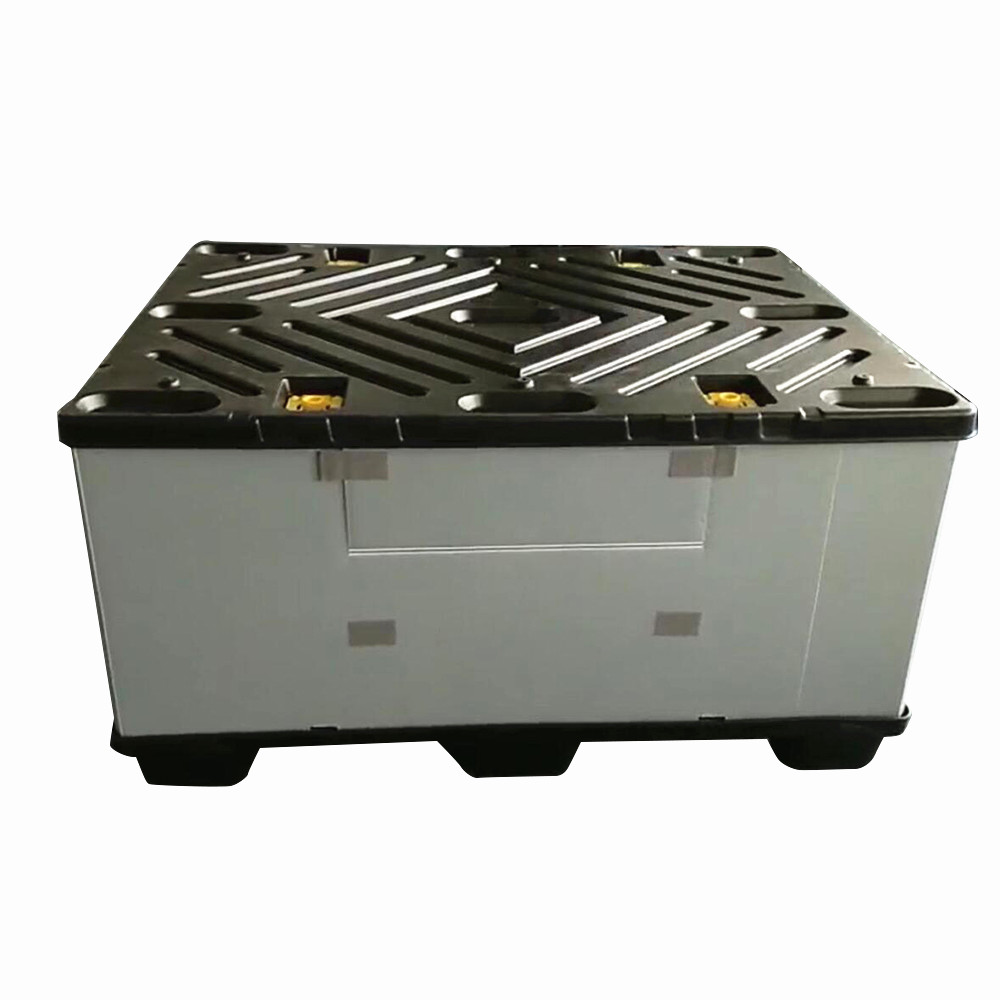
Most packaging specifications are written from the part outwards. Somebody measures the component, adds a clearance, picks a box that fits and stops there. The carrier never sees the part. The carrier sees the outside of the box, multiplied by however many boxes fit in the vehicle, and that is what appears on the invoice.
The number the carrier uses
A load is costed either on mass or on the space it occupies, and most road and sea freight uses whichever of the two produces the larger figure. A box that is 20 mm too tall does not make one shipment 20 mm more expensive. It makes every layer on every pallet 20 mm taller, and at some point that removes a layer from the stack or a pallet from the trailer. The penalty arrives as a step, not as a slope, which is why it is so often missed in a specification review.
What sits between the part and the outside wall
Three things consume the difference between the part and the outer dimension. The dunnage that holds and separates the part. The wall thickness of the box, which on a corrugated PP board is small but not zero, and which doubles wherever panels overlap or a seam folds. And the clearance the packer needs to load the part without forcing it, which is usually generous on a sample build and tight on a production build. Measuring a hand-built prototype is the most common way to under-specify an outer dimension.
Why a round number is expensive
Boxes are frequently ordered at round metric sizes because they are easy to specify. Pallets are not round, and neither is the inside of a trailer. A 600 x 400 footprint wastes more of a 1200 x 800 pallet than a 580 x 380 one does, and the difference is not the 20 mm of board, it is the band of air that opens up along one edge. Modular sizing exists precisely to close that band, and the gain shows up as an extra box per layer rather than as a saving anyone can see on a drawing.
Footprint bands and the step change
Utilisation does not decline smoothly as a box gets larger. It declines in steps, because what matters is how many whole boxes fit along each axis of the pallet. A footprint that fits 3 x 2 may leave a comfortable margin; one that fits 2 x 2 leaves a quarter of the deck unused. Before fixing a size, it is worth writing down the integer across and the integer deep at the two or three pallet formats the lane actually uses. The box that looks 5% smaller in area can be 25% worse on the deck.
The height version of the same problem
Height behaves the same way but against a different constraint: the clear internal height of the trailer, container or mezzanine. A 10 mm increase is invisible until it crosses the line, at which point the top layer is lost everywhere in the load. Stacking height is usually the last dimension to be fixed and the first one to be regretted, because it interacts with lid design, stack features and the height of the part itself.
Where the tolerance goes
An outer dimension is only meaningful with a tolerance attached, and the tolerance matters more than the nominal figure. Boxes at the top of a tolerance band will not fit a pattern calculated on nominal, and the failure shows up as a packer forcing a box into a gap. The practical fix is to state the tolerance the load plan was built on, and to quote it as a maximum rather than a range, because load plans fail on the large boxes, never on the small ones.
Reading a load plan before you commit
A load plan is two numbers per axis and a diagram. It is cheap to produce and it is the only artefact that turns a packaging dimension into a freight cost. Ask for it with the quotation, check the integers against the pallet formats in use, and check the stack height against the vehicle. Where a supplier will not produce one, the specification is being guessed at.
What we can do
We build PP corrugated turnover boxes to a footprint that comes out of a load plan rather than a catalogue, and we quote outer dimensions with a stated maximum. Send us the part, the pallet formats and the lane, and we will show the pattern before anything is cut. The arithmetic behind it is set out in what five points of cube is worth.