
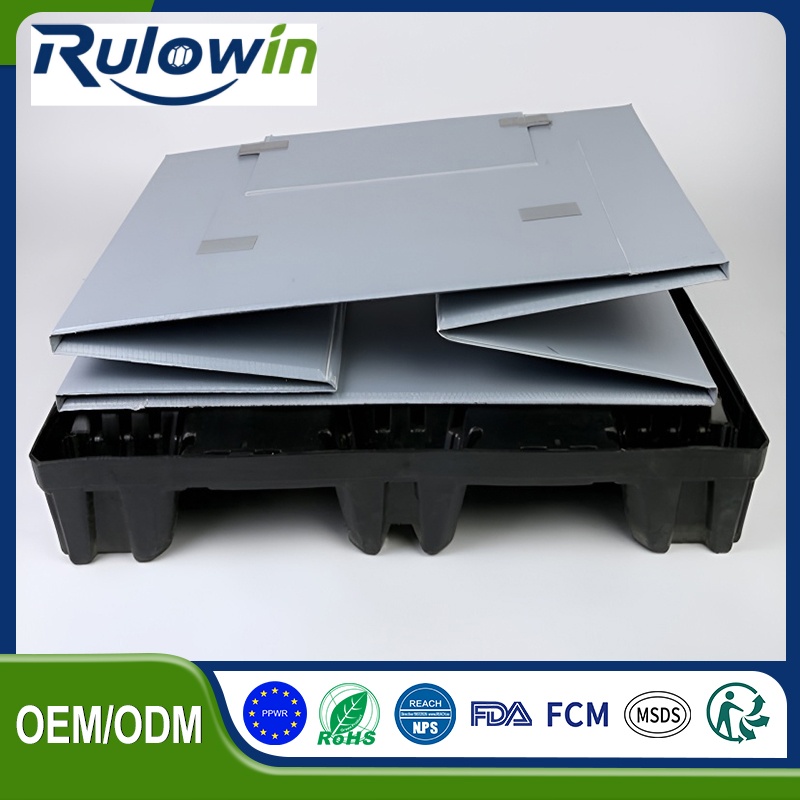
Tolerance arguments waste a great deal of time in packaging, because the dimensions people ask to control are rarely the ones that matter. A box with tight external dimensions and a loose opening will stack badly; a box with a generous external tolerance and a tight opening will work for a decade.
Squareness is the tolerance that matters
A box out of square will not stack reliably, no matter how accurate its dimensions are. It also wears unevenly, because the load path is not distributed as designed. Squareness is measured across the diagonals of the opening and it is the one number worth controlling on every box in a fleet, not just on a sample.
Opening size and the mating features
Where a box stacks on another, the locating features are a fit and the dimensions that govern them need to be controlled. In practice this means the opening and the lid register rather than the overall envelope. Getting that pair right is what lets a stack go up square in a hurry, which is the operational benefit people actually notice.
Where generosity is cheaper and better
External envelope, cut edge positions that are not visible, the exact position of a printed logo, the wall thickness of a non-critical panel. Tightening any of these adds cost and adds nothing functional. It is worth writing a note on the drawing to that effect, because a supplier will otherwise work to the tightest value on the sheet.
Part fit and how much play is right
A part that fits with clearance loads faster and moves more; a part that fits closely is protected better and loads slower. The right answer depends on the surface finish and the operator, not on a general rule. On machined parts a small clearance with soft contact points usually beats a tight fit, because a tight fit has to be right every time and eventually is not.
Weight tolerance and why it drifts
Weight varies with material density and with adhesive or welded assembly. A range of several per cent is normal and only matters if the box has to be handled by hand or weighed. If weight is critical, specify a maximum rather than a nominal, which shifts the design to the light side rather than the average.
What to measure on incoming boxes
Squareness on every box, since it is quick. Opening and locating features on a sample per delivery. Envelope and weight on the first article only. That combination catches the failures that matter and keeps the inspection time to a few seconds per box, which is what makes it survive a busy week.
What to do when a delivery is out of tolerance
Have a stated consequence before it happens, usually rejection of the affected boxes and a replacement. Fleets built on tolerance that nobody enforces end up with a collection of boxes that all stack a little differently, which is exactly the condition where counting and stacking becomes difficult for no good reason.
How to write the notes on a drawing
Two notes remove most of the argument. One states the squareness figure held on every box. The other states that envelope dimensions, non-visible cut positions and print placement are cosmetic and will not be rejected on measurement. A supplier reading those two notes knows exactly where to spend effort, and will usually spend it in the right place.
Keep the drawing to one revision and date it. Where a change is needed, issue a new revision rather than amending the existing sheet, because a tolerance that moves without a revision number is a tolerance that nobody can prove was met or missed. It is the same discipline as freezing the specification at first article.
What we can do
We build PP honeycomb board boxes and will state the squareness figure we hold on every box, the tolerance on the opening, and the dimensions we treat as cosmetic. Ask for those three numbers with any quotation.