
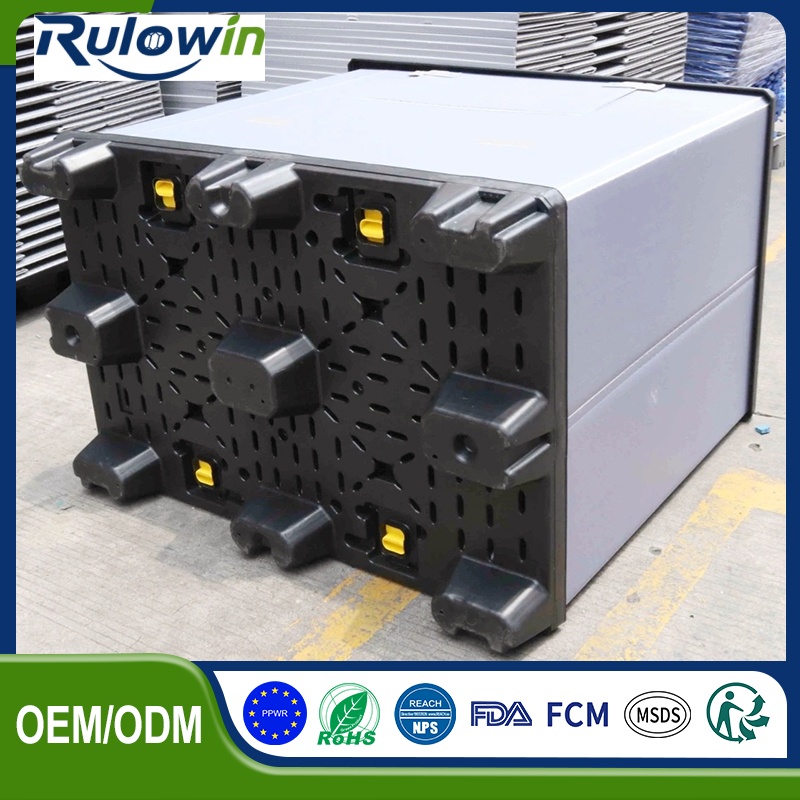
Most of the cost in a custom box is in cutting and assembling panels, not in a mould. That has two consequences: tooling is cheaper than people expect, and the minimum order is often driven by setup time rather than by tooling amortisation. Understanding which one applies to your box tells you where the negotiating room is. The same split shows up on corrugated boxes, covered in tooling and MOQ for a custom box size.
What actually needs tooling
Three things can need a mould or a die. A printed or branded panel needs print tooling. A shaped cut profile, for a dunnage component or a shaped edge, needs a cutting die. And any moulded plastic component, such as a pin, a corner block or a foot, needs a mould. Everything else is cut and assembled from sheet, which is why the tooling on a typical custom box is often a four-figure number rather than a five-figure one.
What MOQ is actually protecting
Setup time, material purchase in economical quantities, and the risk of a small order being uneconomic to run. If the box uses a standard sheet thickness and a simple profile, the setup is short and a small first order is possible. If it uses a special colour, a special thickness or a printed panel, the minimum quantity jumps because the material is bought by the tonne. Ask which of those is driving your MOQ and the answer will tell you whether it can move.
Getting a meaningful first order
The usual approach is to design the box so that the first order is runnable at an economic quantity while the tooling is paid separately. Many suppliers will run a modest trial quantity at a higher unit price and refund the premium against a larger follow-on order. It is worth asking, because it converts a large first commitment into a pilot, which is how most fleets should start anyway.
Standard sizes and where they earn their place
A box built on a standard sheet module is cheaper, faster and easier to extend later. The trade is a slightly larger box than the part needs, which costs a little volume on every trip. On a high-frequency lane the volume matters; on a low-frequency lane the standard size is nearly always the better commercial choice.
Colour, print and the cost of choice
Colour drives a minimum material order, which is usually the largest single reason for a high MOQ. If the colour exists mainly to look tidy, consider a standard colour with a printed identification instead. If the colour is a customer requirement, it stays, but it should be priced explicitly rather than buried in the unit rate.
Tooling ownership and what happens if you leave
State that you own the tooling, where it is stored, and what happens if you change supplier. This sounds like procurement boilerplate and it is genuinely important here, because a print tool or a cutting die for a specific internal profile is not much use to anyone else, and its absence makes switching supplier expensive in a way that has nothing to do with quality.
When custom is not worth it
If the part is small, the volume is low and the protection requirement is modest, a modified standard box with a simple internal set will outperform a custom design on every measure including protection. Custom earns its place when the part is awkward, the volume is real and the loop is long enough for the design to be refined. This is the same judgement as designing for a part family rather than a single part.
Planning the second order before the first
Almost every box design is refined after the first year. Deciding at the start how a change will be handled, whether the tooling allows a small dimensional change, whether colour can be altered, whether the internal set can be modified without new tooling, turns the second order into a quick conversation rather than a new project.
Where a design is likely to change, it is worth asking which modifications are free and which need a new die. That single question shapes the first design in useful ways, because it pushes the variable elements into the parts of the box that are cut rather than moulded.
What we can do
We build PP honeycomb board boxes and will separate tooling from unit price, quote a pilot quantity, and tell you which element is setting the minimum order. Send the part and the annual volume and we will be specific about both.