
Fleet losses rarely announce themselves. They show up as a shortage during a busy week, at which point someone buys boxes in a hurry at whatever lead time is available. A five-minute weekly count prevents that, and it costs less than one replacement box a month.
What to count and how often
Count boxes held at each location, not individual movements. Weekly is right for most plants; daily is unnecessary and monthly is too slow to catch drift. The count is of physical boxes, including the ones sitting in a corner that everyone has forgotten about, because those are exactly the ones the count exists to find.
The one number that matters
Boxes in service as a percentage of boxes owned. You do not need a breakdown by line, by part or by customer to manage a fleet. You need to know whether the total is drifting, and whether the drift is at your site or somewhere else. Everything else is diagnosis, and diagnosis is only needed when the number moves.
Reconciling with the other end
If boxes go to a customer or a sister plant, the count has to happen at both ends. The number that matters then is held stock at the far end, and it should be roughly constant. If it climbs for three weeks, boxes are being kept rather than returned, usually because the far end has no space or no process. That is a conversation rather than a counting problem.
Making boxes countable
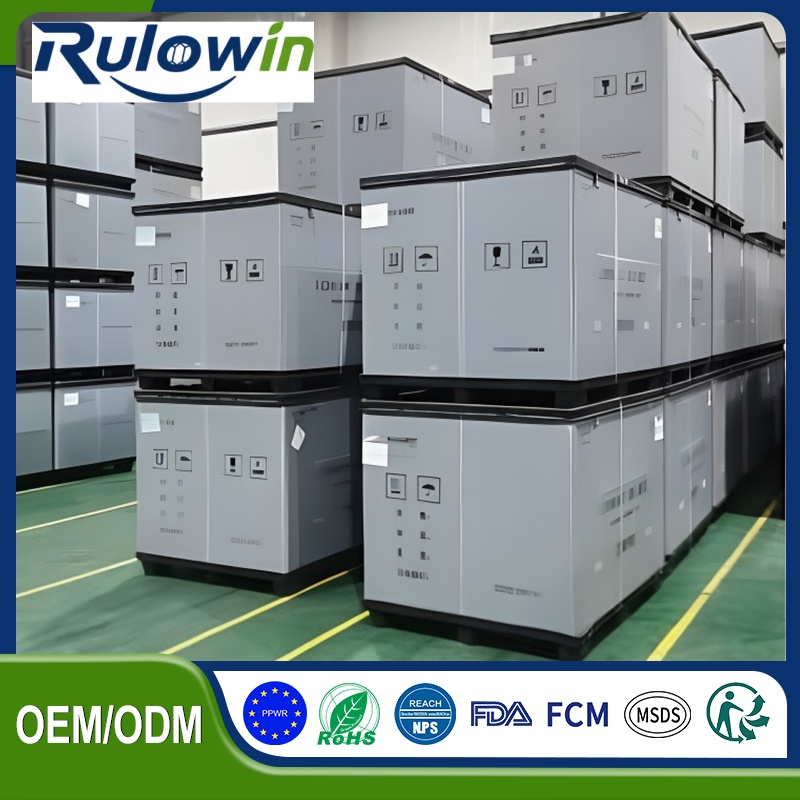
Two things: a number that does not come off, and a place that is easy to count. A printed number survives better than a label, and a marked bay with a standard stack height makes counting a glance. A box fleet that is hard to count will not be counted, no matter how good the spreadsheet is.
What cycle counting costs
Roughly two hours a week across a mid-sized fleet, plus the time to chase discrepancies. Compare that with replacement boxes, expedited freight and the improvised cardboard that appears during a shortage, and the case is not close. This is the same logic as budgeting the running cost of a fleet, with the counting being the thing that keeps the budget honest.
When to move to tags and software
When the fleet is large enough that counting by eye takes more than an hour, or when boxes move between many parties who do not trust each other. Below that, tags add cost and failure modes: readers that do not read, tags that fall off, and a database that gradually diverges from reality. The honest trigger is complexity, not ambition.
What to do when a box is missing
Give it a defined period of grace, then declare it lost and replace it. Fleets that wait indefinitely for a box to reappear run short while the losses accumulate invisibly. A written rule of one month is enough, and it produces an accurate loss rate, which is the number that tells you whether the process needs attention or the fleet needs more boxes.
Getting a count started
Pick a quiet half hour, count every box at one site, and write the number on a wall. Then do it every week at the same time. The first three counts are inconsistent because people are learning where the boxes hide, and after that the number stabilises and becomes useful. Expect to find between five and fifteen per cent of the fleet in places nobody remembered.
Once one site is counting properly, extend to the others and start reconciling between them. That is the point at which the fleet stops being a collection of boxes and becomes a managed asset, and it is also the point at which the business case for the next fleet becomes easy to write.
What we can do
We build PP honeycomb board boxes with durable printed identification so counting is a glance rather than a task. Tell us how many locations the fleet visits and we will suggest a counting routine and the marking that makes it work.