
When a contamination problem appears, the packaging gets blamed because it is new. Usually the panel is innocent and the sources are elsewhere. Understanding which is which saves a great deal of pointless specification.
Where contamination actually comes from
Four sources, roughly in order: the incoming part, the packing area, the dunnage, and the container itself. A clean box packed on a dusty bench is a dirty box by the time it is closed. A box that arrives clean and is opened in a dirty area picks up contamination on the way out. The container is one of four and rarely the largest.
What the panel does
A closed-cell structure with a sealed skin does not shed in normal use. What it does do is trap dust in cell openings at cut edges and hold it there, releasing it intermittently as the box flexes and as it is handled. Sealing the edges removes most of that behaviour, and it also solves the delamination and moisture problems that edges cause anyway.
Wear is the real emitter
Over a few hundred trips, contact points wear and start to produce dust: the box rubbing on its own lid, a dunnage pad rubbing on a wall, a pallet rubbing on a base. That is where particulate generally comes from in a mature fleet, and it grows slowly, which is why a fleet that was fine in year one has contamination complaints in year three. The fix is inspecting and replacing wear components, not changing the container material.
Foam, felt and every open-cell material
Open-cell foams are the largest single source of particles in most returnable systems. They break down at edges, they hold water, and they release material every time they are compressed. If a route has a particle limit, closed-cell or coated facings are close to mandatory, and they have to be inspected and replaced on a schedule.
Cleaning and re-contamination
A cleaned box re-contaminated in transit is indistinguishable from a box that was never cleaned. Where a route is genuinely clean, the transfer point and the cover matter more than the cleaning method. A lid that closes properly, and a vehicle that is not full of cardboard dust, will do more than a better detergent.
When the box genuinely is the problem
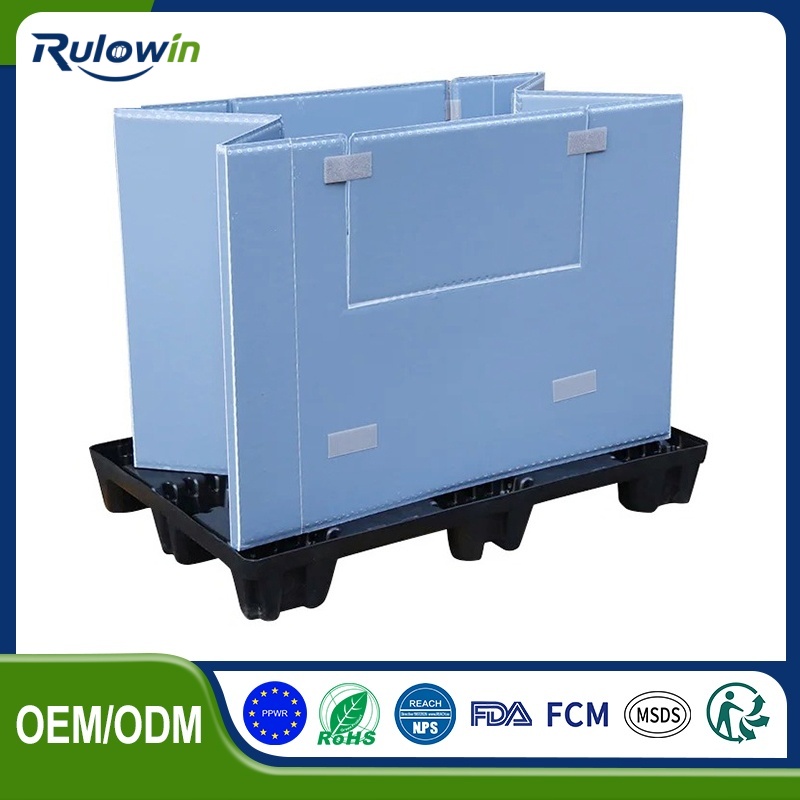
Two cases. Cut edges left open on a box that is regularly flexed, and any inlet where dirt can collect and never be removed, such as an unsealed double wall. Both are solvable at the design stage and both are visible in the drawings, which is why it is worth asking a supplier to show which surfaces are sealed and where the box has openings that cannot be cleaned. The same edge-sealing question drives durability, as described in wall construction.
A practical test before a fleet
Wipe the box, load and unload it twenty times, then wipe it again and look. That simple cycle tells you where the material actually lives, and it takes an afternoon. It is far more useful than a data sheet, because the data sheet tests a flat panel and the box is not a flat panel.
Controlling the packing area
The highest-value change in most contamination investigations is not the box, it is the bench. Packing a clean box in a room with cardboard, forklifts and a concrete floor defeats the packaging entirely. A defined packing position, kept clean and away from the busiest traffic, delivers more than a material upgrade and costs nothing but discipline.
Where the route is genuinely clean, packaging the part immediately after the last process step rather than after a period in general storage removes a whole contamination opportunity. The gap between clean and packed is where most of the particles are picked up.
What we can do
We build PP honeycomb board boxes with sealed edges and cleanable internal surfaces, and we will specify dunnage on closed-cell facings where a route has a particle limit. Tell us the limit and the cleaning regime.