
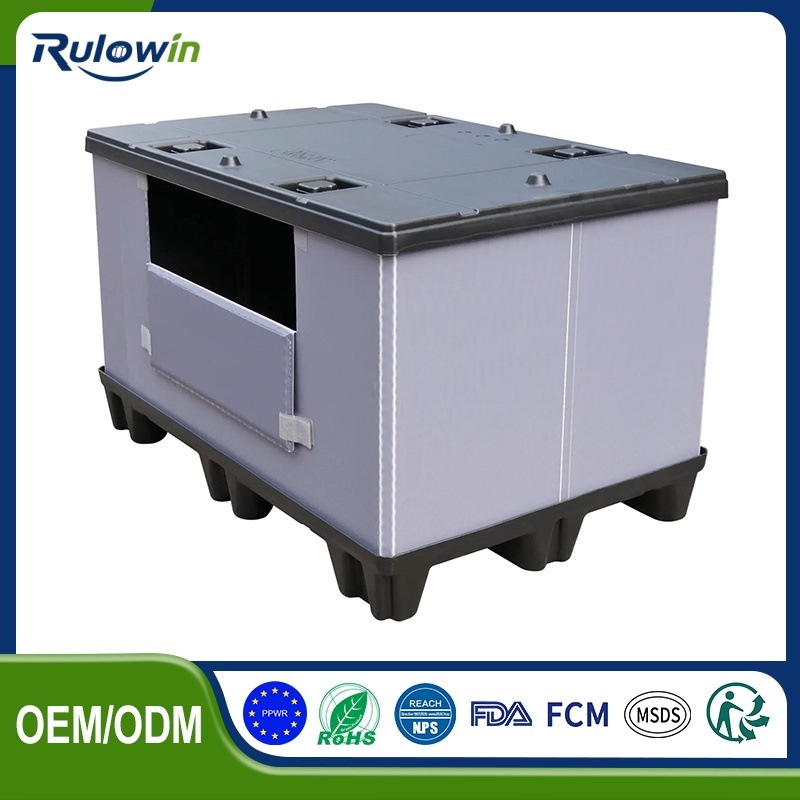
Flat parts, panels, pressings and plates are the easiest things to pack and the hardest to pack well. The obvious solution, layers with separators between them, works beautifully on the first day and degrades steadily as separators go missing and operators start skipping them.
How many layers is right
Driven by weight and by lifting height. An operator lifting the last layer out of a deep box is doing a shoulder-height reach with a part that may be heavy, and that is both a safety issue and the reason the bottom layer gets dumped rather than lifted. Three or four layers is usually the practical maximum without a lift assist, regardless of what the volume calculation wants.
Separator attached or loose
A loose board separator is cheap and disappears. A hinged or captive separator stays and slows the operator slightly. A separator that forms part of the dunnage set and keys into the walls is the middle path: it comes out, but only into one position, so it cannot be lost without the box being obviously wrong. If you only fix one thing in a layered system, fix this.
Sequencing so layers cannot be skipped
If layers can be loaded in any order, they will be loaded in the fastest order. A set where the separator has to be seated before the part drops, and where the part will not sit flat if it has not been, prevents skipping by geometry. It is slower on a good day and much faster on a bad one.
Contact marks and facing faces
Two flat parts in contact will mark each other, especially after a long truck journey. The separator has to be soft enough not to print on the part and clean enough not to leave a mark. Felt-faced separators solve the first problem and need a cleaning schedule for the second. A separator that is cleaned with the box is worth more than one that is only replaced.
Dust and swarf between layers
Anywhere layers stack, dust accumulates in the gaps and ends up sandwiched against a finished face. On a route where parts go into a clean area, that single problem justifies a sealed box with a solid lid. The separator material and the box ventilation have to be decided together rather than separately.
Weight distribution when the layers differ
Mixed layers, where a heavy part sits above a light one, put a point load through the separator and onto whatever is underneath. The separator is then doing structural work it was not specified for. Either keep heavy parts low, or specify the separator to take the load. Layered systems that fail usually fail here, and the cause is a change in the loading pattern rather than a change in the product. This is the same design tension as point loads in a box base.
Counting the layers at the end
Because a layered box has an obvious standard quantity, it is the easiest of all configurations to reconcile. Print the layer count and the quantity per layer on the box, and the count becomes a glance rather than a task. It is a small thing that prevents a lot of arguments.
Marking the standard load
Mark the box with the layer count and the quantity per layer, and mark the separator positions. A marked box turns a judgement call into a check, and it means a partially loaded box is obviously partially loaded from across the aisle. It costs a printing plate once and it prevents a class of miscount that otherwise takes a stock investigation to resolve.
Where layers are interchangeable, number the separators so they always go back in the same order. It sounds excessive until the first time a set of separators is returned in the wrong sequence and does not seat properly, at which point the marks save twenty minutes of fiddling.
What we can do
We build PP honeycomb board boxes with keyed, captive or hinged separators so a layered set stays intact over years of use. Tell us the part, the layer weight and how the box will be unloaded, and we will design the stack height around a safe lift.