
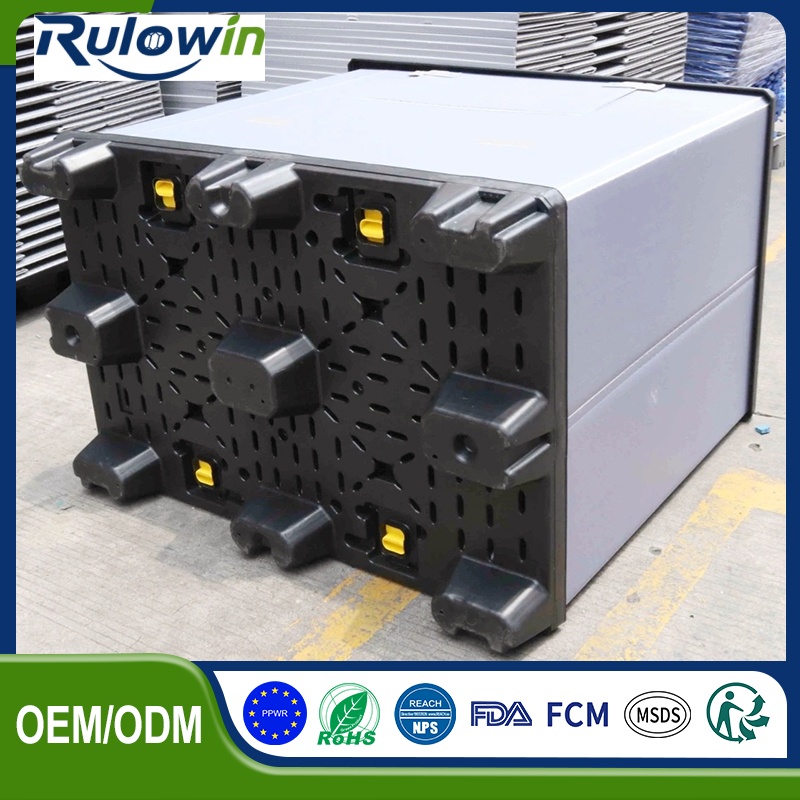
A sub-assembly arrives at the line as one thing, but it is several things joined together and only some of them can take a knock. Packaging it means choosing which of those features defines the protection requirement, and that choice is rarely written down.
Find the fragile member
A welded bracket with a sensor, a connector or a pipe attached is only as strong as its weakest attached part. Design the dunnage to protect that member and the rest follows. Design for the bracket and the connector arrives bent, which is the most common failure on sub-assembly routes.
Rigid enough to hold, gentle enough not to mark
Sub-assemblies are usually heavier than the components and have more surface that must not be marked. That combination pushes towards a set that locates on dedicated features, such as a mounting hole or a machined boss, rather than on a face. Locating on a feature is faster to load and removes the need for soft facing almost everywhere.
Direction of travel and centre of gravity
Where a sub-assembly stands up in service, it often wants to travel on its side, because the centre of gravity is lower and the footprint is more stable. That is a handling decision as much as a packaging one, and it has to be agreed with the line rather than assumed. It also affects how the part is picked out at the far end, which is where back injuries come from.
Contamination and the join lines
A sub-assembly has open ports, threads, electrical connectors and sometimes a sealing face that has to stay clean. Everything open should be capped, and the caps belong to the dunnage set rather than to a bag of loose parts. A captive cap at the correct position means it gets put back; a loose cap means the port arrives with swarf in it.
The count problem
When several small parts are joined to a larger one, quantities stop tying up. Someone has to count what is in the box at both ends, and the box should make that easy: a fixed number of positions, visible from above, so a glance shows whether a position is empty. A box with a visible standard quantity removes a whole class of reconciliation argument, which is the same idea as counting a box fleet applied to the contents.
Changeover between variants
Sub-assembly families usually come in variants that differ by a bracket, a connector or a length. A dunnage set that accepts all of them is more expensive per set and cheaper overall than three sets plus the risk of the wrong one being used. Design for the family, and make the variant differences obvious rather than subtle.
Damaged-in-transit versus damaged-in-assembly
When a sub-assembly is rejected, establishing whether it was damaged in the box or on the line is hard and usually not attempted, so packaging gets blamed by default. A simple record at goods-in, with a photograph of the dunnage and the load, settles the question cheaply the first time it is asked.
Agreeing the handling with the line
Sub-assembly packaging fails most often because the packaging was designed for the way the part is stored and the line handles it a different way. Settling the lift method, the number of people and the height at both ends before the dunnage is drawn removes most of the rework. It is a twenty-minute conversation and it saves a prototype.
It is also worth watching a full shift before finalising anything. The way a part is actually picked up at four in the afternoon on a Friday is the way it will always be picked up, and no drawing survives contact with a busy line unchanged.
What we can do
We build PP honeycomb board boxes and dunnage sets for sub-assemblies, including captive caps and fixed-position layouts that make counts visible. Send the assembly drawing with the fragile members marked, and we will design to those.