
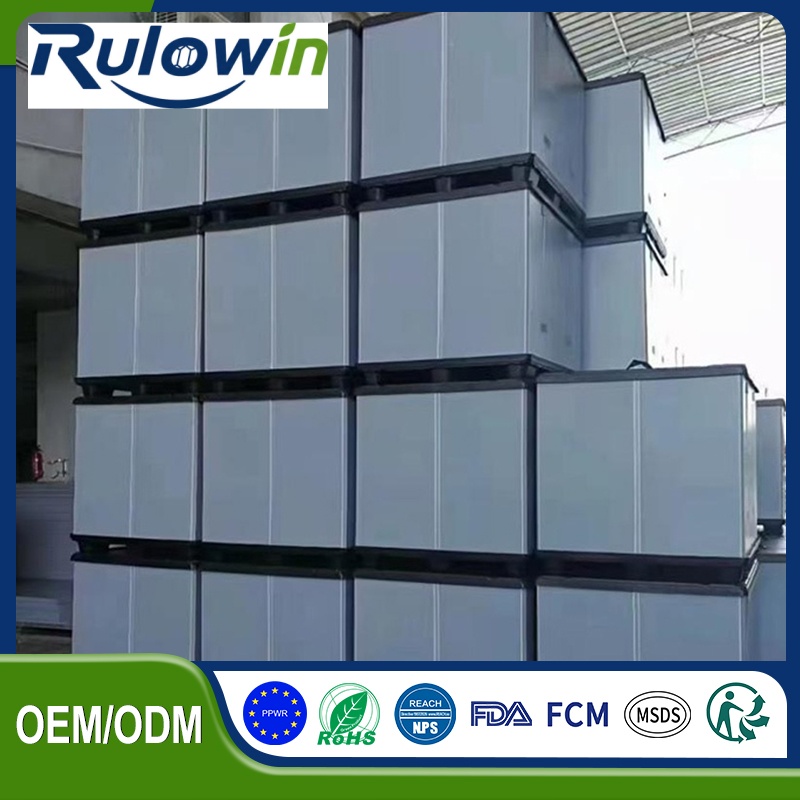
Storage decisions get made once and then live for a decade, usually because a rack is bolted to the floor and unbolting it is a project. That inertia is worth challenging at the point of buying something new, but not on ideology. Racks and boxes do different jobs.
What racking does that a box cannot
Vertical density. A racking bay uses the height of the building with a steel structure that costs nothing per part and needs no maintenance other than a periodic inspection. It also exposes the part for picking, inspection and dust, which is either a benefit or a defect depending on the part. If the stock is heavy, unwrapped and handled by crane, racking is usually correct.
What a box does that a rack cannot
It protects. A box gives the part a clean, cosseted face on all sides, which matters for painted, machined or cosmetic parts that a rack would expose to knocks, dust and drips. It also travels, which a rack does not, and it can be stacked in places with no racking at all, including a yard, a mezzanine or a temporary store. And it can be moved as a unit, which turns a picking problem into a handling problem.
Density is where the comparison is usually decided
Count parts per cubic metre of building, not parts per shelf. An empty box stack wastes volume for most of its life in a store that holds part boxes and empties in the same footprint. If the store holds mostly full boxes, box density can beat racking, because a stack of loaded boxes uses vertical space without any steel. If the store holds mostly part load quantities and picks from them daily, racking wins. Measure the ratio of full boxes to empty boxes before designing anything.
Point loads and deck protection
A rack puts the whole load onto two beams. That is a point load on whatever is underneath, and it is why racked boxes need to be loaded within their span rating rather than their floor rating. A honeycomb board box in a stack spreads the load across a deck, which is gentler, but only if the base is designed for it and the stack height is respected. Neither arrangement is more forgiving than the other; they fail differently.
When the part is the constraint
Long parts, awkward parts and thin parts usually decide the question for you. A two-metre extrusion does not want to be lifted on and off a rack by hand, and a thin cosmetic panel does not want to be racked unprotected. Both push towards boxes with internal support, and the design work moves into the interior. That is the same problem as supporting long extrusions in a box.
Mixing boxes and racks in one aisle
This is what most plants actually end up with, and it works if two rules are kept. Keep the box stacks at one end so the aisle is not a slalom, and never mix a stack height in one bay, because the visual cue for how high to go is what stops the fifth box going on a four-box stack.
The decision in three questions
Does the part need protection from contact or dust? Box. Does the stock sit for months with no movement? Rack. Does the same unit need to travel? Box, because a rack that moves is a stillage and is a different cost entirely. Answer those three honestly and the choice makes itself.
Starting small rather than replanning the store
The temptation is to treat this as a warehouse redesign. It rarely needs to be. Converting the stock for one part family to boxes, in one bay, produces the density figure and the handling experience that the decision actually needs. If it works, the next family converts; if it does not, nothing is bolted to the floor and nothing has been lost.
Measure the parts per cubic metre before and after, over a full month, including the empties. That single comparison is what convinces a warehouse manager who has seen packaging initiatives promise space and deliver clutter, and it is a number that is easy to produce from an ordinary stock count.
What we can do
We build PP honeycomb board boxes sized to the part and designed for stacking in the store as well as travelling on the lane. Give us the part, the weights and the storage footprint, and we will tell you what a box stack does to your parts-per-cubic-metre figure.