
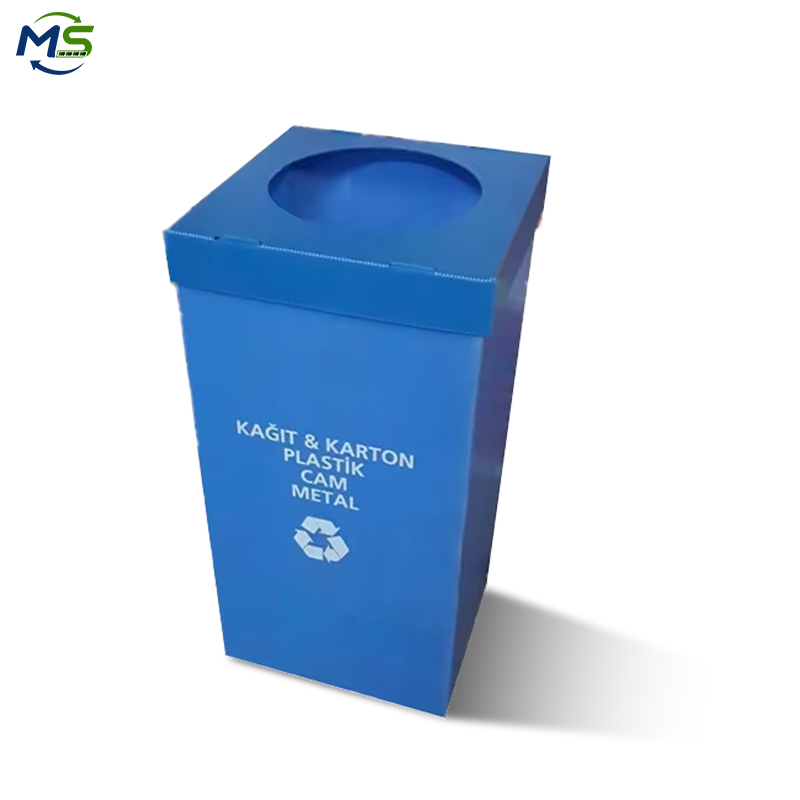
A box going into a clean or controlled area is judged on different criteria from a box going into a machine shop. Strength is rarely the question. Cleanability, particle shedding and chemical compatibility with the cleaning agents are, and they are design properties rather than material ones – the same PP sheet can be acceptable or unacceptable depending on how the box is built.
Cleanability is geometry
Internal corners have to be radiused, because a square internal corner cannot be wiped clean and holds residue. Internal surfaces have to be smooth and free of fixings – no rivets, no exposed fasteners, no open flutes at a cut edge where they can trap material. And the box should have no unnecessary features: every rib, recess and step is somewhere for contamination to sit. A simpler box is a more cleanable box.
Cut edges are the weak point
Corrugated PP cut through the flutes leaves open channels at the edge, which trap fluid and shed particles. In a clean application, edges should be sealed or folded so the flutes are closed. This is a manufacturing detail that costs very little and it is the difference between a box that passes a cleaning validation and one that never will.
Chemical compatibility with the cleaning agent
PP is resistant to a wide range of cleaning agents, but not to all of them, and the agents used in controlled environments are more aggressive than a factory wash. Check the specific agent and concentration against the box material before committing, and ask the supplier for compatibility data rather than a general assurance. Where the agent is aggressive, a dedicated box grade is cheaper than a failed validation.
Documentation and traceability
Controlled environments require the packaging to be part of the documented process: material declarations, lot traceability on the boxes themselves, and a defined cleaning and inspection cycle. That argues for permanent serial numbering and for a box that can be identified after a hundred washes. It also argues for keeping the fleet small and dedicated rather than sharing boxes between areas. Clean-area material considerations are discussed further in cleanroom compatible PP board.
Validating a box rather than assuming it
A box intended for a controlled environment has to be validated in that environment: cleaned by the actual process, with the actual agent, and then checked against whatever particle or residue criterion applies. A material declaration is not a validation. A box that is cleanable in principle may not be cleanable by the method the site actually uses, and the difference only appears when it is tested.
Run the validation on the boxes that will be used, including any printing or numbering, because a printed surface can behave differently from a plain one under aggressive cleaning. Run it after several cleaning cycles rather than on a new box, because the surface changes with use. And keep the validation tied to a specific box specification, because a change in grade, printing method or corner construction invalidates it – which is exactly the sort of change a supplier may make without thinking it matters.
Keeping clean boxes clean
A clean-area box that is stored in a general warehouse between uses is not clean when it is needed. Dedicated boxes need dedicated storage, and the storage needs to be inside or adjacent to the controlled area rather than wherever there is space. This sounds obvious and it is the most common failure in practice: a validated box, cleaned correctly, stored in a dusty corridor for three weeks.
The minimum workable arrangement is a covered storage position inside the controlled area with enough capacity for the boxes in circulation, plus a defined route for boxes going out to be cleaned and coming back. Where space does not allow storage inside the area, box covers or a sealed stack with a lid on the top box is an acceptable compromise. What is not acceptable is an open stack in a shared space, because the cleaning validation applies to the box and not to the three weeks before it is used.
What we can do
We build PP corrugated boxes with sealed edges, radiused interiors and no internal fixings, and we will provide material declarations for the sheet. Tell us the classification of the area and the cleaning agent and we will tell you what we can validate and what we cannot.