
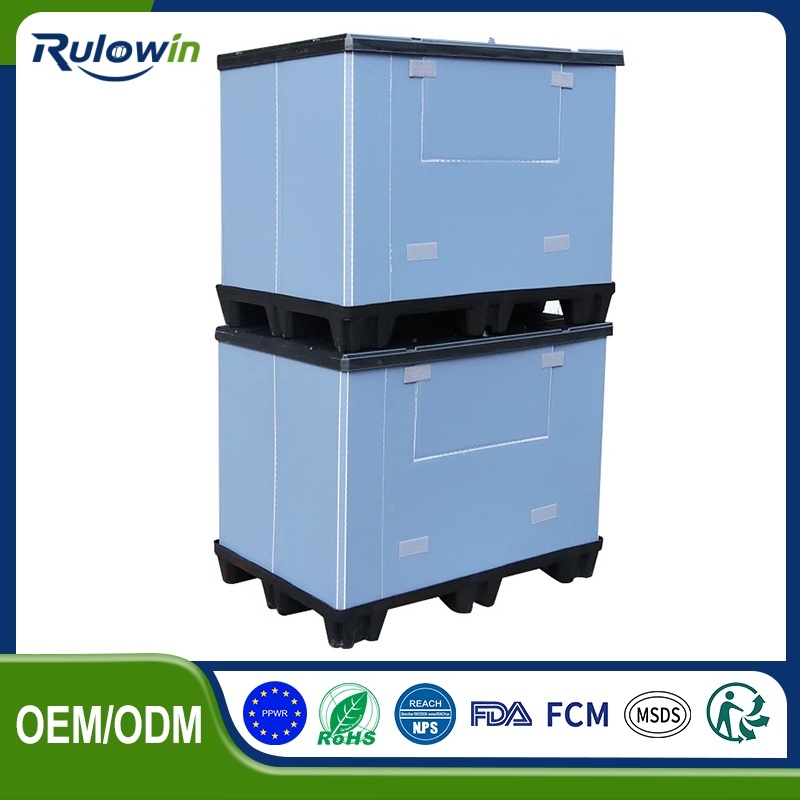
One of the quieter advantages of a plastic returnable box on an export route is paperwork: no ISPM 15 heat-treatment marking, no fumigation certificate, no phytosanitary question at the border. That is real and it is worth money in administrative time alone. What surprises people is that removing wood also changes how the load behaves, because wood was doing structural work nobody credited it for.
What wood was doing
A wooden pallet is stiff, it spreads point loads, and it friction-grips the load above it. A plastic box on a plastic pallet is a much lower-friction, higher-flex combination: the load slides where it used to grip, and the pallet deflects where it used to be rigid. The load plan that worked with wood will not transfer unchanged. Either add anti-slip material between layers or add strapping that the wood-and-carton combination never needed.
Pallet choice matters more without wood
If the load is going on a plastic pallet, specify one with a lip or a retaining edge, because the box feet or base will otherwise walk off the deck under sea motion. If the load goes on a wooden pallet – still common and still fine – check that the pallet is in grade, because a returnable box is heavier than the carton it replaced and a marginal pallet that carried cartons will not carry boxes for three hundred trips.
Declaration and duty questions
Reusable packaging that is expected to return is not the same customs object as packaging that is sold with the goods. It may need to be declared separately, and in some jurisdictions it can be entered temporarily. Get the treatment right with a broker before the first shipment rather than at the border, because a container held for packaging paperwork costs more than the packaging.
What does not change
Moisture, contamination and physical security. A reusable box is not a sealed export pack; it still needs a lid, still needs to be clean of soil and debris before it ships, and still needs the contents secured inside it. Customs cleanliness requirements apply to plastic packaging in exactly the same way as to wood. The washing step before an export leg is not optional.
Where wood is still the right answer
Plastic returnable packaging is not universally better and it is worth being clear about where wood wins. For a one-way export with no return leg, a treated wooden crate or a plywood case is often cheaper and stronger than any returnable box, because there is no fleet to amortise and no return to plan. For very heavy loads, timber still spreads and carries point loads better than an equivalent plastic structure at a comparable price.
And for a route with no reliable return flow, the reusable option has no economics at all. The decision is not plastic versus wood, it is returnable versus one-way, and the answer is determined by whether the container comes back. Where it does, plastic wins on treatment paperwork, on life and on consistency. Where it does not, buy the crate, treat it correctly, and move on. Suppliers who will not say this are selling rather than advising.
Cleanliness before an export leg
Reusable boxes going abroad have to be clean, and clean means free of soil, debris and any organic contamination, not merely free of yesterday’s swarf. Border inspections look for exactly this and a dirty container is a real risk of a hold. The wash step before an export leg is not optional and it should be documented.
What catches plants out is that the boxes have usually been in general internal service before they ship, so they carry whatever the plant carries: oil residue, metal fines, labels from three destinations ago, and occasionally something organic from a box that was used for something else. One dedicated wash before loading, an inspection of the interior, and removal of old labels is enough. Where boxes ship repeatedly, keep a sub-fleet for export only and do not let it drift into general internal use.
What we can do
We supply PP corrugated turnover boxes that need no treatment marking, and we will flag the load-behaviour change rather than letting it be discovered. Tell us the route and whether the packaging returns, and we can also point at the pallet specification that suits a plastic-to-plastic load – the same issue covered in pallet toppers for export containers.