
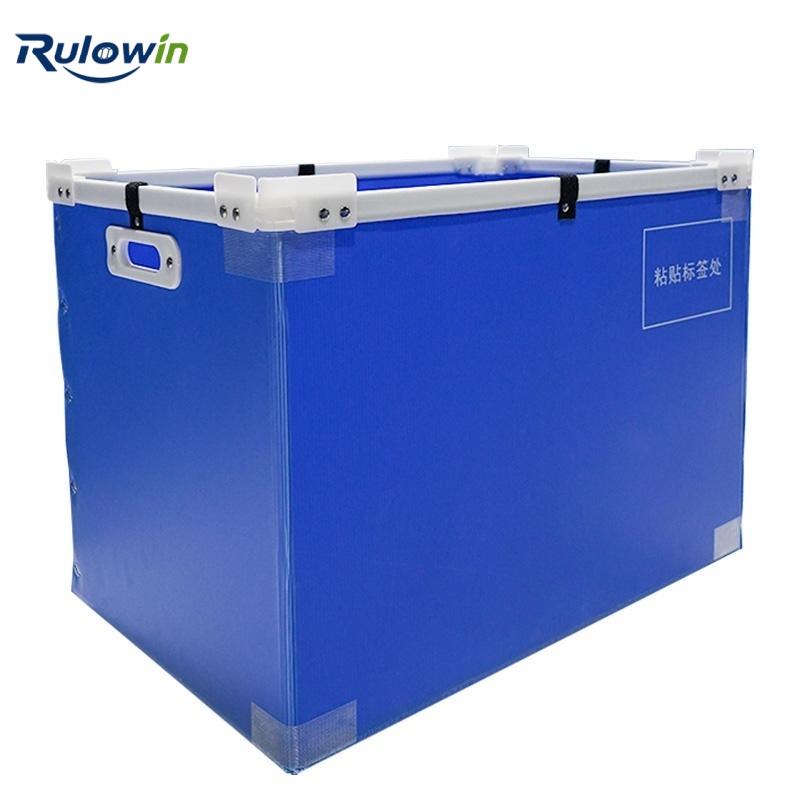
Full boxes have an owner. Somebody ordered the parts, somebody is waiting for them, and if they do not arrive there is a problem with a name on it. Empty boxes have no owner. They are nobody’s job, so they accumulate at the end of a line, get moved to a corner, and three weeks later the plant is short of boxes and reordering. Every failed returnable scheme has this in its history.
Name a person, not a department
“The line clears its empties” is not an assignment. “Dave on late shift empties the rack at the north end onto the returns trolley before handover” is. It does not need to be a dedicated role – it needs to be a named person at a named time on a named route, written down, with a count. In multi-shift operations the handover is the natural moment, because it already has a checklist and an audience.
One route, one direction
Empties should move in one direction along one route, at one time. A route that depends on someone noticing a full stack will fail on the day that person is busy. A fixed-time collection – trolley goes out at 14:00 and 22:00, regardless – is predictable, and predictable beats efficient here. If the plant has an existing internal milk run for parts, attach empties to it rather than creating a second movement; the marginal cost is then close to zero.
Count at the point of collection
One number, recorded at collection: how many empties went back today. It takes fifteen seconds and it is the early-warning system for the whole loop. If the number drops, boxes are accumulating somewhere, and you find out this week rather than in month three when the fleet runs dry. A clipboard at the collection point beats a dashboard nobody opens.
Where empties physically sit
The return leg needs a defined location at both ends – a stack position at the line and a staging position at the store – and both need to be on the floor plan. Unmarked empties become floor clutter, and floor clutter gets cleared into a skip during the next housekeeping push. A marked floor position with the box silhouette painted on it is unusually effective for something so cheap. The same loop discipline is what keeps internal parts transfer running when volumes rise. The same loop discipline is what keeps internal parts transfer running when volumes rise.
What to do when empties accumulate anyway
They will. Even with a named owner and a route, empties build up somewhere – usually wherever a process change created a new step nobody thought about, or wherever a station ran hot and generated more empties than the route was designed for. The failure is not the accumulation, it is not noticing it. A weekly walk of the plant looking specifically for stacks of empties in places that are not on the route takes ten minutes and finds them while they are still small.
When a persistent accumulation point appears, the fix is usually to move the collection point rather than to add discipline. If empties pile up at the end of a line, put the collection there rather than asking somebody to walk them to a distant trolley. The route should follow where boxes actually are, not where the process document says they should be. Changing the route is free; changing behaviour is not, and a return scheme built on behaviour change will decay the first time the plant is busy.
What a good return route looks like
A workable empty return has four properties. It runs at a fixed time rather than on demand. It is short, because a long route gets abbreviated on a busy day. It ends somewhere defined, so boxes do not get left wherever the trolley filled up. And it is one person’s job, with a name, not a shared responsibility.
Where a single route cannot cover the plant, split it by zone rather than extending it – two short routes that both complete beat one long route that gets truncated. The test of whether the route works is not whether empties move, it is whether the same number move on a Friday afternoon as on a Tuesday morning. If the Friday number is lower, the route depends on discretion and it will fail eventually.
What we can do
We build PP corrugated turnover boxes that nest or stack for the return leg, so a trolley load of empties is a trolley load rather than half of one. Tell us how empties will travel and we will specify the stack or nest geometry for that route, not for the outbound.