
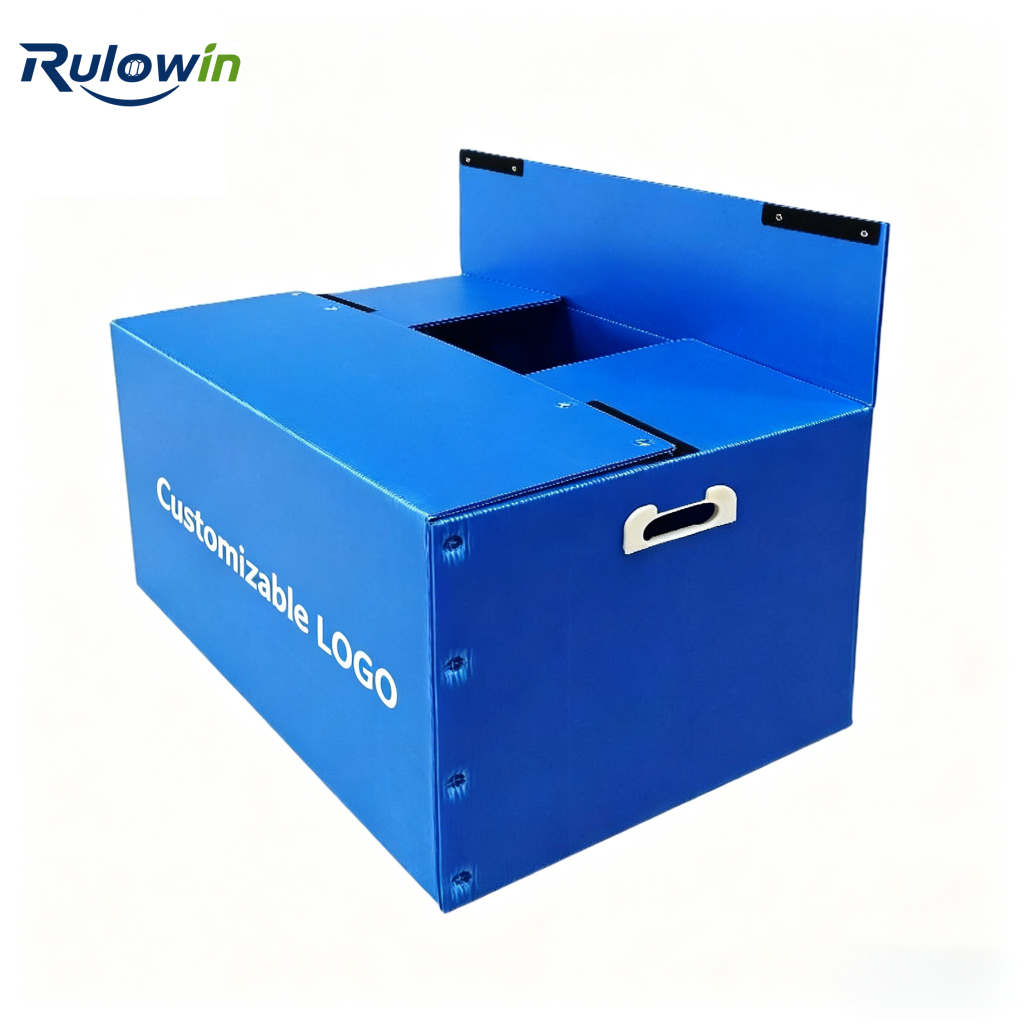
Two heights govern a returnable box system and they pull in opposite directions. Loaded stack height decides how many parts fit in a truck and how high a pallet can be double-stacked. Empty stack height decides what the return leg costs. A box that is excellent on the first can be hopeless on the second, and the specification that gets chosen is usually the one that was measured first.
Why loaded height is limited by the box, not the truck
A trailer has a fixed internal height and most loads run out of height long before they run out of weight. What limits the stack is whether the box below can carry the box above: a loaded PP corrugated box with a flat, supported base and a defined rim will stack reliably, but the height at which it stops being reliable depends on wall thickness, how the load sits inside and whether the boxes are interlocked. Interlocking – rotating alternate layers – raises the safe height materially and costs nothing.
Empty height is the return leg’s whole cost
Empties still occupy the vehicle. If a box nests, an empty stack is a fraction of a loaded one and the return leg is cheap. If it does not nest, a truck of empties is a truck of air, and on a long return leg that is the single largest operating cost in the scheme. This is why collapsible and nestable designs exist, and it is also why the return ratio gets quoted so heavily – see the same trade-off worked through for sleeve boxes on the return leg.
Nesting is not free
A box that nests has tapered walls, and tapered walls cost usable volume – the same outer footprint holds less because the base is smaller than the top. On a box carrying small dense parts that hardly matters. On a box carrying large light parts it is a real penalty on every outbound trip to buy a saving on the empty one. Do the trade honestly: nesting ratio times return frequency against volume lost times outbound frequency.
Stacking when the box is only part full
The worst case is a part-filled box with a heavy part in it, stacked on another part-filled box. The load path is no longer through the walls, it is through whatever the part happens to touch. Two mitigations: a lid that transfers load to the rim regardless of contents, or a rule that part-filled boxes are not stacked above two high. The second costs floor space and the first costs a lid, and most plants end up with both.
Getting the number from the supplier
Ask for two figures and the conditions: safe loaded stack height at a stated load per box, and empty stack height per ten boxes nested or stacked. Any supplier quoting a stack height without a load figure is quoting nothing. Then test it – stack them in your own store, at your own load, and leave them overnight, because creep over hours is what actually causes a stack to lean.
Test it in your own store, not on a data sheet
Supplier stack figures are generated under controlled conditions: boxes new, load evenly distributed, floor level, no vibration. Your stack will be none of those things. The test that matters takes an afternoon and costs nothing. Build a stack at your intended height with your actual load, in your own store, and leave it overnight.
Come back and look at three things. Whether the stack has leaned. Whether the bottom box has dished – sight along the base edge, because a few millimetres of dish is invisible from above and is the beginning of the end for that box. And whether the boxes separate when you break the stack down, which tells you whether the rim is locating or merely resting. Do it at the height you plan to use and at one layer more, so you know where the margin is. Every plant that does this once ends up specifying a different stack height than the one it started with, and every plant that skips it finds out during a busy week.
What we can do
We supply PP corrugated turnover boxes with stated loaded and empty stack heights for a given load, and we will tell you which of the two your route is actually constrained by. Send us the outbound and return legs and we will run both numbers rather than the flattering one.