
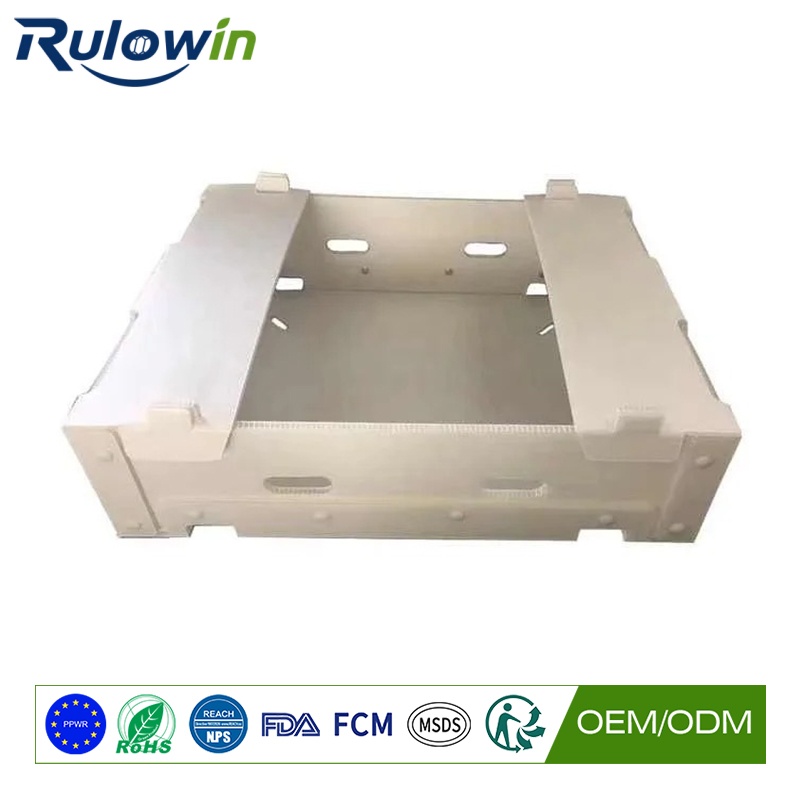
A crate fleet needs a retirement rule, and it needs to be one that a person can apply without stopping to think. Four checks – each taking a couple of seconds – sort crates into keep, downgrade and scrap, and they can be done while crates are being stacked.
Check one: rim
Run a hand along the rim and look for cracks, particularly at the corners and around the hand holes. A cracked rim will not carry a stack load properly and it is the failure that causes a load to settle. Cracks that are visible without flexing the crate mean scrap; hairline cracks that only open under pressure mean downgrade to non-stacked use.
Check two: base corners
Look at the four bottom corners from underneath. Cracks here are the most common serious failure, because the base corner takes the drop and the load. A crate with a cracked base corner can drop produce or fail under a stack, and it should come out of food service immediately.
Check three: base condition
Look at the inside of the base for thinning, polish and cracking – the wear pattern from abrasive crops. A base that has worn through is a contamination risk and will eventually fail. Also check the drain channels: if they are blocked solid with hardened debris and cannot be cleared, the crate will not drain and should not be used for wet produce.
Check four: flexibility
Press the wall. A crate in good condition resists and springs back. A crate that feels unusually stiff and brittle – or one that creaks rather than flexes – has been UV damaged and will crack under the next impact. Chalking on the surface is the visual version of the same signal, and both point to the same conclusion.
What downgrade means
A crate that is not fit for food contact or for stacking is still useful for storage, internal transport and non-food use. Downgrading rather than scrapping extends the value of the fleet substantially, and it is worth having a designated colour or a mark for downgraded crates so they do not drift back into produce work. The repair-versus-replace judgement is set out in repairing reusable produce boxes.
Where to apply the checks
At the point crates come back into the yard, and again at the start of the season. Doing it on return spreads the work across the season; doing it all at the start creates a bottleneck in the week before packing begins. Most operations do a quick check on return and a proper sort in the off-season.
Recording it
Count the scrapped and downgraded crates. That number is the fleet’s real wear rate, and it is the input to next season’s top-up order and to the business case. A fleet with no recorded attrition is a fleet where nobody is looking.
What to do with the downgrade pile
Downgraded crates are worth money if they stay useful and cost money if they clutter the yard. Give them a purpose – storage, internal transport, non-food handling – and a place, and mark them so they do not drift back into produce work. A crate with a cut corner or a painted stripe is recognisable at fifty metres, which is what stops the drift.
Where the downgrade pile grows faster than the uses for it, that is information about the fleet rather than about the yard. A rising downgrade rate usually means the wash regime, the handling or the specification has changed, and it is worth investigating before simply selling the pile on.
What we can do
We supply produce crates that fail visibly and gradually rather than suddenly, and we will quote replacement volumes against a measured attrition rate. Tell us your current scrappage and we will help size the fleet properly.