
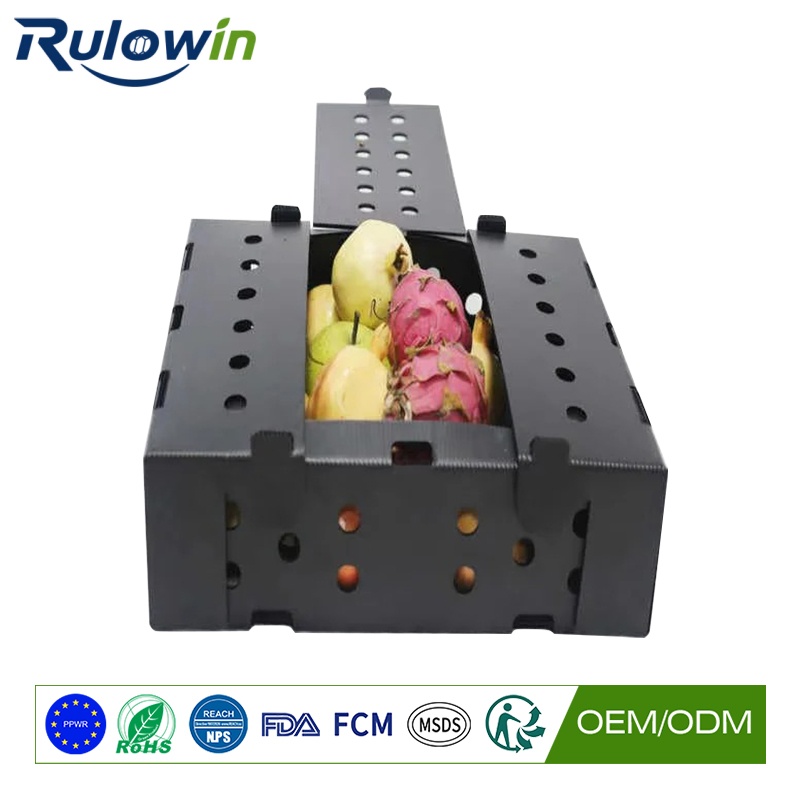
Visual inspection of a washed crate usually passes. The flat surfaces are clean, the crate looks fine, and it goes back into service. The problem is in the corners – the internal angles, the drain channel ends, the underside of a rim – where wash water does not reach properly and where organic residue survives a wash cycle.
Why corners survive a wash
A wash tunnel delivers water from fixed nozzles at a fixed angle. Anything in shadow from those nozzles gets less water and less mechanical action. Internal corners are the most common shadow, and the tighter the radius the worse it is. A crate with sharp internal angles will have residue in them after washing, and a crate with generous radii will not – which is a design question that gets decided years before anyone notices the consequence.
What the residue does
Two things. It feeds microbial growth, so a colony establishes in the corner and then contaminates whatever goes into the crate next. And it dries hard, becomes difficult to remove, and eventually requires manual cleaning or retirement of the crate. The first is a food safety issue, the second is a cost, and both start in the same place.
How to find it
ATP swabs on internal corners after the wash cycle will tell you in a minute, and they are the fastest way to find out whether the wash is reaching everywhere. Swabbing the flat wall as a control and the corner as the sample shows the difference immediately. If the corner reading is consistently higher than the wall, the crate design or the nozzle pattern needs attention, not the disinfectant.
Design that avoids it
Radiused internal corners, drain channels that are open at both ends rather than closed, and no unnecessary ribs or recesses. Those three features are what make a crate washable, and they are visible on a sample crate in about thirty seconds. Where a crate is being bought for a high-care crop, that inspection is worth doing before the order rather than after the first audit finding.
Drying is the second half
A crate that drains and dries does not support a colony; one that stays damp does. Corner residue and trapped water together are the combination that causes problems. Where crates are nested straight after washing they hold water in exactly the wrong places, which is why drying is treated separately in drying and storing produce boxes between uses.
What to do about an existing fleet
A fleet that already has sharp corners is not scrap. A pre-rinse that removes bulk debris before the wash, a nozzle check to see which areas are in shadow, and a periodic manual clean of the worst crates will manage it. Where the fleet is being replaced anyway, specify radii on the next order – it costs nothing and it removes the problem permanently.
Why the wash tunnel is not always the culprit
A tunnel commissioned for one crate design has a spray envelope sized for that crate. A taller or more heavily ribbed crate introduced later can sit partly outside it, and the parts outside the envelope never get properly washed. That presents as a crate cleaning problem and is a nozzle geometry problem.
Before changing detergent or temperature, stand at the wash outlet and look at where the water actually lands on the crate. The dry patches are visible during a cycle if someone watches. Repositioning two nozzles frequently solves a problem that months of chemical adjustment did not.
What we can do
We supply produce crates with radiused internal corners and open drain channels, designed so a fixed-nozzle wash reaches every surface. Ask for a sample and swab the corners yourself.