
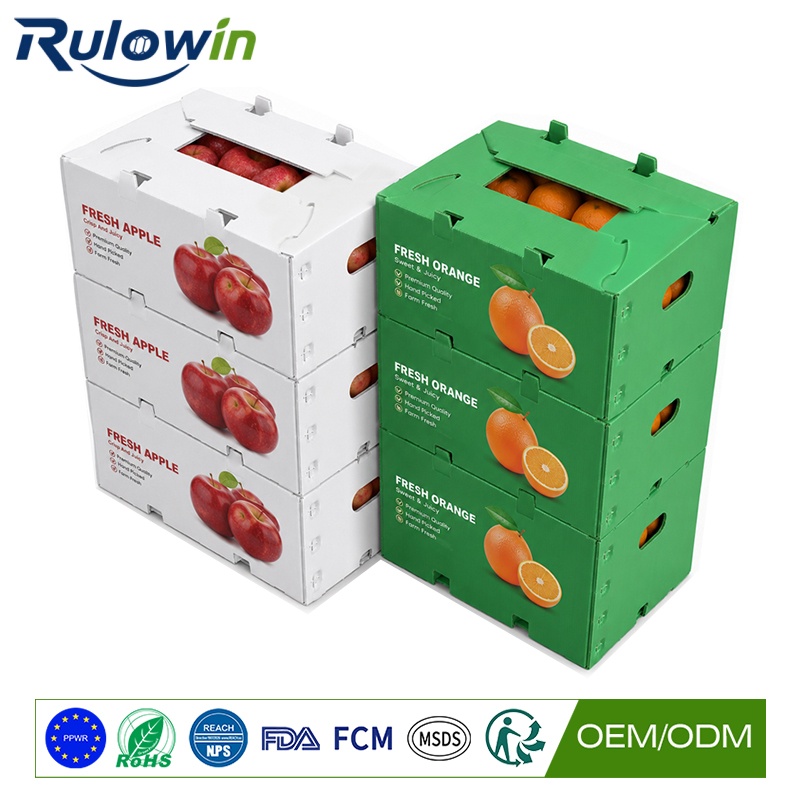
Corrugated board is a good material. It is cheap, it prints beautifully, it folds flat and it stacks well – while it stays dry. The trouble is that a produce packhouse is one of the wettest places a package ever goes, and everything that makes corrugated cheap is also what makes it fail there.
How fast the strength goes
Dry corrugated has a stacking strength that is predictable and easy to design around. Wet corrugated does not. Water breaks the hydrogen bonds holding the cellulose fibres together, and the fluting – the part doing the structural work – loses its shape first. On a typical single-wall carton, an hour of standing water at the base takes a large share of the stacking strength with it, and it does not come back when the carton dries.
What that looks like on the floor
It is not a dramatic collapse. It is the bottom layer of a pallet slowly bowing outward over a shift, so the pallet leans, so the pallet cannot be double-stacked, so the load has to be re-worked by hand. It is the carton that splits at the corner when a picker lifts it by the hand hole. It is the base going soft under a pallet of washed produce sitting in the staging area. Every one of those costs labour rather than material, which is why the carton still looks cheap on the purchase ledger.
Where the water comes from
Rarely from a hose aimed at the carton. Usually from four places: washed fruit going in wet, condensation on cold produce in a warm room, a wet floor in the staging area, and the wash-down at the end of the shift. A packhouse can be dry at the packing line and wet everywhere else, and the carton only has to meet water once.
The repair nobody prices
The usual response is to over-specify the carton – a heavier grade, a waxed or coated board, more plies. That works and it costs money, and it still leaves a one-trip package. The other common fix is a loose corrugated PP sheet on the pallet to spread the load over a soft base, which helps the pallet and does nothing for the carton itself. At some point on a packing line running every day, the honest comparison is not carton versus carton but one-trip versus many trips, which is the point at which reusable fruit boxes versus single-use cartons becomes the real question.
What to measure before you decide
Two numbers, both easy. Count the cartons re-worked in a week because a pallet leaned or a base failed – not the ones that failed outright, the ones somebody fixed. And weigh the carton waste for a week. The first number is labour, the second is disposal, and between them they are usually a larger figure than the carton invoice that got everyone’s attention.
Where cartons are still right
Dry packhouses, short seasons, export consignments where the carton is the retail unit and never comes back, and any crop where the box travels once and is unpacked at the far end into something else. We are not going to tell a grower packing for a fortnight that a crate fleet is the answer – it is not, and the arithmetic does not support it.
What we can do
We make returnable PP produce crates that hold their stacking strength wet, and we will run the comparison against your actual carton spend rather than a hypothetical one. Tell us the crop, the season length and how many trips a box currently makes, and we will tell you honestly whether the switch pays.