
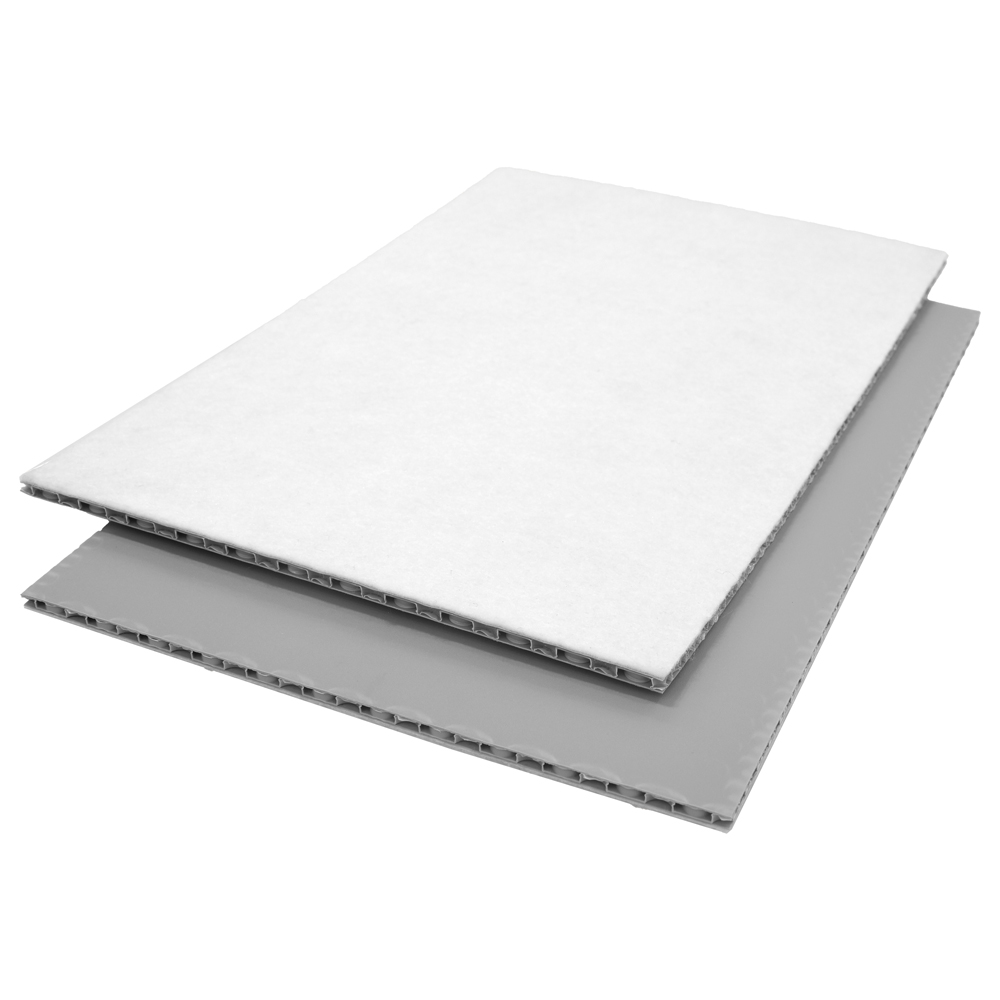
Most protection board is bought flat and cut on site. Some of it is worth buying fabricated: cut to a stair tread, shaped to wrap a nosing, formed into a cradle for finished material. It costs more per piece and it removes the slowest and most error-prone job on site.
What is worth fabricating
Repetitive shapes with a tight fit – stair treads, lift car floors, column notches – and anything where the shape does the protecting rather than the flat area: nosing profiles, edge trim, cradles, stillage pads. Those are the items where site cutting produces a poor fit and where the fit is what does the work.
What is not
Anything with an uncertain dimension, and anything that will be needed somewhere else later. A panel cut for one corridor is a panel that cannot be reused in another, and on a rolling programme that is a real cost. Cut flat stock and reuse it, or cut bespoke and accept it is single-location.
How it is made
CNC routing for accurate repeat shapes, die cutting for high volumes of one shape, and hot-air or hot-wedge welding for joints and edge sealing. Each suits a different quantity: routing for tens, dies for thousands, welding for anything that needs to be watertight at the edge.
Tooling and lead time
A die is a tooling cost and a lead time, and it is the critical path on a bespoke requirement. Start it early. Where the quantity is small, routing avoids the tooling entirely and is usually the better answer even at a higher unit cost.
What to send
A dimensioned drawing, or a template. A physical template of a stair tread is better than a measurement, because treads are rarely square and measurements rarely capture that. Where possible send the template.
What fabrication cannot fix
A shape cut accurately will still not fit if the opening is out of square, and a stair tread template taken from one tread will not fit its neighbours on an old flight. Templating several, or building in clearance, is worth the small extra effort. Fabrication is precise; the building usually is not, and the fit is where that gap shows up.
Cutting on site versus cutting at the factory
Every cut made on site produces an unsealed edge and an offcut. Cutting to order at the factory produces a sealed edge and shifts the waste off your site – which matters if you are paying for skip haulage or working to a waste target. The trade-off is lead time and the fact that you have to measure correctly the first time.
The practical split: order cut-to-size for the repetitive areas – corridors, lift lobbies, standard rooms – where one dimension repeats dozens of times, and cut on site only for the awkward obstructions. We hold drawings for repeat orders so a second phase can be produced without re-measuring. Panels that arrive oversize and get trimmed with a knife are the usual source of the curl you see at door thresholds, and the waste arithmetic is set out in cutting protection panels on site, waste and offcuts.
What we can do
We cut and fabricate PP protection board to drawing or template, including stair treads, nosing profiles and cradles, with welded edges where they need to be washed. Send us a drawing or a template and the quantity, and we will say whether routing or a die is the right route. Notching on site is covered in notching panels around columns and pipework.