
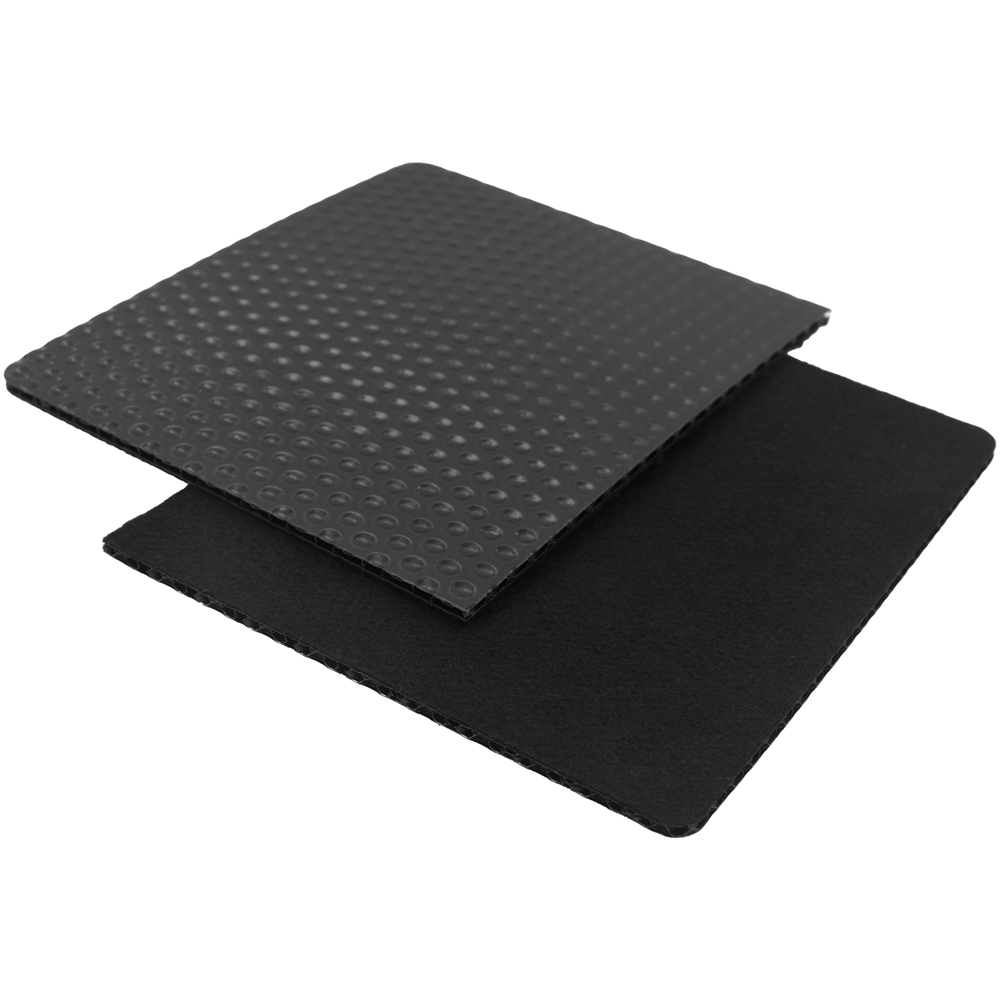
A framework agreement for protection board is worth setting up in one situation: when the same specification will be used repeatedly over a period. It is not worth it for a single job, and setting one up for a one-off purchase is administrative cost with no return.
What a framework fixes
Unit price for the period, lead time per call-off, and the specification itself. Those three are what vary between quotes and what cause friction on a programme. Fixing them means each subsequent phase is an instruction rather than a negotiation, and that saves more time than any discount.
When it is worth doing
Rolling programmes – hotel floors, store estates, school estates, phased office refits – where the same board is used across every phase. Also worth it where the specification has been approved by a client or an operator, because re-approving it each time is slower than the purchase itself.
What to watch
Price escalation clauses, minimum call-off quantities and the period. A framework with a minimum annual volume you cannot hit is worse than spot buying, and a price fixed for a period longer than the supplier can hold raw material costs is a price that will be renegotiated anyway.
What to put in it
Specification with grade and size, price and its validity, lead time per call-off, documentation to be supplied with each delivery, and what happens at the end – whether remaining stock is collected, credited or kept. The end-of-term clause is the one that gets forgotten and the one that causes the argument.
What it does not do
A framework does not guarantee availability if the supplier does not hold stock. Ask whether there is a held-stock commitment behind it. Without that, a framework is a price list with a delivery risk attached.
What to do when the specification changes
Agree how changes are handled at the start. A programme that switches from a foot-traffic route to a wheeled route mid-way needs a different board, and a framework that only covers the original grade becomes an obstacle. A short clause allowing an alternative grade to be called off at an agreed price difference is worth having and costs nothing to write.
What to fix, and what to leave open
A framework agreement works when it fixes the things that cause arguments and leaves the rest flexible. Fix the price basis, the panel specification, the lead time and the damage-claim process. Leave quantities open, because no contractor can predict how many square metres of protection a two-year programme will consume, and a committed volume you miss is worse than no commitment at all.
The clause that gets forgotten is the call-off mechanism. If every delivery needs a new purchase order and a new credit check, the framework saves nothing. Agree a single call-off contact and a maximum response time, then test it early with a small order before you rely on it during a busy phase. Where several sites draw from the same agreement, the stock model described in consignment stock for multi-project contractors usually matters more than the headline price.
What we can do
We supply PP honeycomb protection board under framework terms with held stock and agreed call-off lead times. Tell us the programme length, the number of phases and the likely annual volume, and we will set out terms that are worth having rather than a document for its own sake.