
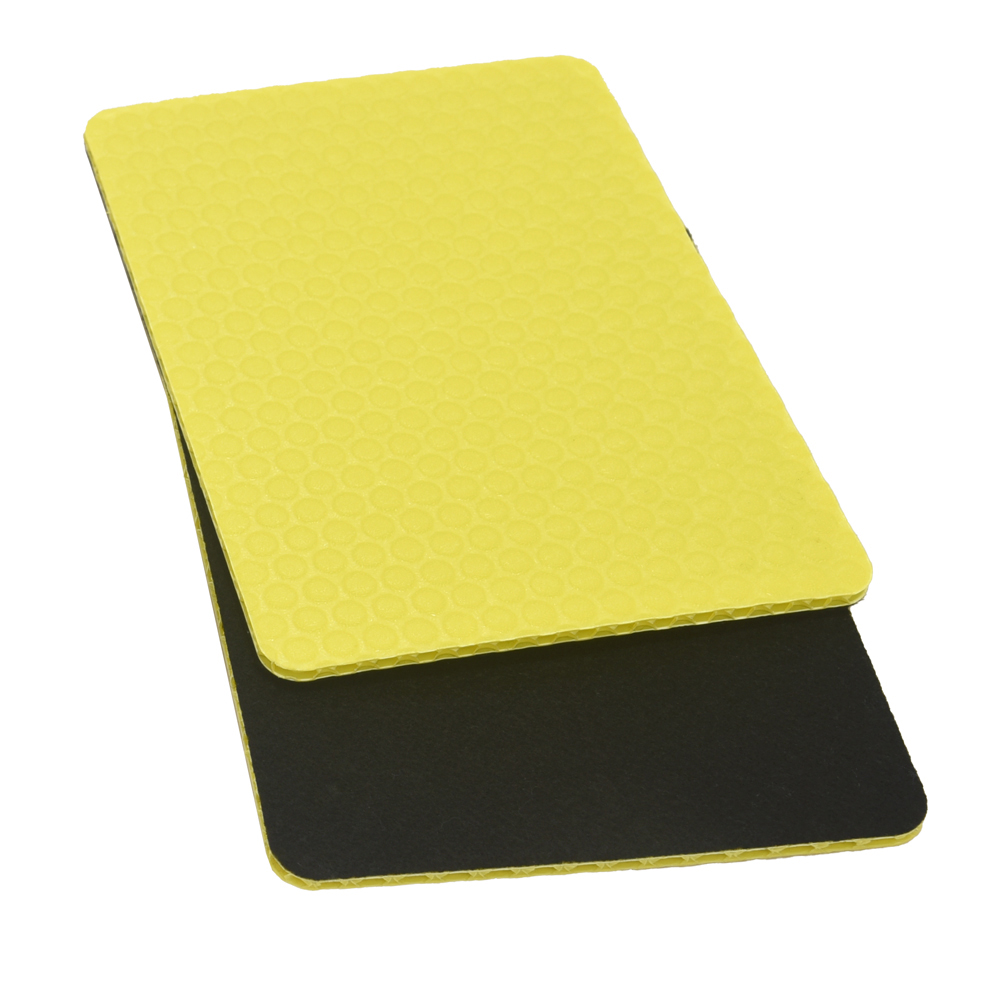
Foam and foam-backed underlay are cheap, light and easy to lay, and they are bought for floor protection far more often than they should be. The reason is simple: they feel like protection. The mechanism is wrong for almost everything a site floor actually experiences.
What foam does well
Cushioning. A soft closed-cell foam absorbs a light impact and protects a delicate surface from a knock, which is genuinely useful for transporting finished items and for protecting vertical surfaces. It is also light, quiet underfoot and cheap per square metre. Those are real advantages in the right application.
Why it fails on a site floor
Three reasons. It compresses under load, so a wheel or a foot still arrives at the floor with most of its pressure. It tears under anything dragged across it, and torn foam gets walked into the floor. And it holds water against the surface rather than draining, which is the failure mode that damages timber and stone. Cushioning is simply not the mechanism that protects a floor from traffic.
What board does instead
Spreads. A stiff board takes a concentrated load and distributes it over a much larger area of floor, which is what actually prevents dents and point-load damage. It does not cushion, and it does not need to. On a floor with wheeled traffic or standing loads, stiffness is the property that matters and foam has none.
Cost comparison
Foam is cheaper per square metre and much more expensive per week, because it is effectively single-use on a working floor. A reusable board costs more to buy and lasts across several phases. On anything longer than about three weeks the board is cheaper, and on anything with wheels it is cheaper from day one.
Where foam is still the right answer
Packing and transit protection for finished goods, short-term protection of vertical surfaces, and anywhere the requirement really is cushioning rather than load spreading. It is a good product used for the wrong job most of the time it is bought for floors.
The quiet exception
Foam is genuinely better than board in one place: under a finished item in transit, where cushioning is what is needed and load spreading is irrelevant. A piano, a stone worktop or a glass panel on a trolley is better off on foam than on a stiff board. The mistake is using that logic on a floor, where the load case is completely different – see why thin protection sheet does not stop dents.
Compression is why foam loses
Foam underlay is designed to sit under a floor covering and recover slowly. On a site it is asked to do the opposite: take repeated point loads from boots, trolley wheels and scaffold feet and spring back immediately. It does not. After a few days the traffic routes are visibly compressed into permanent channels, and once compressed the foam has no thickness left to protect anything.
The second problem is that foam is soft, so a load that would be spread across a panel’s cell structure is concentrated instead. A dropped tool on foam goes straight through to the floor beneath. PP honeycomb panel spreads that load over its cell walls and the panel usually survives with a dent of its own – which is the point of protection: damage the cheap thing, not the expensive one. Foam still has a place as a thin layer under panels on a very delicate surface, but on its own it is not protection against impact. The thickness question is set out in why thin protection sheet does not stop dents.
What we can do
We supply PP honeycomb protection board and will say honestly when a cheaper product would do – including foam, where the requirement is genuinely cushioning. Tell us the floor and the load, and we will tell you which mechanism applies.