
A museum or gallery refit involves moving collections, installing cases and re-laying floors, often in buildings where the floor is part of the listed fabric. The constraint that dominates is not load or traffic – it is that nothing may leave a residue, an odour or a mark on surfaces that cannot be replaced.
Chemical inertness first
Anything that touches a historic floor, a case interior or a collection storage area has to be chemically inert and low-emitting. Some polymer products plasticise and leave a mark, and some adhesives off-gas into closed cases. Polypropylene is stable and low-odour, which is why it is specified here, but the adhesive used to fix or joint it is the part that needs checking, not the board.
Soft contact on historic surfaces
Original stone, marble, parquet and encaustic tile all mark from hard contact under load, and all of them are effectively irreplaceable. A fibrous face against those surfaces, held with friction rather than fixed, is the standard approach. Nothing gets taped to a historic floor; everything is laid and weighted or butted.
Moving collections
The highest-risk operation is moving objects and cases. Cases are heavy and often on small feet or castors, and the route crosses finished floors. Load-spreading boards along the route, with ramped transitions at thresholds, is the whole requirement – and it needs planning with the registrar rather than being worked out on the day.
Procurement reality
Museum projects are usually small in area and large in specification effort. The order is modest and the documentation is not, which means the supplier’s ability to provide inertness and emissions information matters more than the price per sheet. Ask for it early; it is the slowest part of the process.
Where less will do
In stores, workshops and back-of-house corridors with modern floors, standard board is fine and the heritage specification is wasted. Museums overspend here by applying the gallery standard to the whole building.
Case interiors and storage
Protection inside a display case or in a collection store is a different question again: low emissions, inert, and no transfer to objects. Polypropylene is a safe choice but the adhesive on any tape used with it is not, and neither is the print on a branded board. Where anything goes inside a case, ask for the emissions and inertness information specifically rather than relying on a general compliance statement.
Protecting surfaces you cannot replace
In a museum or a listed gallery the floor is often the reason the building is listed. A damaged stone or parquet surface cannot be matched, and the cost of repair has no upper limit because it is a conservation job rather than a flooring job. That changes the specification: the protection has to be non-marking, chemically inert against the finish, and removable without residue.
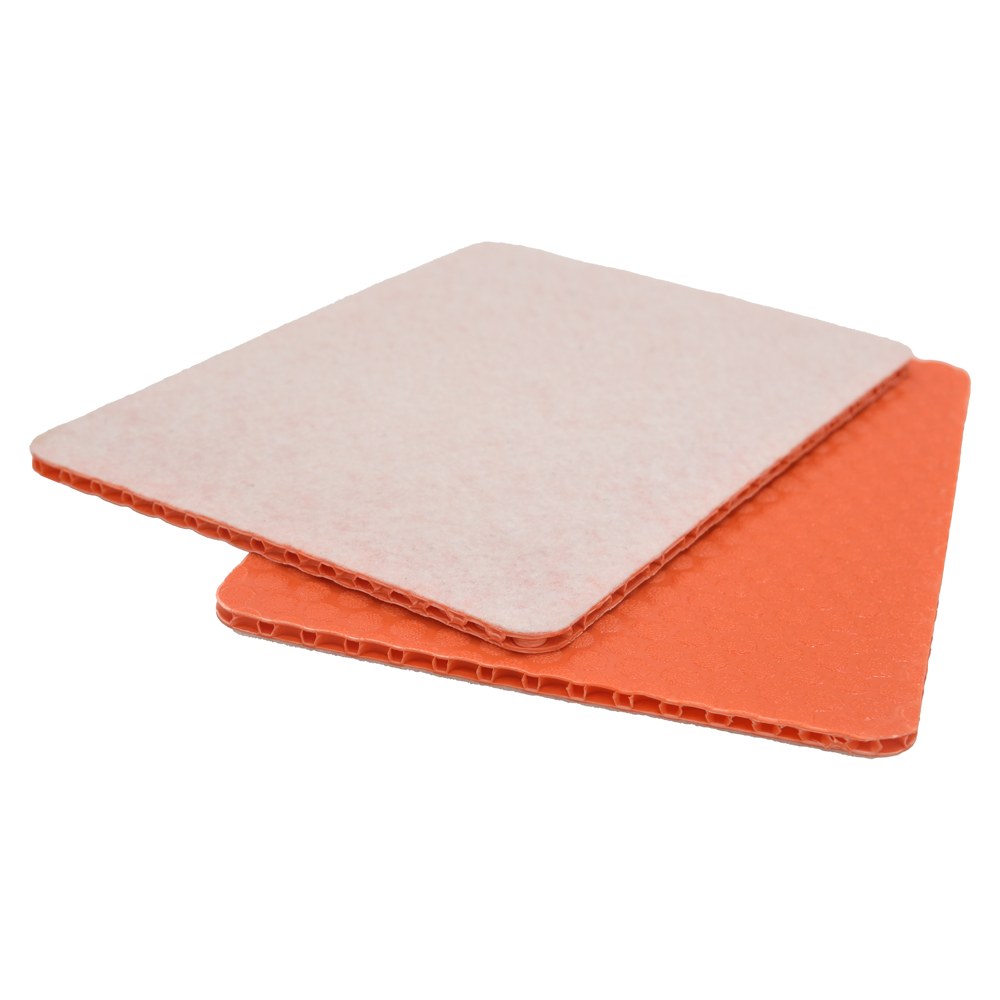
The felt face matters here. A plain sheet against a polished surface can polish-mark it over time through vibration and foot traffic; a felt face separates the two. Adhesive is the second risk – nothing should be stuck directly to a historic surface. Hold panels with perimeter tape onto a sacrificial border, or weight them at the edges. Moisture is the third: stone needs to breathe, so do not seal a historic floor under an impermeable membrane for months. The same caution applies to protecting glazed facades and shopfronts during fit-out, where the surface is equally irreplaceable.
What we can do
We supply PP honeycomb protection board with a fibrous face for historic surfaces, and can advise on fixing methods that leave nothing behind. Tell us what the floor is, what is being moved and whether the building is listed, and we will specify accordingly. Residue risk is discussed in tape, adhesive and staining on finished floors.