
Rail estate work has a specific shape: short possessions, usually at night, on floors that are frequently heritage finishes, under an operator’s standards that are stricter than building regulations. Protection has to be installed and removed inside a possession, and it has to be documented before it is allowed on the network.
Possessions set everything
A possession might be four hours. Protection that takes a shift to lay is not usable, which rules out anything cut to fit on site and anything that needs fixing into the floor. What works is a stock size laid loose with tapered edges, carried in and out by two people, in a quantity that matches what can realistically be laid in the window.
Heritage finishes
Station concourses often have stone, terrazzo or tile that is listed or simply irreplaceable. That raises the cost of any damage well above the cost of protection, and it usually means soft-face contact plus chemical protection – stone etches from alkaline slurry, and nothing fixes that on site. Where there is listed fabric, expect the operator to require a method statement before anything is laid.
Fire and slip documentation
Network standards typically require a fire test report and a wet slip test result for anything left in a public area, and both have to be for the actual product rather than for a generic material. Ask for them with the quote rather than after the order. This is the item that most often delays rail work, and it is entirely avoidable.
What to order
One size, one grade, held as a fleet by the contractor rather than bought per job. Rail estate work repeats across stations and years, so the reusable board pays back quickly and the consistency makes the documentation simpler – one submission covers the fleet rather than one per delivery.
Where protection is not needed
On platform surfaces that are being replaced, in staff areas with a service floor, and anywhere the possession is long enough that the works themselves are the only risk. Over-protecting a station is a real cost and it slows the possession down, which is the thing that actually matters.
Weight and what two people can carry
In a four-hour possession everything is carried by hand. A board that weighs eight kilograms is a one-person carry and a board that weighs twenty-five is not, and that difference determines how much can be laid in the window. On rail work, weight per sheet is a more useful specification than thickness, and it is worth asking for explicitly.
Night possessions and public safety
Station work happens in short overnight possessions with the public walking through the same space hours later. Protection has to be laid, used and removed inside a shift, and whatever is left behind has to be safe for a commuter in a hurry at six in the morning. That rules out anything that needs a curing time, anything that leaves a residue, and anything with a raised edge.
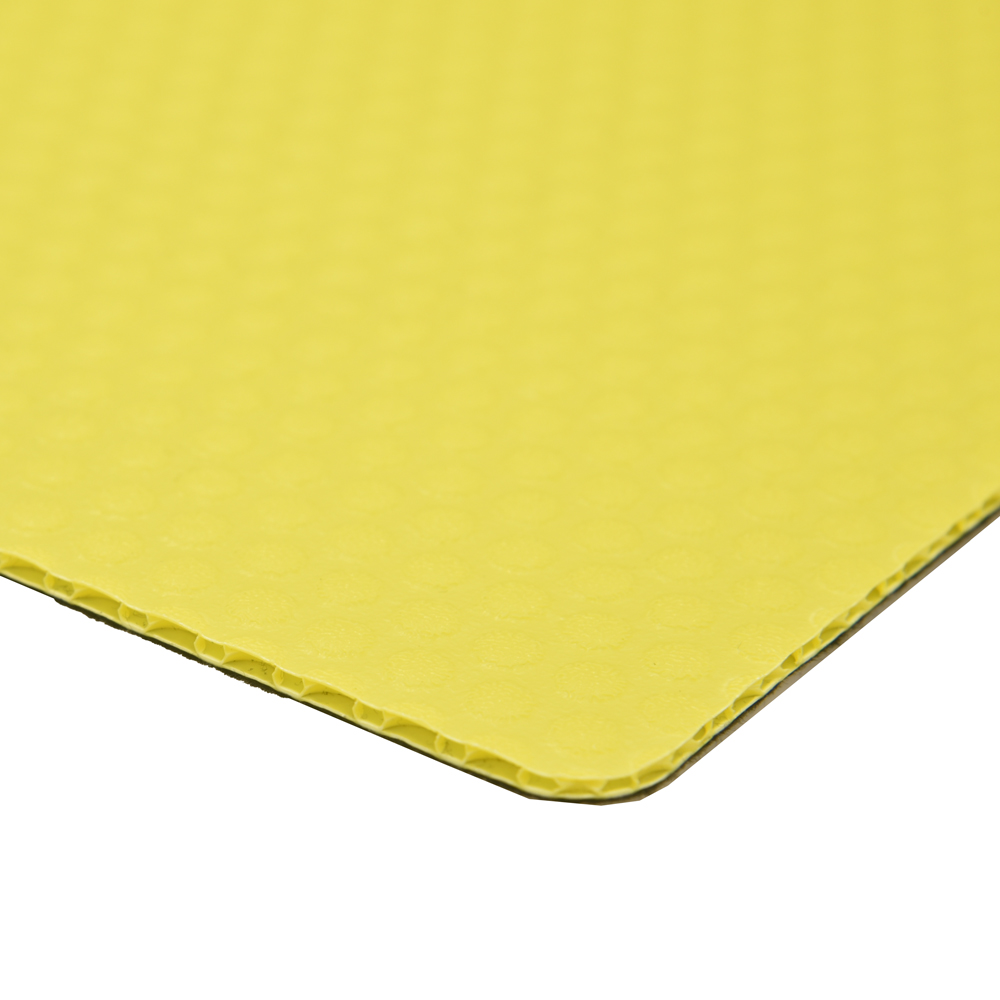
Panels need to be light enough for a small gang to move quickly and stiff enough to bridge a joint or a drain cover without flexing under a trolley. Anti-slip matters here more than anywhere, because station entrances get wet and a smooth sheet over a polished concourse is a genuine slip risk. The felt face down is the usual choice on stone and terrazzo; the studded face down where water is being carried in from outside. The public-safety phasing is described in phasing protection across a live building.
What we can do
We supply PP honeycomb protection board in a single stock size suited to rapid laying, with the fire and slip documentation needed for network submissions. Tell us the possession length and the floor finish, and we will size the fleet. Slip testing is explained in slip resistance testing on protection panels.