
Decorating is the phase when most finished floors are already down and most of the remaining trades are still working, so it is where protection earns or loses its money. Paint itself is rarely the problem – it is the things that come with painting: dust from filling and sanding, drips that travel, and ladder and trestle feet.
What paint actually does to a floor
An emulsion spill wipes off a hard floor while it is wet and comes off most floors with the right solvent once dry. A gloss or oil-based spill is harder and can leave a permanent shadow on porous stone and unsealed wood. None of that is catastrophic, which is why decorators are relaxed about it – but a spill that dries overnight and is walked on becomes a ground-in mark, and that is a different matter.
Filling dust is the abrasive
Filler and plaster dust from sanding is fine, hard and gets everywhere. It is the same mechanism as site grit: harder than most finishes, carried on boots, ground in by traffic. The difference is that it is generated inside the room being decorated, so it lands on the floor in the protected area rather than arriving from outside. A cover that holds dust rather than dragging it is the requirement, and it needs cleaning during the job, not after.
Ladder and trestle feet
A decorator’s ladder carries a person and leans, which means one foot takes a concentrated load at an angle. On a hard floor that is fine; on timber, vinyl or a young screed it dents. Load-spreading feet under the ladder are cheaper and more reliable than trying to protect the floor against them, and they are the item that should be in the decorator’s kit rather than in the protection order.
Drips travel downhill
Paint runs down a wall, along a skirting and under the edge of whatever is protecting the floor. A cover that stops 100 mm short of the wall leaves the strip where every drip lands unprotected. Extend the cover up the skirting or mask the junction, and check where the drips actually end up rather than where they start.
Where a drop sheet genuinely is enough
For a straight emulsion job in a room with a hard, already-marked floor, a cotton or plastic drop sheet is adequate and a reusable panel is wasted. The panel earns its keep where the floor is new or soft, where the job runs for weeks, or where there is traffic rather than just one person working in one room. Ask which it is before ordering.
Solvent-based paint and what it does to covers
Oil-based and solvent products attack some polymer covers, softening the face or bonding to it. Where solvent paint is being used, the cover needs to be polypropylene rather than a soft vinyl or a foam-backed product, and spills need wiping rather than leaving. A cover that has gone soft under a spill is no longer protecting anything and it will mark the floor when it is lifted.
What we can do
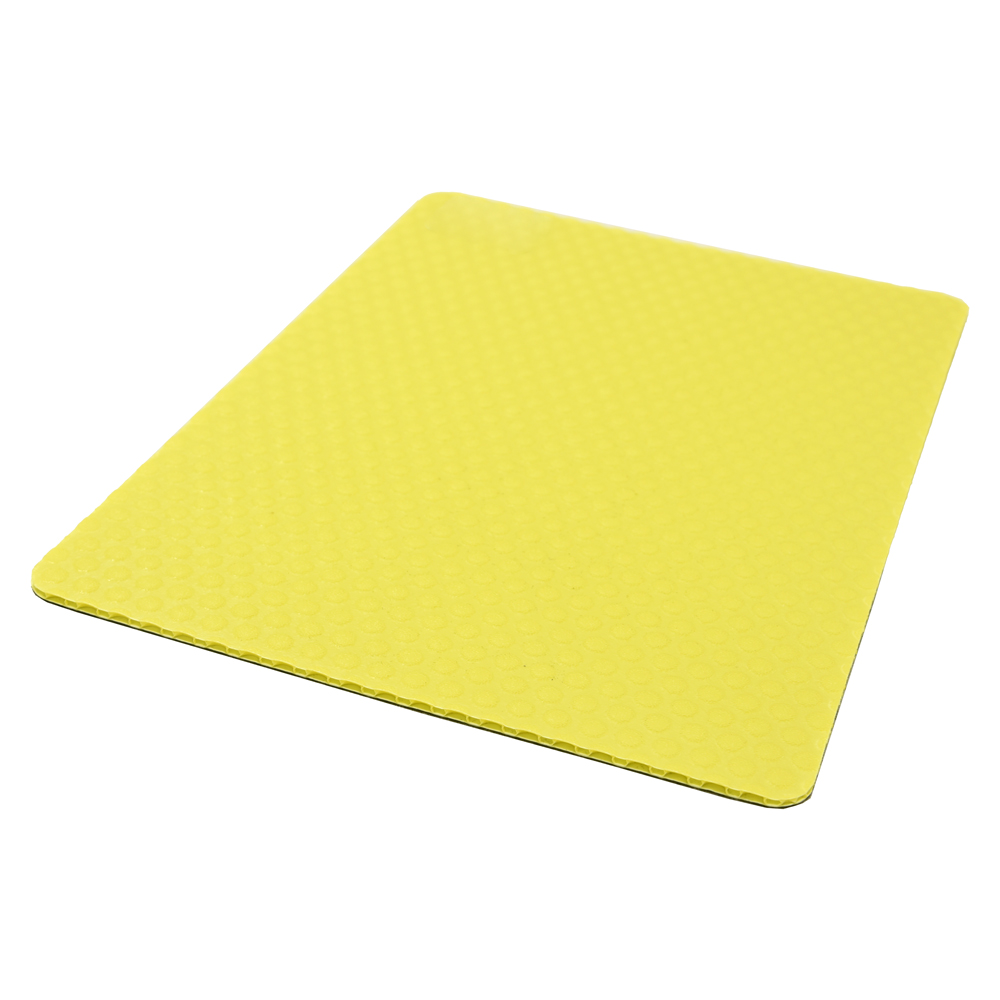
We supply honeycomb protection panels that hold dust instead of dragging it, and can cut them to run up to the skirting line. Tell us what the floor is and how long the decorating runs, and we will say whether a panel, a sheet or a drop cloth is the right answer. Dust and grit behaviour is explained in site grit is what scratches floors, not boots.