
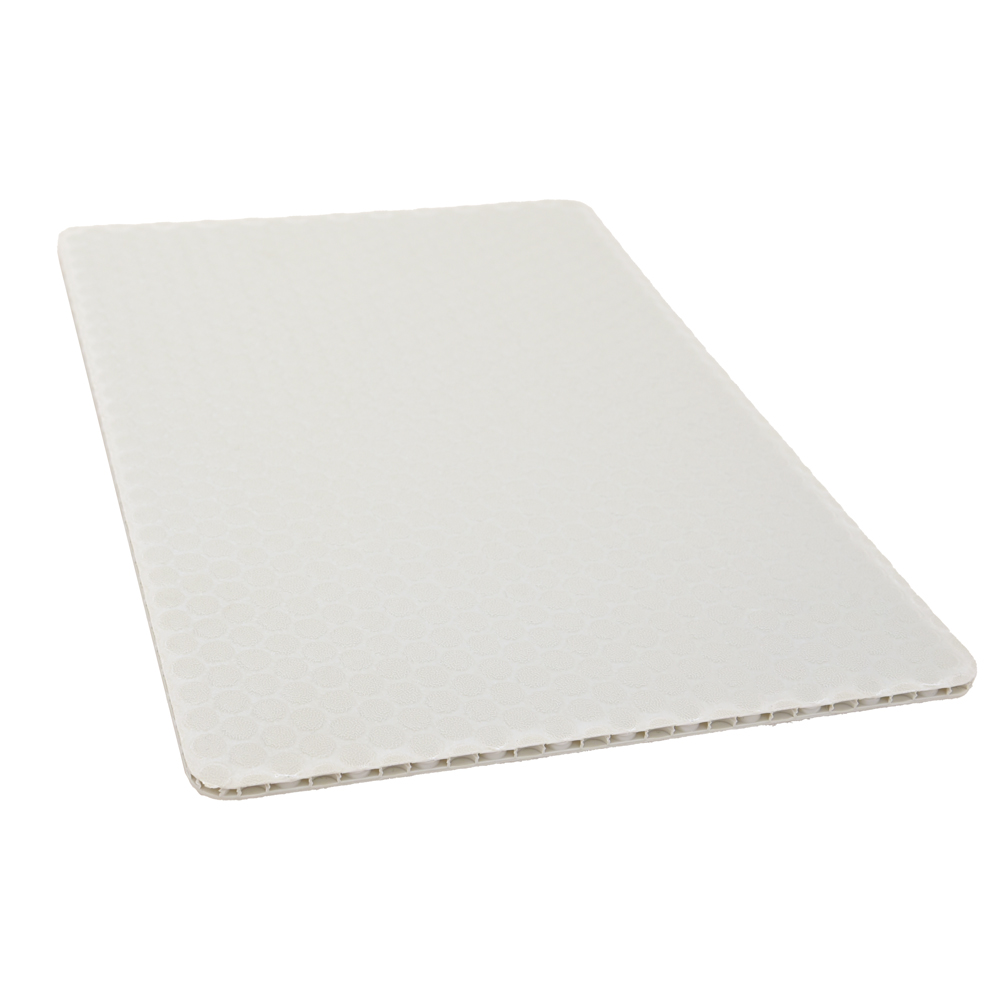
A renovation in an occupied house is the hardest environment for floor protection. There is no site rule that sticks, the route through the house changes as rooms come in and out of use, and the floor has to be walked on by people in socks every evening and by people in boots every morning. Protection that works on a commercial site often fails here for reasons that are about living rather than building.
Why commercial site protection does not translate
On a commercial site the protection is laid once and the route is fixed. In an occupied house it gets lifted, walked around, moved for a delivery, and put back slightly wrong. Anything that depends on being laid correctly and left alone is a poor fit. What works is protection that can be lifted and put back without damage, and that is obvious enough to put back the right way up.
The two-face problem in a domestic setting
A panel with a soft face and a grip face only works if it goes down the right way. In an occupied house, where whoever is passing puts it back, that is not guaranteed. The practical answer is faces in different colours so orientation is obvious at a glance – it costs nothing at manufacture and it removes the most common failure in this setting.
Routes change as the job moves
The path from the door to the kitchen in week one is not the path in week four. Protection gets moved and the unprotected areas shift, which means the risk moves too. Keeping a stock of half-size panels makes it possible to re-lay a route in a few minutes rather than cutting sheet each time, and it is the single cheapest thing to have on this kind of job.
Evening and weekend traffic
The household walks on the protection in the evening, often in socks or bare feet, and children run on it. That means trip edges matter more than on a site, and a raised panel edge that a boot would step over is something a child will catch. Tight joints and a tapered edge at any change of level are worth insisting on here in a way they are not on a commercial job.
What genuinely does not need protecting
Be honest with the household: rooms that are not part of the works do not need covering, and covering the whole house is a lot of product and a lot of daily hassle for no benefit. Protect the route and the rooms being worked in, and leave the rest. That is a smaller order and it is far more likely to be used properly.
Pets, children and the cover as a toy
Dogs skid on a smooth cover and children lift corners. Neither is a reason to avoid protection, but both are reasons to pick a cover with a fibrous top face and to fix the perimeter rather than leaving it loose. A loose corner in a house with a dog gets lifted within a day, and everything under it is then exposed.
What we can do
We supply PP honeycomb protection panels in half and full sizes with visually distinct faces, which suits occupied domestic work better than a single large sheet. Tell us the route and which rooms are in scope, and we will size the order to that rather than to the floor area. Face orientation is explained in which face goes down on finished floors.