
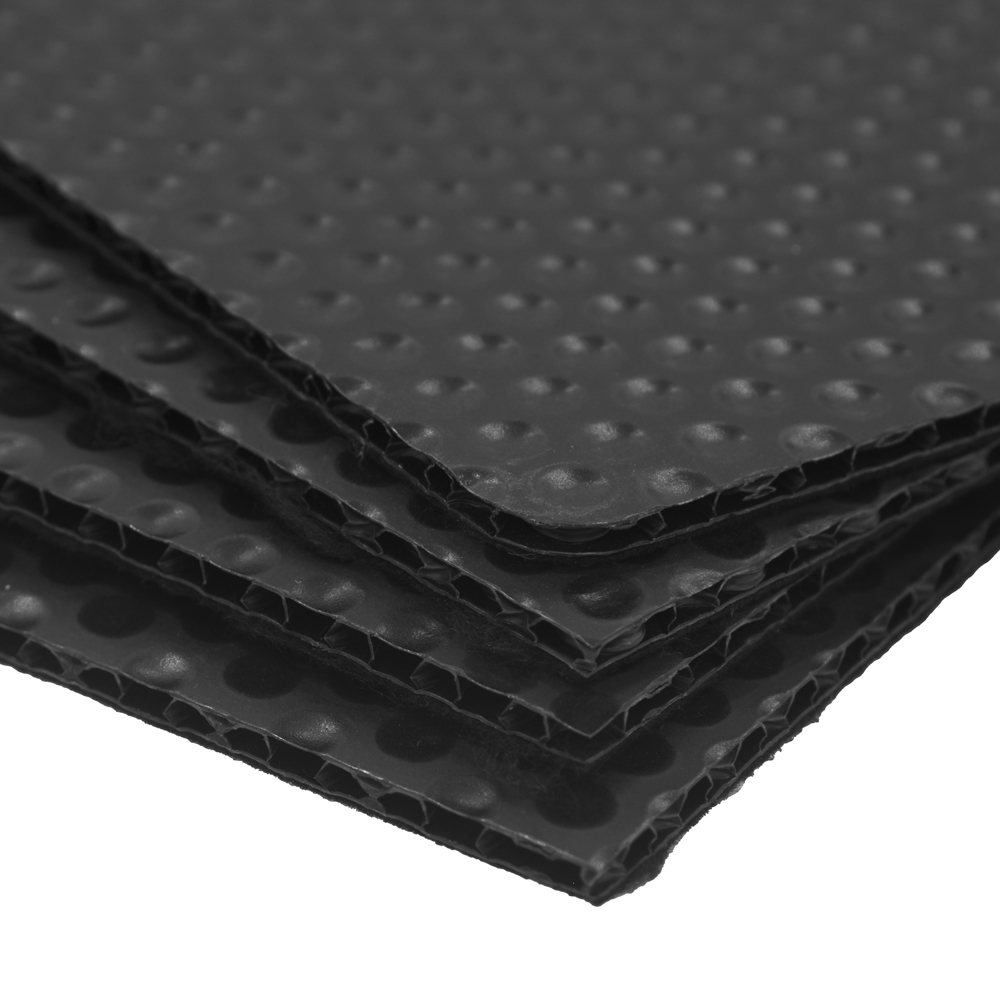
The two common ways to protect glazing and polished metal during a fit-out are shrink wrap and a soft-faced panel. They look like they do the same job, and they fail in completely different ways. Choosing between them is mostly a question of what happens to the water and the heat that get behind the cover.
What shrink wrap does well
It conforms to any shape, it is fast, it is cheap, and it keeps dust out completely. For a complex item – a balustrade, an assembled frame, anything with curves – nothing else fits as well for the money. It is also the only sensible answer where the item is being stored outside for a defined short period in dry weather.
What it does badly
It is a sealed film. Water that gets behind it has nowhere to go, and against glass in direct sun that produces a greenhouse: the temperature between film and glass rises well above ambient, and the combination of heat and trapped moisture etches some glass coatings and stains some metal finishes permanently. Low-emissivity coatings and anodised aluminium are the two that suffer most. It also holds any condensation produced by a building drying out, which is the situation on almost every fit-out in the first weeks.
What a felt-faced panel does instead
It stands off, it breathes, and the face against the surface is fibrous rather than film. Air moves behind it, so moisture does not sit and heat does not build. It is more expensive per square metre and much slower to fit on a complex shape. On a flat run of glazing – a shopfront, a curtain wall at ground level, a run of internal screens – the panel is usually the better answer and the shrink wrap is the risk.
The middle option
Where a panel will not fit and wrap is the only option, the mitigation is to stop it being a sealed system: leave a drainage gap at the bottom, do not seal the top edge, and check behind it weekly. A wrapped item that is inspected is far safer than one that is fitted and forgotten. Most wrap damage happens on items nobody looked at for two months.
Scratch risk is different too
Wrap protects well against a light knock and badly against abrasion, because any grit trapped between film and surface is held in contact and rubs with every movement of the film. A felt face holds grit away from the surface instead. On a site with cutting or grinding happening nearby, that difference is the whole story.
Duration is the deciding variable
Under about three weeks in dry conditions, either works and wrap is cheaper. Beyond that, or in a building that is drying out, or in direct sun, the vented rigid cover wins. We would rather quote the panel and explain why than quote wrap and take the call at handover. The glazing-specific detail is set out in protecting glazed facades and shopfronts during fit-out.
A cost comparison that is actually fair
Wrap is cheaper per square metre and slower to remove, and removal is where the cost hides – cutting it off without scratching the surface takes longer than putting it on. Panels cost more to buy and take minutes to lift and stack, and they can be reused. On a programme with more than one phase the comparison usually reverses in favour of panels; on a single short phase it does not, and we will say which applies.
What we can do
We supply felt-faced honeycomb panels for flat glazing and polished metal, cut to size with a standoff detail so air moves behind them. Tell us what the surface is, whether it is coated, and how long it stays covered, and we will say whether a vented panel or a wrap is the right call.