
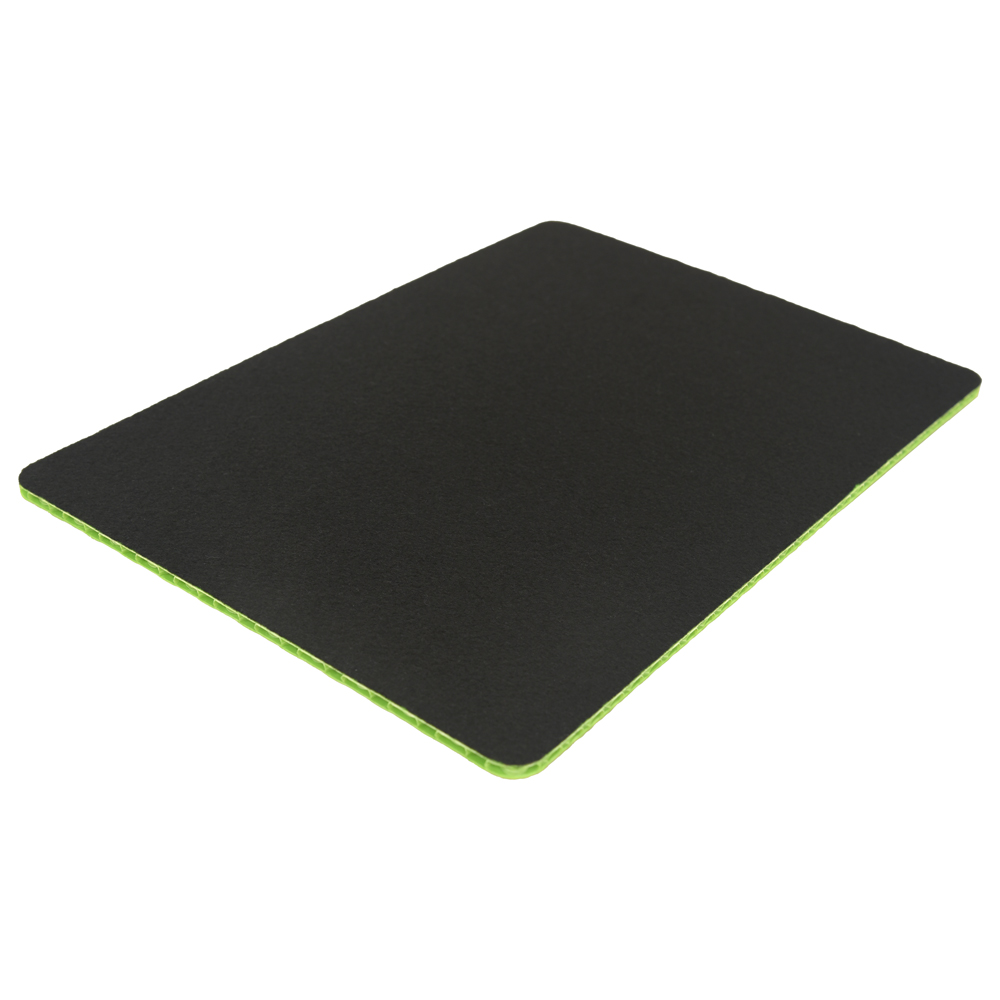
Impact protection and standing-load protection are not the same product requirement, and confusing them is why some floors get marked under scaffold even though the panels looked substantial. A scaffold leg carries a few hundred kilograms through a base plate or a timber sole pad the size of a coaster, and it does that continuously for weeks. Nothing about that event is about energy absorption. It is about pressure.
Pressure is the whole problem
Take 300 kg through a 100 mm square pad and the floor sees roughly 300 kilopascals before any protection is involved. Most finished floors will carry that for a day and creep under it for a month. Vinyl and timber are the two that show it first, usually as a shallow dish that is only visible in raking light at handover. The protection panel cannot remove the load; all it can do is spread it.
What spreading actually achieves
A stiff panel spreads load at an angle through its thickness. The stiffer the panel and the thicker the core, the wider the footprint by the time the load reaches the floor. Spread 300 kg over four or five times the pad area and the pressure drops below what the finish takes permanently. That is the entire mechanism, and it is why a panel that is stiff in bending outperforms a thicker panel that is soft – the soft one just dents locally and passes the pad shape straight through.
The places this goes wrong
Three of them. Over a panel joint, where the load is on one panel edge and the adjacent panel is not sharing it. Over a void – a service void, a raised floor void, a gap under a threshold – where the panel is bending in the air rather than being supported. And on panels laid over a hard inclusion, which converts a spread load back into a point load. Sole boards help enormously, and the cheapest fix on most sites is a wider sole board rather than a thicker panel.
Creep, and why it matters at handover
Continuous load on a polymer panel produces slow deformation, and a panel sitting under a scaffold leg for eight weeks will show a shallow permanent dish that does not recover. It is not damage to the floor underneath if the load was spread properly, but it does mark the panel, and a dished panel then rocks under foot traffic and becomes a trip complaint. Rotating panels under fixed loads at phase boundaries is a cheap way to avoid it; the load behaviour is set out in more detail in honeycomb panels under heavy point loads.
Checking before the scaffold comes down
Walk the scaffold line the week before strike and look for visible dishing in the panels and for any panel that has split at the skin. Both are cheap to deal with while the scaffold is still standing and are a re-laying or a panel swap at that point. Once the scaffold is down and the client is walking the floor with a snagging list, the same condition becomes a floor repair.
What we can do
We make PP honeycomb panels with the core density and skin thickness specified for standing loads rather than for impact, which are not the same order. Tell us the leg loads, the pad size and how long they will stand, and we will confirm whether the spread is adequate – including telling you when a wider sole board is the cheaper answer.