
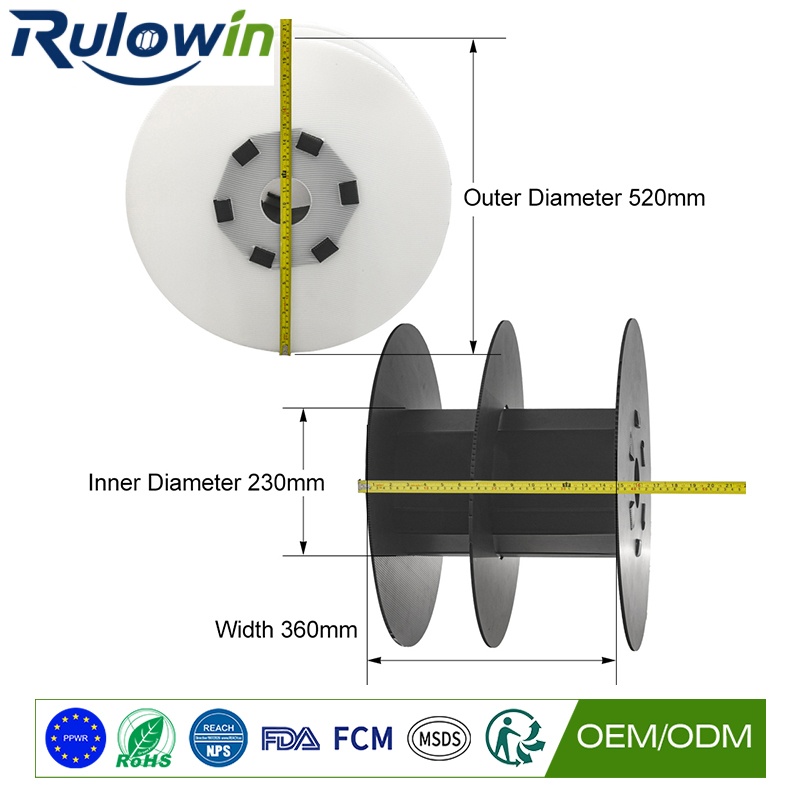
Of all the dimensions on a cable reel, the bore is the one that decides whether the reel can be used. Flange diameter affects capacity, traverse affects length, but a bore that does not fit the stand means the reel is unusable – and it is the dimension most often ordered without checking.
Why it goes wrong
Buyers order to a nominal bore size from a catalogue and the stand takes something slightly different. A couple of millimetres is enough to make a reel bind on the arbor or wobble on it, and neither is acceptable at payout speed.
The second cause is that stands vary. The same nominal size from two manufacturers is not necessarily the same arbor diameter, and shops with several stands of different ages frequently have more than one size in use.
What to measure
The stand arbor, with a caliper, not the reel. Then the bore of a reel you know works. The difference between them is the clearance your equipment actually needs.
Measure the oldest stand in the shop as well as the newest, because they are often different and the old one is the one that will be used on the awkward job.
What to ask a supplier for
The bore with a tolerance, not a nominal size. A nominal bore with no tolerance is not a specification – there is nothing to check the delivery against and nothing to argue from if the reels bind.
Then ask whether the bore is moulded to size or machined. Machined bores hold a tighter tolerance and cost more; for high-speed payout it is often worth it.
Adapters and reducers
A sleeve that reduces a large bore to fit a smaller arbor is a common and legitimate fix, and it is cheaper than buying reels in two bore sizes. What it does is add a part that can be lost, and it introduces a little runout – fine at low speed, less fine at high speed.
What happens when it is wrong
Too tight and the reel binds, the hub takes the load, and hubs crack. Too loose and the reel wobbles, the cable pays out unevenly, and the bore wears oval. Both are worth avoiding and both are caused by the same oversight.
Whether reels fit standard stands generally is covered in do plastic reels fit metal payout stands, and the dimensional vocabulary in reel terms: hub, flange and bore explained.
Sizes that exist, and mixed fleets
There are a handful of bore sizes in common use and most suppliers stock them, so the first question is whether yours is one of them rather than whether a custom bore is needed. Custom bores are available and they cost more for no benefit if a standard one fits.
If your shop has mixed stands, standardise on one bore and use adapters on the odd stand. Two bore sizes in one store is a source of errors – the wrong reel on the wrong stand, forced, and a cracked hub.
What we can do
We supply cable reels for production lines and will confirm the bore against your drawing before any order. Send us the arbor dimension – we will tell you whether our standard bore fits, and say so plainly when it does not.