
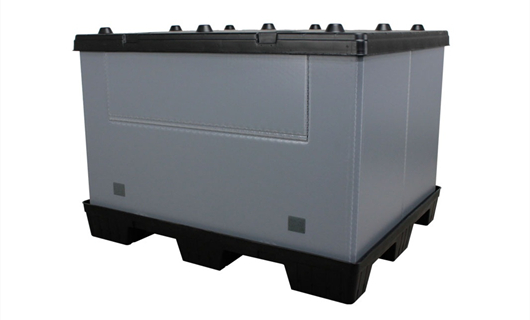
A sleeve box on a road journey is subject to braking, cornering and a certain amount of vibration, and the strapping is what holds it together through that. Most strapping problems are not about how many straps are used but about tension and about where the strap bears.
Where the strap goes
Over the lid, across the box, pulling down onto the base. That is the arrangement that holds the assembly together – it clamps the lid, the sleeve and the base into one unit.
A strap around the sleeve only, without crossing the lid, does nothing to hold the lid on. If a lid has come off in transit, that is usually why.
Tension
The most common fault by a distance. An under-tensioned strap looks correct and does nothing – it goes slack the moment the load settles, which happens within the first few kilometres.
Over-tension is the opposite problem and it damages the box: it crushes the lid at the strap line and, on a tall box, pulls the walls in. The right tension is firm enough that the lid cannot lift and no more.
Edge protection
Where a strap turns a corner, it concentrates force on a line. On a plastic box that line wears, and eventually the strap cuts in. A corner protector – even a piece of offcut panel – spreads it and costs almost nothing.
Can you strap directly over the panel, and what happens, is covered in can you strap over a honeycomb panel.
How many straps
One, for most boxes. The reasoning and the exceptions are set out in does a pallet sleeve lid need its own strap, and the short version is that a second strap is usually solving a lid stiffness problem rather than a strap problem.
What to check before it leaves
Press down on the lid at each corner. If it lifts anywhere, the tension is wrong or the lid is not seated. Then look at the strap line – it should be straight across the lid, not angled off a corner.
And check the base is properly located on the pallet. A box that is not seated on its base will shift no matter how well it is strapped.
What happens on arrival
Note whether the strap was still tight. A strap that arrives slack tells you the load settled, which means either the contents compacted or the strap was never tensioned properly. Both are worth knowing before the next load.
Strap material and tension loss
PET strap is the usual choice and it holds tension better than PP strap over a long journey. Steel strap holds better still and it cuts into plastic edges faster, so it wants corner protection without exception.
All straps lose some tension as the load settles. The useful check is what the tension looks like on arrival rather than at loading – if it arrives slack every time, either tension it more or add a re-tension point.
And the check on arrival
Note whether the box is still square. A box that has gone out of square in transit has been strapped unevenly or has taken a side load, and both are worth knowing before the next one goes out.
What we can do
We supply reusable pallet sleeve containers and will tell you what lid stiffness and strap arrangement suits your load. Describe what you ship and how it is strapped – we will tell you if one strap is enough, which it usually is.