
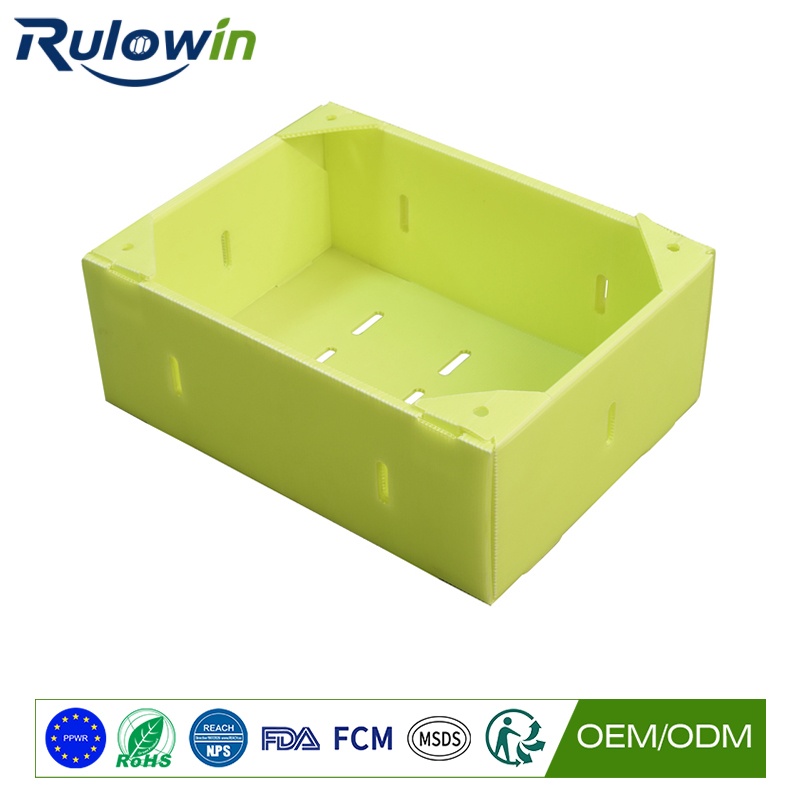
Vented produce crates get bought for food and end up storing everything else – tools, parts, cables, archive boxes, shop stock. They are genuinely good at it: they stack, they nest, they survive being knocked about, and they are usually the cheapest rigid container available in their size. Two things are worth checking before you commit.
Caveat one: the vents
A produce crate is vented to let air through, and the vent pattern is sized for fruit, not for small parts. Anything smaller than the vent opening will fall out, and anything with a protruding element will catch in it.
Workarounds exist, all of them partial: a liner, a solid-wall version of the same crate, or choosing a pattern with smaller apertures. Which of those is cheapest depends on what you are storing. The vent options and what they change are set out in vented vs solid-wall crates for storage.
Caveat two: food-contact history
If a crate has been used for produce and you want to use it later for food again, that is normally fine – wash it. If a crate has been used for something non-food and you then want to use it for food, that is a different question and the answer is usually no, because you cannot evidence what it has been in contact with.
Practical rule if you might go back to food: keep the two fleets physically separate and mark them. It takes one label per crate and it prevents an awkward conversation with an auditor.
What they are good at
Anything that needs air circulation, anything that might be stored damp, and anything that gets handled roughly. They are also good where you need to see the contents without opening the crate, which is why retail stockrooms end up with so many.
They stack well when full and nest well when empty, which is a combination worth paying for. Not every crate does both.
What they are bad at
Very small items, as above. Liquids, obviously. And anything where the crate is going to be slid along a rough surface – the vent slots catch on edges and the base wears through faster than a solid base would.
They also are not dust-proof, which matters for parts storage in a dirty environment. A liner fixes it and costs pennies.
Load and stacking limits
A crate designed for twenty kilos of tomatoes is not rated for twenty kilos of steel components, even though the weight is the same. The difference is point loading: fruit distributes its weight, a machined part does not.
If you are storing dense items, drop the fill weight and check the base after a month. The failure mode is a base cracking at a corner, and it happens gradually enough to be missed.
Cleaning between uses
If non-food use is dirty – oil, grease, solvent – a crate that then needs to go back into food service is difficult to evidence as clean. PP is washable and chemical-resistant, but “washed” is not the same as “demonstrably free of a previous contaminant”, and some auditors will not accept it.
Washable in principle, and the practical constraints are covered in whether PP crates can go through a wash tunnel.
What we can do
We make PP crates for fruit and vegetables in vented and solid-wall versions, and we also supply them for non-food use. Tell us what you are storing and how heavy it is – we will tell you which pattern suits, including when a solid wall is worth the extra cost.