
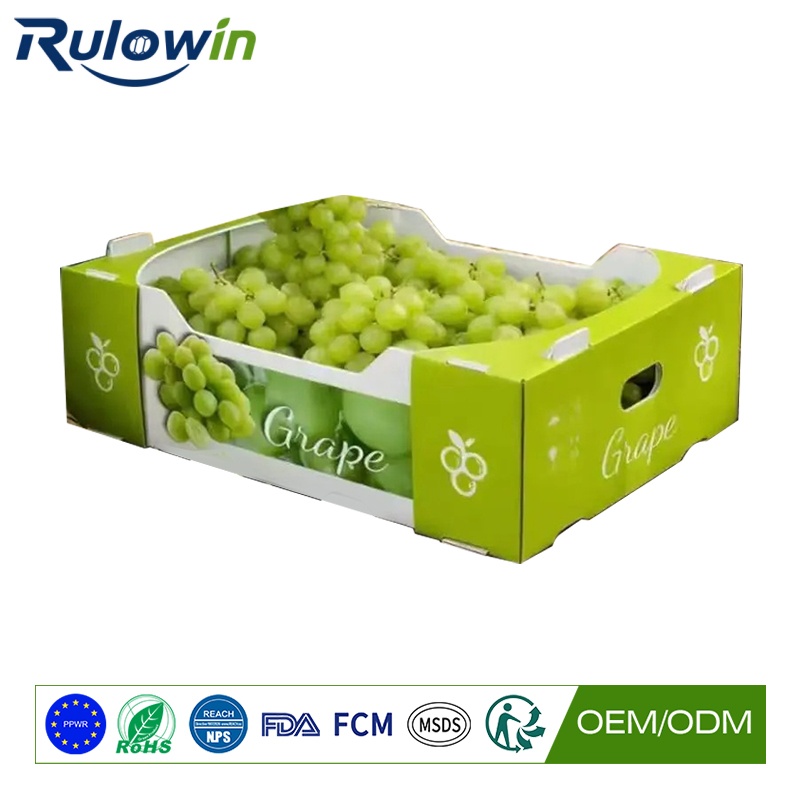
Vented crates exist to move air through the load, which is exactly what you want during pre-cooling and exactly what you do not want during storage. The two stages want opposite things, and most operations buy one crate for both.
Cooling: vented wins clearly
Air has to reach the produce. A vented crate with generous side and floor openings lets a forced-air system pull heat out quickly, and speed here determines shelf life downstream. For the cooling stage there is no argument – more open area is better.
We covered that in crates for pre-cooling straight after harvest.
Storage: the case reverses
In a cold store the product is already cold and the priority changes to holding it there without losing moisture. Air moving through a vented crate carries moisture off the produce, and weight loss is money. A solid-wall crate slows that down considerably.
Solid walls also stop the cold-store airflow from drying out the outer layer of produce unevenly – a common cause of a pallet where the outside of the load has degraded and the middle is fine.
Stacking behaviour differs too
A vented crate has less material in its walls, and vent openings are where walls flex. Under a tall stack, vented crates deflect more than solid ones. If your cold store stacks high – and cold stores usually do, because floor space is expensive – that matters.
Also: vented crates let debris through. Anything that spills or drips in a vented stack goes into the crate below. In a mixed store that is a cleanliness issue.
The practical resolution
Two fleets, if volume justifies it: vented for field and cooling, solid for storage. That is what a lot of larger operations do and it is the technically correct answer.
One fleet, if it does not: choose based on which stage is the bottleneck. If your cooling is slow and shelf life suffers, buy vented. If your product arrives in good condition and then loses weight in storage, buy solid.
A compromise that usually works
A crate with moderate venting and a solid lower section. The lower part holds moisture around the product and gives stacking strength; the upper part allows air movement. It is not optimal for either stage and it is adequate for both, which for most operations is the right answer.
Worth asking about specifically – it is a common option and it is rarely offered unprompted.
Condensation, which cuts the other way
There is an argument for venting in storage that is worth stating: a solid-wall crate in a cold store with a temperature cycle will hold condensation against the produce, and standing moisture promotes rot.
So the solid-wall advantage on moisture loss can become a disadvantage on free moisture. Which one you get depends on how stable your store temperature is. A stable store favours solid walls; one with wide swings favours some venting.
Worth looking at what actually happens in your store before choosing – the answer is not the same in every cold chain.
What we can do
We make PP crates for fruit and vegetables in vented, solid and mixed configurations. Tell us your cooling method and your storage stack height, and we will tell you which suits – including when two fleets are worth it and when they are not.