
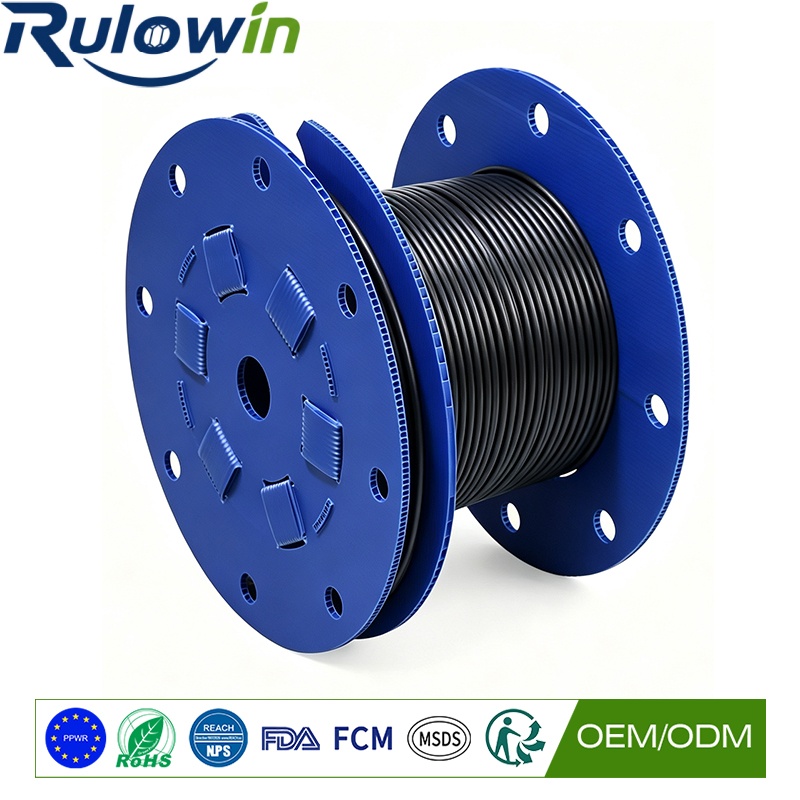
Pulling cable through duct is a specific and unforgiving operation: a long continuous payout under tension, often from a footway or a chamber, with limited space and no second chance if the cable kinks. The reel requirements are different from a short drop run.
Free-running, for a long time
A duct pull can run for an hour or more. Any inconsistency in the payout – a periodic tight spot, a wobble, a brake that grabs – shows up as tension variation, and tension variation is what risks exceeding the cable’s pull rating.
What that requires from the reel is a true-running bore and a balanced flange. Both are manufacturing qualities rather than design features, and both are worth asking about. We listed the questions in what to ask a cable reel supplier before ordering.
In-line payout
Cable should leave the reel in line with the direction of pull. In a footway setup that is rarely convenient, and the temptation is to pull at an angle – which walks the cable across the flange and into the gap between flange and hub, where it jams.
Either position the reel so the pull is in line, or use a roller guide to bring the cable off square. A guide costs very little and it removes the most common cause of a jammed pull.
Overrun control
When the pull stops, a light reel keeps spinning and pays out loose cable. On a duct pull the loose cable ends up on the footway, where it gets walked on and kinked. Either brake the reel lightly or have someone control it.
This is more important on a long pull than on a short one, because there is more cable out and more inertia in the reel.
Size, and the space constraint
A footway setup has limited space. A very large flange will not fit, and reels for duct work are usually chosen smaller than the length rating would suggest, with the difference made up by using more reels and jointing.
Worth planning: where the second reel goes when the first runs out, and how the join is managed. That is a site plan question rather than a reel question, and it is the part that catches crews out.
Two checks before starting
Hub-to-flange junction for hairline cracks, and bore for roundness. Both are described in why cable reel flanges crack near the hub. A reel with hairlines at the hub should not be pulled to full tension.
Weather, and the thing nobody plans for
A duct pull happens outdoors, and if it rains the cable gets wet going into the duct. Wet cable has higher friction and the pull tension rises, sometimes past the cable’s limit. Most aborted pulls on a wet day are this.
Keep reels covered between pulls and consider whether the job should stop in heavy rain. It is an unpopular decision and it is cheaper than a failed pull.
Cold matters too. A reel handled in winter is more brittle, and a plastic reel dropped on a frozen footway cracks where the same drop in summer does nothing. Worth knowing before the crew concludes the batch is faulty.
What we can do
We supply lightweight plastic reels for fiber drop cable with bore and balance held to tolerances suitable for long pulls. Tell us the cable, the pull length and the tension limit, and we will specify – including when a smaller reel plus a join is the better plan.